
When millions of soldiers returned home from World War II, Americans were focused on building families, homes and cities.
It was a time of prosperity and soaring optimism. Skyscrapers reached new heights in cities across the country. Freeways were constructed that stretched from New York City to San Francisco. New technology and an eager workforce made bigger and better infrastructure a reality.
Yet, the impacts of climate change – arguably the largest looming threat our species faces – was far from a topic of conversation.
“In the immediate postwar period, no one was thinking about this,” said Matthew Anderson, a professor of urban planning and development at Eastern Washington University. “No one was thinking about the heat. No one was thinking about climate change, and preparing for a future of changing weather and increasing extremes on both ends.”
Spokane was no exception.
Anderson said that period of growth was characterized by an overwhelming emphasis on the modernization of infrastructure to pave a path for the automobile. Planning and engineering for U.S. cities were completely geared toward making the movement of people, resources and commodities more efficient.
Today, many must have access to a vehicle in order to get around. The bus system is a worthy alternative, but it can’t compete with the convenience of a car, Anderson said.
“The footprint of land given over to automobile transportation is incredible, especially if we are building primarily surface area parking lots,” Anderson said. “Look at a map of most cities in the U.S. Spokane is particularly egregious.”
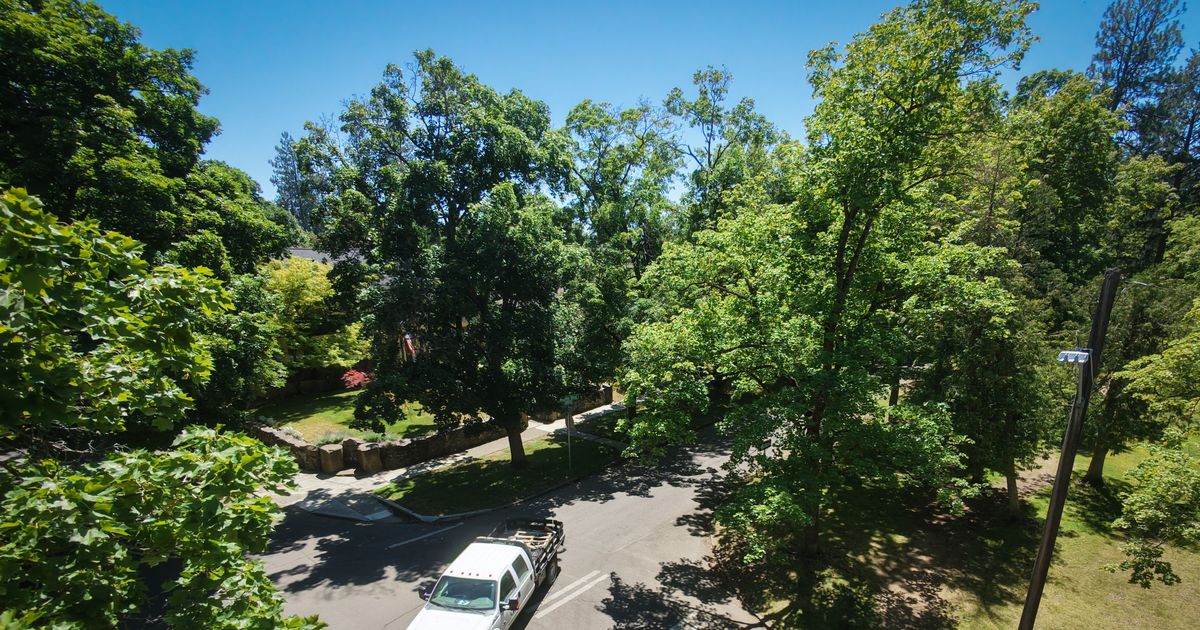
A “colossal amount” of space in Spokane is dominated by impervious surfaces. These impenetrable shells make it so that run-off water has nowhere to go but the nearest sewer opening. That water, which often picks up contaminants on its way to nearby drain grates, must eventually go through wastewater treatment plants. With heavy rainfall, sometimes grates are clogged, which can lead to flooding. Anderson proposes that a simple solution to the oversaturation of all these impervious surfaces is to plant more trees and establish soil plots to manage stormwater runoff. This solution is commonly known as low-impact development.
Not only does the concentration of concrete in Spokane take up lots of space and make wastewater treatment more difficult, it also traps heat.
An urban heat island is a phenomenon where metropolitan areas dense with concrete are warmer than surrounding areas with canopy cover and vegetation.
“When you’re developing higher-income neighborhoods, tree cover green spaces are a magnet for upper-income buyers,” Anderson said.
This means that during a heat wave, low-income individuals are often the most affected.
Waking up to a deadly heat wave
In June 2021, a lethal heat wave pushed temperatures to 109 degrees Fahrenheit in Spokane. The heat lingered for more than a week, and 19 people in Spokane County died. Another 300 visited hospitals with heat-related illnesses. The Climate Impacts Group out of the University of Washington called it the deadliest weather-related disaster in Washington state history. It took 126 lives across the Evergreen State between June 26 and July 2.
In response to that event and using a grant from the National Oceanic and Atmospheric Administration, Gonzaga’s Institute for Climate, Water and the Environment began tracking urban heat islands in Spokane.
Brian Henning, the director and founder of Gonzaga’s Institute for Climate, Water and the Environment, said while their work is centered on making sure homeless people have enough places to stay during extreme heat waves, it isn’t their only focus.
“Part of what we learned was that most of the people who died were housed,” Henning said. “They were more geographically distributed across the city and the county than might otherwise have been predicted. … The three hardest-hit (neighborhoods) were Hillyard, East Central and downtown, in terms of heat.”
People in apartments – especially upper-level residences – those with preexisting health conditions and the elderly were all common correlates among those who died. Because of neighborhood differences in tree cover, green spaces and dark surfaces, some parts of Spokane were as much as 13.9 degrees warmer than other parts of the city during the heat wave.
“Past a certain temperature, I think it’s around 95 degrees, a fan will actually increase your risk (of dying) rather than decrease it,” Henning said.
Henning said a fan is just pushing hot air around and causing liquids in the human body to evaporate faster than they normally would after a certain temperature. He compared it to being cooked in a convection oven.
And what’s really dangerous about an extreme heat event, like what was seen in 2021, isn’t so much that it’s hot during the day, but the fact that high temperatures remain sustained throughout the night.
“Two to three extreme heat events a year is typical for Spokane,” Henning said. “And by midcentury, the projection is that they could go up to 20 to 30 days a year in Spokane.”
Even with that predicted increase in extreme heat, Eastern Washington is expected to be a climate-resilient haven compared to the rest of the nation. Places like the Midwest and the East Coast are expected to be much worse off than folks living in the Pacific Northwest.
In the future, Henning believes people will become increasingly knowledgeable of a metric known as the wet-bulb temperature, which is the combination of heat and humidity. A study out of Pennsylvania State University reported that temperatures exceeding 87 degrees Fahrenheit at 100% humidity makes it so that the human body is no longer able to effectively cool itself. This can lead to heat stroke, fever and even death.
With places like Spokane and the Great Lakes area in Michigan becoming more hospitable than the vast portion of the rest of the nation, Henning expects to see an increase in migration.
His question for current residents is: Will Spokane become an impenetrable fortress or a welcoming sanctuary?
The next is whether the city of Spokane and its electric grid is prepared for extreme heat waves, smog-choked streets and other varying effects of climate change the community is bound to experience.
Grants gone
In 2024, Gonzaga University and the city of Spokane were awarded $19.9 million from the Environmental Protection Agency. A little less than half of that sum, according to Sarah Nuss, the director of emergency management for the city of Spokane, was meant to build up Spokane’s network of regional resilience hubs. In other words, it was supposed to provide funding for staffing, masks for wildfire smoke, bottled water, and more resources to the three community centers and five libraries that act as spaces of refuge during extreme weather events.
Henning said about $8 million was going to go to Spokane Neighborhood Action Partners to install new heat pump systems in 300 low-income families’ homes. Another $2.6 million was going to be dedicated toward a “regranting program” where community organizations were invited to “propose up to $400,000 projects for how they thought they could use the resources to improve Spokane’s resilience” in their own communities.
Money was all set to be awarded when the Trump administration rescinded the grant in May 2025. In total, the administration eliminated $2.8 billion in environmental justice grants throughout the nation.
“Just last month, a federal judge ruled that the termination of the grants were unlawful, but that no relief will be coming,” Henning said.
While U.S. District Judge Richard Gergel found it was illegal to terminate the grants, he refused to issue a permanent injunction to return the program. He said it was “impractical” that the Trump administration would rehire the employees overseeing the grant after they had just fired them.
“Similarly to the EPA grant, we received a federal grant for the tree equity program that at first was rescinded because of the word ‘equity’ by the Trump administration,” said Erin Hut, the spokeswoman for the city of Spokane. “And then it was put back in place, and so that’s about $6 million over five years.”
Through this program, the city plans to partner with the Lands Council to remove dead trees and plant new ones to build out Spokane’s tree canopy. The hope is that this will reduce the impact of urban heat islands and provide some respite for people living or working in those zones.
The city of Spokane also recently received some money from the Washington State Department of Commerce to help individual neighborhoods with decarbonization planning. This can manifest itself in numerous ways and includes, but is not limited to, innovative ideas like increasing green space, building better bike lanes, creating new clean energy sources or offering more community facilities.
The grant from the commerce department and the one from the EPA were both meant “to get the community involved and do a participatory budgeting process where the community would decide the projects,” Nuss said.
Taxing the system
Another issue that arose from the 2021 heat dome was the stress it put on portions of Avista’s electrical grid. So many people were using their air conditioners that occasional power outages occurred.
Jared Webley, the senior communications manager at Avista, said they have made significant investments to strengthen the system and address capacity since 2021. Higher-capacity equipment has been installed, and several substations have been upgraded “to provide greater operational capacity and switching flexibility.”
“This includes replacing aging equipment, expanding system capacity, improving monitoring and operational awareness, deploying advanced distribution technologies, and implementing new tools that help operators identify issues sooner and respond quickly,” Webley said, via email.
He said no utility company can guarantee there will be no power outages during extreme weather events, especially when temperatures remain around 109 degrees Fahrenheit for extended periods of time, but that they feel much better equipped than they were in 2021.
Simple solutions?
Todd Myers, the vice president for research at the Washington Policy Center, has worked in environmental policy for over two decades. He said one silly, but easy and effective, idea is to paint dark surfaces white to create an albedo effect , or that white surfaces reflect heat back into the atmosphere better than black surfaces.
He’s skeptical of doing things like putting gardens on rooftops because it’s an expensive practice and the weight can stress infrastructure.
“Hardening electricity equipment and that sort of thing probably makes more sense, in terms of saving lives, than planting gardens,” Myers said.
When it comes to reducing urban heat islands, he thinks a reasonable answer could be shifting toward building things with wood. A better alternative, since wood is a great fuel for fire, is a material called cross-laminated timber.
A study from 2019 in the journal Wood and Fiber Science found that a cross-laminated timber structure could withstand more than 90 minutes of burning before collapsing. A single-story wood-frame home collapsed after just 17 minutes.
These massive, pre-fabricated wood panels made by gluing lumber layers at alternating 90-degree angles are durable, able to store carbon and easy to install. Using more wood in building is a win-win, Myers argues, because it reduces emissions and provides the revenue necessary to thin out fire-prone forests.
“Those seem more mundane,” Myers said. “But a lot of times the mundane solutions are better than the fancy ones or cool-sounding ones.”
Planning for the future
On the other side of the state, Lara Whitely Binder, the climate preparedness manager for King County, said all of their infrastructure projects include preparation for future weather conditions.
“How do we more systematically change our capital planning processes to make sure that climate change is being accounted for in all kinds of projects?” Binder asked.
She said King County is far from the only jurisdiction to do so and that many others around the nation, but especially in Washington state, are taking similar steps. She used the Georgetown Wet Weather Treatment Station as an example. When the station was being designed, the planners incorporated 2 feet of sea level rise into their design. Through a partnership with the city of Seattle, the Ship Canal Water Quality project, which is a 2.7-mile-long storage tunnel made to reduce the amount of pollutants in stormwater runoff, was increased from 14 feet to 18 -foot-10 to account for heavier rainfall. This effectively doubled the storage capacity for stormwater runoff.
Even though Spokane is less than 300 miles from Seattle, the climate impacts on this side of the Cascades are drastically different. Wildfire smoke and heat are the main risks Spokane faces, Henning said.
Regardless, the need for infrastructure to account for a changing climate is important throughout the United States. The impacts of climate change are vast and multifaceted. Some places may see more rain than before, while others may see less. The importance of data gathering, like what Gonzaga’s Institute for Climate, Water and the Environment does for the city of Spokane, cannot be understated.
Moving into the future, important questions must be asked, such as what can cities do to improve infrastructure and help residents, as well as what can residents learn about their environment to better prepare themselves for what’s to come?
“We should invent technologies and design economies as not the ends of human existence, but as the means to having a flourishing, equitable society within flourishing ecosystems,” Henning said. “The great work of our age is to try and imagine and then realize what that looks like. How would we do that, so that we’re living in a symbiotic, mutually beneficial way as part of, not apart from.”
“But as humans, what does that look like? Right now, we pretend as though we’re separate from nature, and we’re experiencing the consequences of that illusion. There’s nothing else. There’s just the planet.”