
From railways to power plants, China has become the leading force in overseas infrastructure development. These investments have accelerated demand for carbon-intensive materials such as steel and cement across the Global South, while scrutiny has grown over their environmental impacts.
However, China has a lever to green its overseas infrastructure: using procurement rules to incentivise the use of lower-carbon steel and cement. As China launches its 15th Five Year Plan, for 2026-30, which includes a call for “new avenues for cooperation on green development” through the Belt and Road Initiative (BRI), green procurement can answer that call by cutting emissions before a project breaks ground.
Much of the “green BRI” debate has focused on power generation – fewer coal plants, more renewables. But one major opportunity for China’s overseas green development remains overlooked. That is the “embodied carbon” embedded in construction materials themselves, in the CO2 created during their production.
In a recent report by the Boston University Global Development Policy Center, we examined the steel and cement use in global energy and transport infrastructure projects that received finance in 2008-2024 from China’s two major development finance institutions (DFIs), the China Development Bank and its Export-Import Bank. Steel and cement, the world’s two most emissions-intensive industrial sectors, make up nearly 20% of global CO2 emissions, making them major drivers of infrastructure’s carbon footprint.
To quantify these emissions, we identified power generation and transport (road and railway) projects that received Chinese development finance. We then estimated the carbon footprint of these materials via data on project size and literature-based material and emissions-intensity factors.
Chinese development-financed infrastructure projects typically source cement domestically within the host country, largely because cement is heavy and expensive to transport internationally, and because many countries have sufficient local production capacity. Case studies from Pakistan, Cambodia and Nigeria suggest that even in Chinese-financed projects, cement is generally procured from local suppliers, often also reflecting local content requirements.
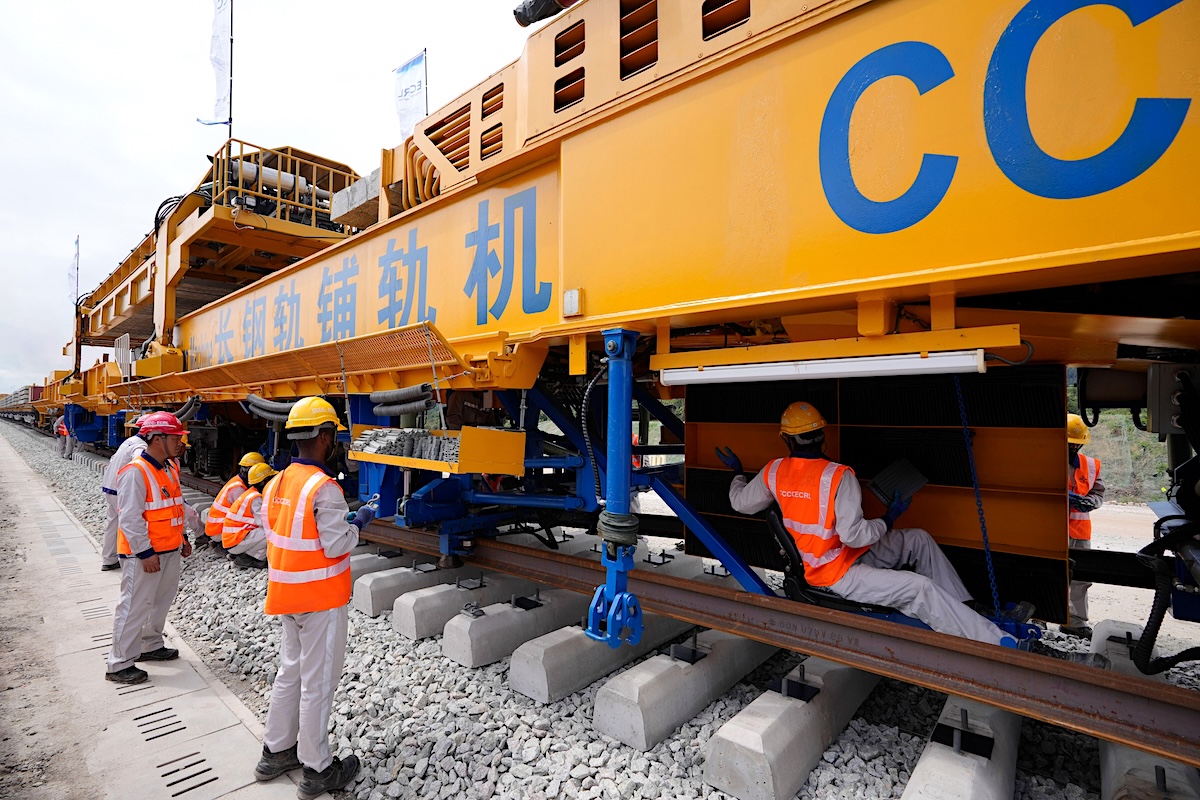
In contrast, we found case study evidence that steel may be more frequently imported from China, especially for technically demanding infrastructure such as railways, where Chinese standards, specifications and supply chains play a larger role.

A worker examines stacks of steel bars to be shipped abroad at a plant in Dalian, China. Compared to concrete, steel may be more frequently imported from China for its overseas development-financed infrastructure projects, especially for technically demanding infrastructure such as railways (Image: Imaginechina / Alamy)
This sourcing choice matters for emissions. The carbon intensity of steel production varies significantly depending on whether steel is produced domestically or imported from China, whereas cement production emissions are relatively similar across countries due to standardised clinker-based production processes. Chinese-supplied steel can carry up to 37% more embodied carbon than steel produced in or near most of the Global South countries hosting Chinese-backed projects. This is due to the carbon-intensive steelmaking technologies in play in China, namely coal-based blast furnaces.
Steel used in the projects financed between 2008-2024 that we analysed could represent up to 3.5 to 4.8 million tonnes of CO2 emissions, depending on where the steel is sourced. (Because project-level procurement records are not consistently public, our calculations use different sourcing scenarios for steel rather than confirmed records of where it was purchased.)
Meanwhile, cement use in the projects analysed from the same period is estimated to have generated 2.5 million tonnes of CO2 emissions.
The new study finds that ambitious green procurement standards set by Chinese DFIs or their regulators could have cut up to 3.6 million tonnes of steel emissions, and up to 1.8 million tonnes of cement emissions. With some Chinese development-financed projects still under construction or in planning, and for future projects, that window for change is still open and the opportunity is immediate.
In addition, as these numbers only focus on certain energy and transport projects receiving Chinese development finance, they capture only a subset of China’s overseas infrastructure engagement, which goes beyond development finance to investment, other forms of lending, construction arrangements and more.
The total transformational potential of green procurement in China’s overseas infrastructure projects could lead to emissions reductions orders of magnitude higher than our initial numbers.
Transformative potential
While low-carbon procurement has long been treated as a technical footnote, it is in fact a frontline climate policy tool. Decisions on carbon content from Chinese DFIs, state-owned enterprises and project developers can transform the emissions footprint of overseas infrastructure, including decisions on what carbon data must be disclosed, and which materials qualify in tenders.
This is critical now more than ever in today’s global context. Heavy industry is now central to climate policy. Some governments, such as the European Union, Canada, and US states like California, are already using green procurement to build markets for lower-emissions steel, cement and concrete. Meanwhile, some DFIs, such as the World Bank, Inter-American Development Bank, African Development Bank and Asian Development Bank have developed broader sustainable procurement standards. The carbon intensity of construction materials is quickly becoming an issue of competition under policies like the European Union’s Carbon Border Adjustment Mechanism (CBAM), which will tax high-carbon imports to the bloc.
Green procurement is not only a practical way forward but provides an opportunity for host countries. Chinese-designed frameworks that reward lower-carbon production could help local firms upgrade, reduce air pollution, build technical capacity, and stay competitive in markets where low-carbon standards are becoming more important globally.
China’s DFIs and state-owned enterprises do not need to wait for a perfect market in near-zero steel and cement. There are concrete steps they, and China’s government ministries, can take now:
● Improving carbon transparency by requiring steel and cement producers involved in Chinese-financed overseas projects to disclose verified, product-level carbon emissions, creating a consistent baseline for comparing materials and tracking impact.
● Establishing clear, tiered carbon-intensity benchmarks for steel and cement, aligned with global standards.
● Pairing standards with financial incentives for developers to make greener purchases, procurement performance metrics, and internal scoring systems, while investing in technical capacity to ensure implementation and improvement.
However, there are real barriers to achieving this. Low-carbon materials can cost more. Emissions data is often poor or missing. Some host countries lack certification systems, monitoring capacity, or domestic supplies of cleaner steel and cement. Chinese institutions themselves, meanwhile, have yet to develop a mature overseas framework for this kind of procurement.
But these policies could be phased in across China’s overseas infrastructure engagement, starting with transparency and data. Then, basic standards that tighten over time could be set, while offering technical assistance and support to suppliers that can meet them.
Green procurement can reduce the carbon footprint of projects long before the operations begin, and shape emissions for decades to come. Such purchasing can be a “new avenue” in green overseas engagement that the 15th Five Year Plan calls for – cutting embodied emissions and potentially supporting the industrial capacity of partner countries at the same time.