
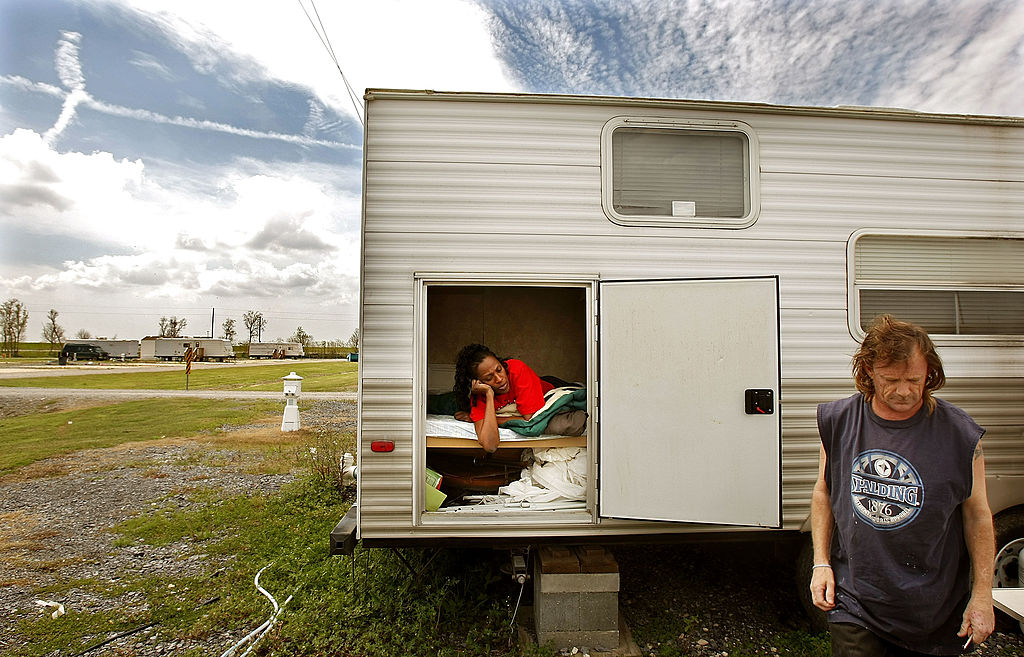
I’ve never been called “trailer trash”, but I did live in a trailer in Northeast Georgia in my early teens. Trailers don’t have the best reputation, but I liked it better than the home I grew up in. It was well-insulated, with a shotgun floorplan, so my room was far from my mother’s and her boyfriend’s, giving me more privacy than when we’d shared a wall (Iggy Pop, who lived with his parents in a trailer in Ypsilanti, Michigan, felt differently, and tells how he used to draw pictures of fantastical, u-shaped trailers where a boy would have space to hide). There was a hill I could skate down, woods to walk through, and because we were parked over gravel rather than dirt, we didn’t have as many problems with bugs. I had lived in a typical postwar suburb where neighbours were suspicious of each other and maintained a degree of distance. The trailer park, by contrast, was cosy; people knew each other and waved hello. I remember having long talks with a man there who owned four beautifully restored Ford Mustangs from the Sixties.
And yet, in America, the widespread prejudices against those who live in trailers, as well as the downsides of owning and renting them, have long kept them attainable for the rural and suburban poor. Mobile homes are uniquely prone to bad weather — hence the slang term “tornado bait” — and if they catch fire, they can burn to the ground in just 10 minutes. You can’t park a trailer in most neighbourhoods, so living in one often means longer commutes to work and a dependency on driving in every aspect of daily life. Trailers are considered personal property, not real estate, and, like other personal property, they depreciate quickly: 10-20% in the first year and 3-5% each year after, though this depends on location and upkeep. It’s an ugly affirmation, but a true one: in a market economy, the best way to keep housing affordable is to make it undesirable.
As home prices and apartment rents climbed precipitously in the 2010s, the trailer park remained a refuge for the poor (I would like to go back to “poor” rather than the anodyne “underprivileged”, because it ought not be a privilege to have food and a place to eat). But after three rounds of quantitative easing (one to save the global banking system, and two more because speculators really liked the first one), all the obvious investments were taken. When QE4 came during the pandemic, pumping an unprecedented $4 trillion into the financial system at a time when interest rates were near zero, those of us who didn’t have money were perplexed to hear of investors paying tens of million dollars for NFTs or properties in Mark Zuckerberg’s now all-but-defunct Metaverse, not to mention crypto billionaire Justin Sun’s purchase of Maurizio Cattelan’s “artwork” Comedian — a banana taped to the wall that Sun subsequently ate onstage. Never has the argument that the rich must be allowed to operate untaxed and unregulated looked stupider; but amid this idiocy, a more insidious form of extractive rent-seeking was also at work. Institutional investors were dumping mountains of loose cash into the goods and services people’s lives depend on: healthcare, nursing homes, rehab facilities, and housing. “Alternative real estate” was a big part of that, including co-working spaces, student housing, data centres — and trailer parks.
The trailer park has proven particularly enticing to private-equity investors for a number of reasons. It is largely recession-proof, because for many, it is the last stop before homelessness, and people will do anything they can to avoid eviction. And zoning laws prevent the opening of new trailer parks in many municipalities, so landlords enjoy the advantages of cartel pricing in a nominal free market. It is, incidentally, worth noting that around two-thirds of manufactured home residents own their homes, but most rent the lots where they sit, while the other third rent home and lot together.
Though, in theory, manufactured homes can be moved, doing so is expensive: around $3,000 for a short move, and up to $20,000 for a long one. Given that the median income for trailer owners is $38,087, and for renters it’s $28,280, park residents are essentially stuck. With modest initial investments — the cost of land or $50,000 for a new single-wide trailer vs. hundreds of thousands of dollars per newly built apartment or home — developers get a significantly higher return on investment than with traditional properties, making it clear why, during the pandemic surge, nearly a quarter of manufactured housing transactions involved institutional investors.
“The trailer park has proven particularly enticing to private equity investors”
Since 2022, with the spike in interest rates, enthusiasm for investing in trailer parks has waned somewhat — though a friend who owns parks in Virginia tells me not a week passes in which he doesn’t get calls from potential buyers. If the pandemic marked the accumulation phase for large landlords, the years since have brought the squeeze. Talk to anyone whose park has been purchased by a private equity firm — there are now 1,900, accounting for more than 400,000 lots, according to the Private Equity Manufactured Housing Tracker — and you’ll hear the same story: rents go up, services decline. Often this is a prelude to a sale: by immiserating tenants, landlords add value to their assets, which they can then unload for a premium. An irony is that almost half of trailer park purchases were aided by government-sponsored lenders Fannie Mae (the Federal National Mortgage Association) and Freddie Mac (the Federal Home Loan Mortgage Corporation), yet most individual mobile home purchases are ineligible for this financing.
There was a time when firms would claim that rent increases were justified by capital improvements. Now the gloves are off; owners wave their hands at “the market” and jack rents up to the maximum tenants can bear. At Smoky Palms North in Clinton, Tennessee — an extremely landlord-friendly state where 35% of households are considered at risk of eviction — a new owner, Volunteer Runway Communities, recently raised rents for some tenants more than 100% overnight.
Not content with extortionate rates, many such companies also fleece their residents on fees. Nowadays, “convenience fees” and processing fees for paying your rent are increasingly common. Submetering companies — third-party services that bill residents for public utilities — often charge exorbitant costs as well. Several have been found to be giving kickbacks to landlords with the blessing of the free market — free for the rich but often a prison for the poor — as long as they’re called “incentives”, “revenue sharing”, or a “door fee”.
Then there’s the “self-help eviction” strategies such as removing a tenant’s windows and doors. These are illegal almost everywhere, but nonetheless common, and there is little a resident can do about them. Business Insider found that though most states have penalties for illegal evictions, police rarely investigate tenants’ complaints. Even more powerless are the many undocumented workers who live in trailer parks — or even legal residents who might look or sound foreign, since racial profiling is now a matter of “common sense” according to Supreme Court justice Brett Kavanaugh. Many are rightly afraid of collusion between state and local police and ICE.
In January, Donald Trump signed an executive order, “Stopping Wall Street From Competing With Main Street Homebuyers”, that targets institutional investors. A good thing, as far as it goes, but its effects will be modest to say the least. It applies only to existing homes, and so won’t touch the large, publicly traded firms like D.R. Horton, which is now responsible for around half of new construction in America. It does nothing about bulk sales, which bypass individual buyers in favour of investment companies that purchase blocks of dozens or hundreds of homes at a time; and it makes no provision for trailer parks at all.
For many of us, homeownership means security: having a piece of the world no one can take away. But a recent article by Rebecca Egan McCarthy shows how different the situation is for trailer owners on rented land. She visits a park in Archbald, Pennsylvania, whose residents are being evicted to make way for a data centre; the same thing is happening to another one in Mason County, Kentucky. There, the unnamed company has offered owners compensation to move their homes, but there aren’t enough nearby parks to absorb them. This kind of thing must occur, according to our current crop of hype-vending luminaries, to reach Artificial General Intelligence, about which a plurality of Americans holds a negative view. AGI will allegedly eliminate a large proportion of our jobs, though not, presumably, the jobs of the job destroyers, who are important, because they are also job creators, per an ever-staler Republican dogma. Or maybe the myth of the mogul as job creator is dead now: maybe pure exploitation is no longer gauche, and crushing the weakest and least fortunate is winning, to use Trump’s favourite word.
But if you think otherwise, the combined work of resident activists, nonprofits, and politicians in Maine — where mobile homes make up 8% of housing stock — shows a path forward. Private-equity investors purchasing manufactured homes there must now contribute to a preservation fund for mobile homes and manufactured housing, and there are tax breaks for landlords who sell to homeowner’s cooperatives as opposed to private equity buyers. Park residents have a right of first refusal — if they band together and can match an investor’s offer, owners are legally obliged to sell to them. Troy Jackson, a candidate in Maine’s gubernatorial race, recently declared in an ad: “We must clamp down on greedy private equity landlords”. This strong rhetoric is right for the moment. If we’re stuck with populism, as seems to be the case, then one that targets billion-dollar companies picking at the bones of the most defenceless is preferable to the de facto royalism to which the American Right has capitulated.