
Stablecoins entered 2026 with a familiar reputation. They were the crypto market’s cash layer, useful for moving between exchanges, parking capital during volatility, and settling trades without touching the traditional banking system. By September, that description feels increasingly incomplete. Banks are piloting their own stablecoins. Payment companies are putting them directly in consumer accounts. Asset managers are integrating them into institutional infrastructure. Governments are writing rules intended to let them operate at much greater scale.
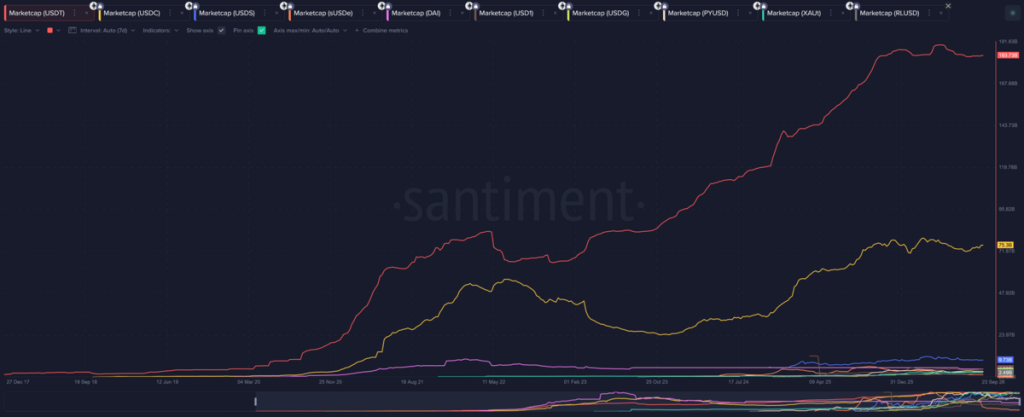
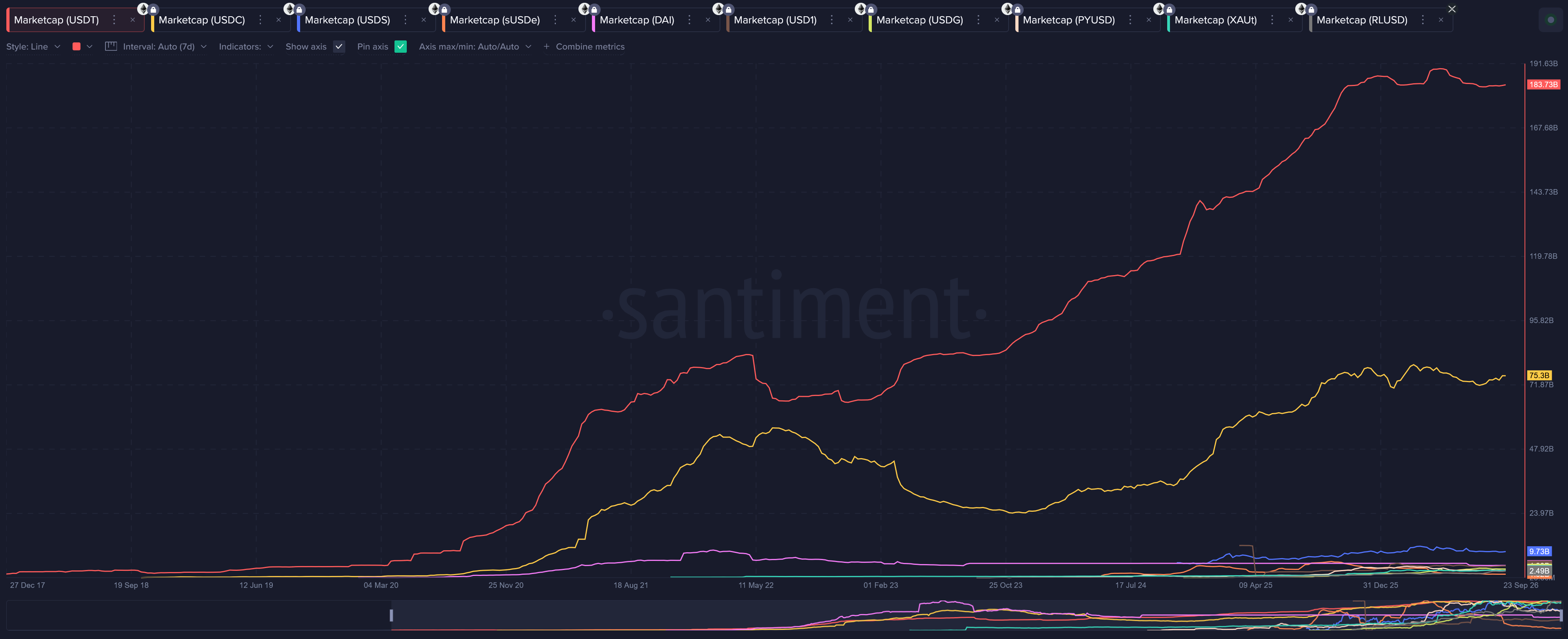
The market is still extremely concentrated. As of late September, USDT sits near $184 billion and USDC near $75 billion, while the next-largest names are measured in single-digit billions. But competition underneath those two giants is much more interesting than it was a year ago. USDS, USDe, USD1, USDG, PYUSD and RLUSD are no longer obscure experiments. Several have crossed into multi-billion-dollar circulation, and some are finding distribution channels that USDT and USDC did not have during their own early years.
Image 1 puts that scale difference into perspective. When every asset shares the same axis, USDT and USDC tower over everything else. It is a reminder that a $2 billion or $4 billion stablecoin can be growing very quickly while still appearing almost flat beside Tether.
The second market-cap view tells a different story because each asset can be examined on its own scale (see below). That makes the late-summer movement much easier to see. USDC strengthened toward $75 billion, while USD1 moved toward $4.4 billion and RLUSD toward $2.4 billion. CoinGecko data confirms USDC above $75 billion by late September, USD1 around $4.4 billion, and RLUSD near $2.4 billion.
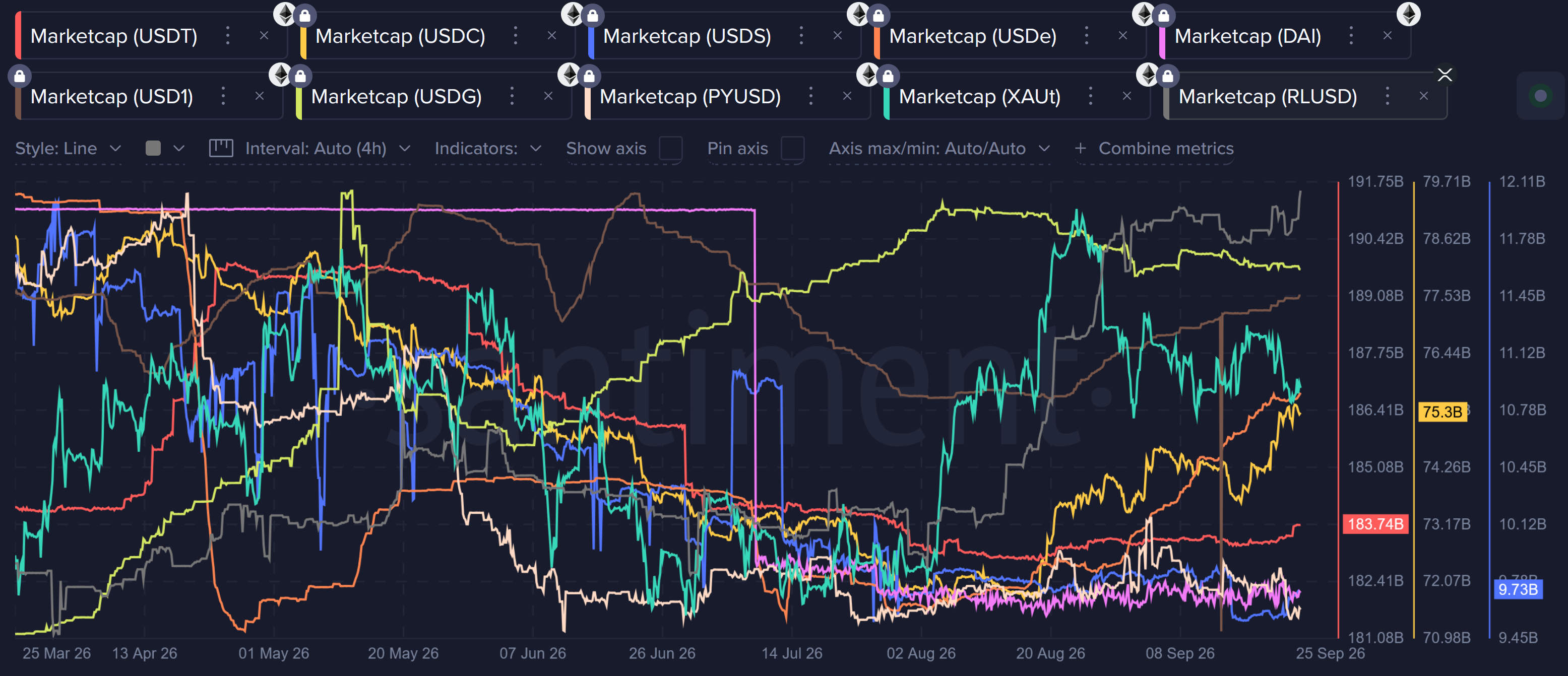
Those three deserve particular attention. They represent three very different distribution strategies. USDC increasingly looks like the institutional generalist. USD1 has built substantial exchange liquidity and is moving toward a more formally regulated operating structure. RLUSD is leveraging Ripple’s existing banking and payments relationships to expand geographically. Their growth does not mean USDT’s dominance is disappearing, but it does suggest that the stablecoin market is becoming less dependent on one path to adoption.
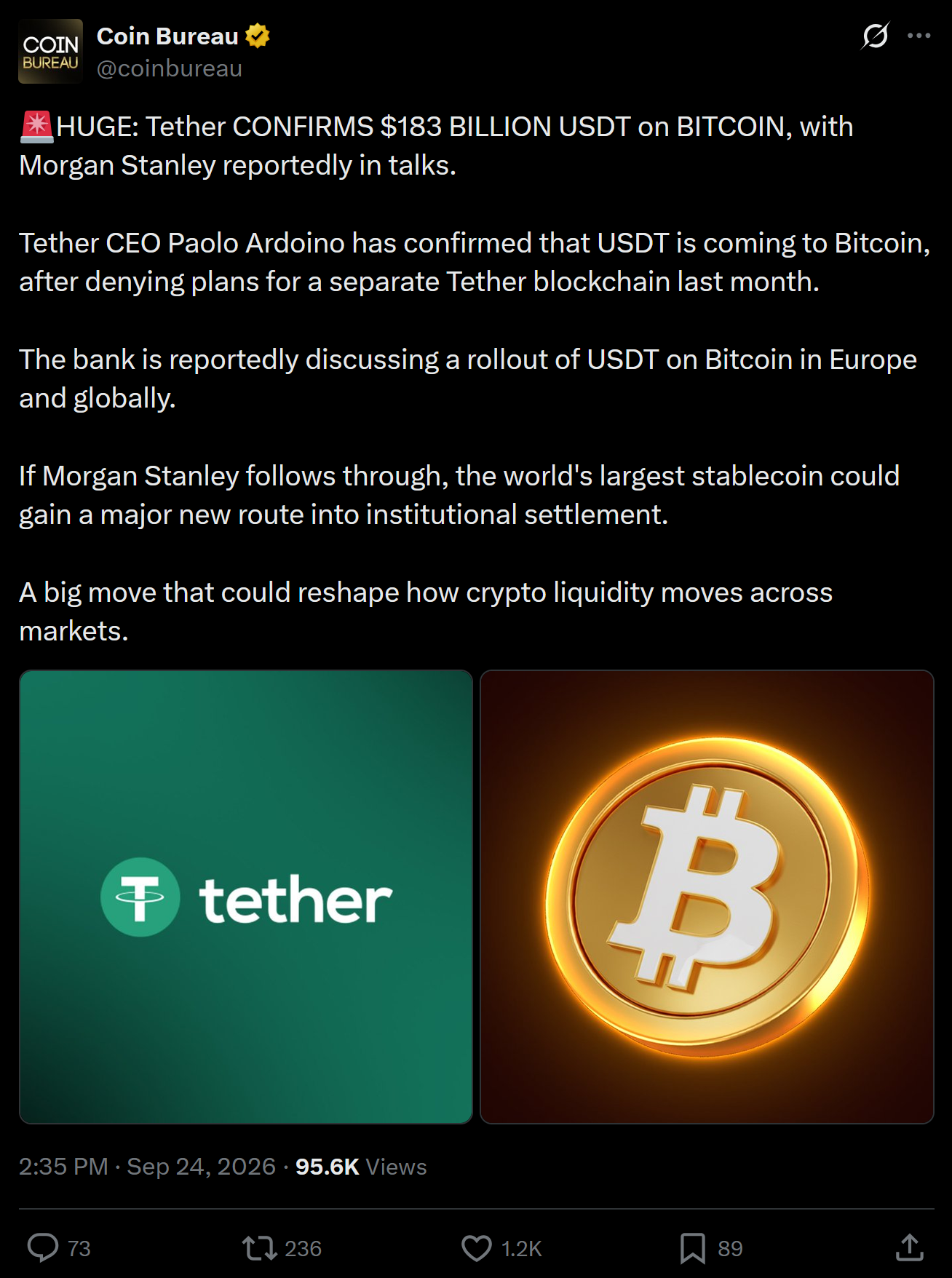
- USDT, $183.7B: Tether remains in a category of its own by circulation and trading liquidity. One important 2026 credibility milestone was the completion of a full KPMG audit of Tether International’s 2025 financial statements, while Tether has also pushed farther into institutional credit through a $400 million jointly sponsored private-credit fund with Fasanara. The Bitcoin story also deserves a clarification. Tether announced plans to issue USDT through RGB, a Bitcoin-based protocol, but the roughly $183 billion figure represents USDT’s total market capitalization, not $183 billion of USDT already sitting on Bitcoin. The expansion is still meaningful because it adds another potential settlement rail to an asset already used globally.
- USDC, $75.3B: Circle reported $73.3 billion of USDC in circulation at the end of Q2, up 19% year over year, while quarterly onchain transaction volume jumped 151% to $14.8 trillion. September brought another substantial institutional signal when Binance invested $100 million in Circle and signed a new five-year agreement focused on increasing USDC access and usage globally. USDC is arguably showing one of the clearest combinations of supply growth and infrastructure growth. Circle also launched the Arc mainnet in September with more than 100 institutional and ecosystem builders, giving USDC another native environment built specifically around financial applications.
- USDS, $9.7B: Sky’s USDS has quietly become the largest challenger below the USDT-USDC duopoly. Sky says USDS supply grew 74% during 2025, and by 2026 it had become the third-largest stablecoin, backed by overcollateralized protocol assets and connected to Sky’s savings and lending infrastructure. Its advantage is different from a conventional reserve-backed token. USDS is deeply embedded in DeFi capital allocation, while the related sUSDS product provides access to the Sky Savings Rate. Cross-chain integrations have continued in 2026, including expanded USDS connectivity and liquidity infrastructure on Avalanche.
- USDe, $4.9B: Ethena’s USDe occupies another category entirely. It is a synthetic dollar rather than a conventional cash-and-Treasury-backed stablecoin, so its risk model should not be treated as identical to USDT or USDC. Institutional integration nevertheless accelerated sharply in 2026. USDe gained support within BlackRock’s Aladdin ecosystem, while Ethena expanded relationships with Coinbase, Janus Henderson and institutional lending counterparties. June governance reporting put USDe supply around $4.46 billion while noting that its backing ratio remained above 101%.
- DAI, $4.6B: DAI remains one of crypto’s most established decentralized stablecoins, but its 2026 story is increasingly about coexistence with its successor, USDS. Users can upgrade DAI into USDS, while Sky’s newer products, incentives and capital allocation architecture are centered increasingly around USDS. That helps explain why DAI can remain enormous without displaying the growth trajectory of USDS. Its continued $4.5 billion-plus circulation reflects entrenched integrations and liquidity, while the ecosystem’s newer growth engine has moved elsewhere.
- USD1, $4.4B: USD1 has become one of the fastest-growing newer entrants and has also developed unusually high trading turnover for its size. In August, its issuer received conditional preliminary approval from the OCC for a national trust bank charter, a step that would place issuance and custody activities under federal supervision if all conditions are met. Its market cap continued rising through September, reaching roughly $4.4 billion by September 24. The important test from here is whether that liquidity becomes durable payments, treasury and institutional usage rather than remaining heavily trading-driven.
- USDG, $3.3B: Paxos-issued Global Dollar has grown through a network strategy rather than trying to build distribution alone. Global Dollar Network reported more than 150 partners and over $3 billion of USDG circulation by July, while integrations during 2026 included Aave, Robinhood Chain, Mantle, payments providers and several institutional platforms. USDG also has a regulatory-first pitch. It is issued under Singapore supervision, maintains segregated reserves and publishes monthly reserve reports and attestations. That combination of partner economics, exchange distribution and formal reserve oversight has helped it emerge much faster than many previous stablecoin launches.
- PYUSD, $2.7B: PayPal possesses something nearly every crypto-native stablecoin issuer would like to have: an enormous existing payments network. In March, PayPal expanded PYUSD access across 70 markets, putting the token directly in front of millions of consumers and merchants rather than relying solely on crypto exchanges. By August, U.S. merchants could automatically settle part of their PayPal balances into PYUSD and receive a 4% reward. That makes PYUSD less of a token looking for distribution and more of a stablecoin being inserted into an already-established payments product.
- XAUt, $2.7B: Tether Gold is the outlier in this ranking because it is not a dollar stablecoin at all. It represents physical gold, making it better described as a tokenized stable-value commodity, but its size now places it alongside some of the largest dollar-pegged alternatives. Tether expanded its institutional positioning in 2026 when XAUt received recognition as an accepted spot commodity in Abu Dhabi Global Market and subsequently received Shariah-compliance certification. Those developments potentially increase its appeal to institutions and investors looking for blockchain-based gold exposure rather than digital dollars.
- RLUSD, $2.4B: Ripple USD has become one of the most striking newcomers. Its June launch in Japan followed regulatory approval there and made RLUSD available through SBI VC Trade to both retail and institutional users. By late September its market capitalization was around $2.4 billion, giving Ripple a substantial stablecoin footprint in less time than many incumbents needed to reach comparable scale. Image 9 captures the Japan expansion, which is particularly important because Ripple is using existing financial-services relationships rather than relying only on crypto-native distribution.
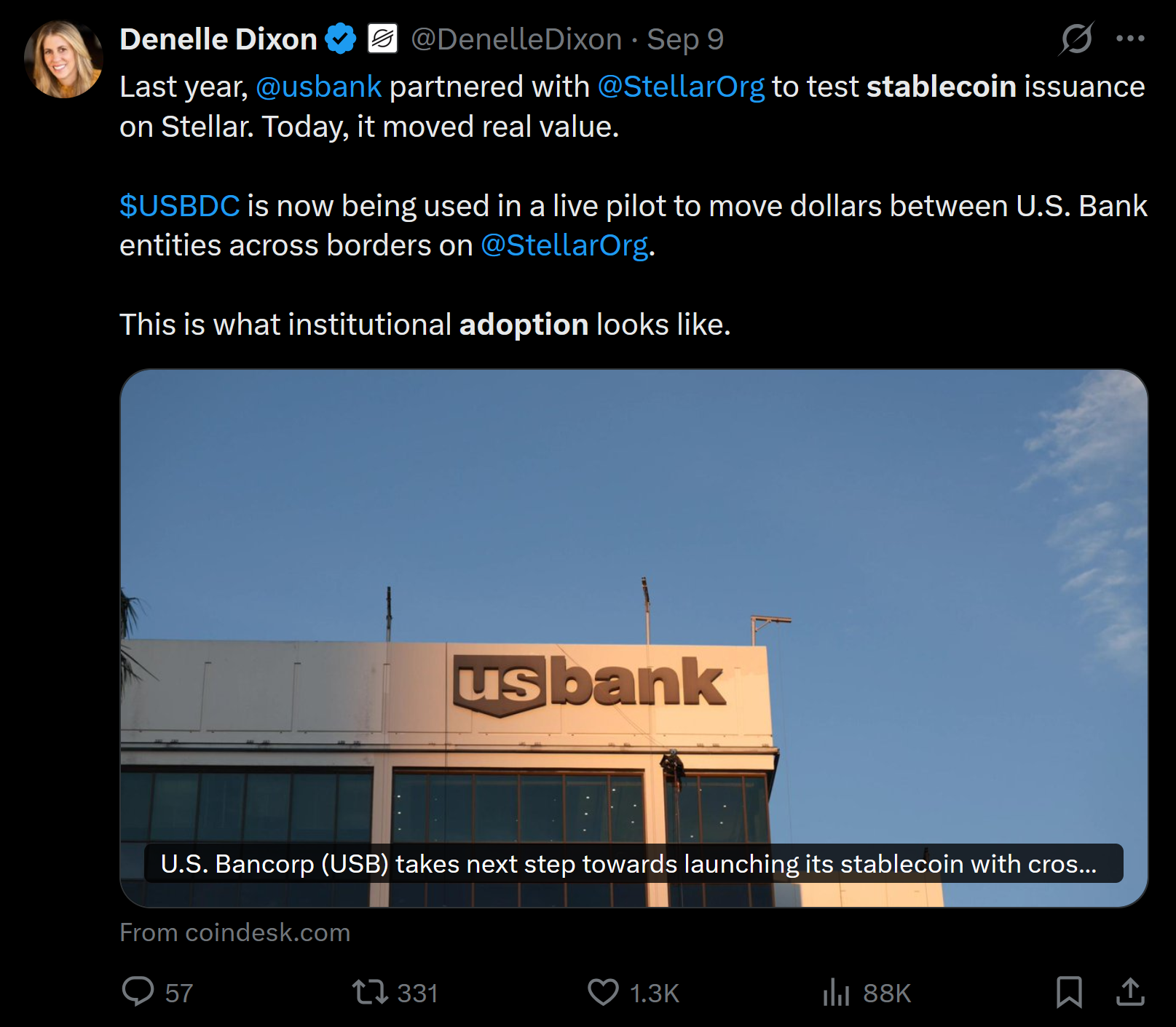
Perhaps the biggest shift in 2026 is that stablecoin adoption increasingly involves institutions moving actual value rather than publishing proofs of concept. U.S. Bank completed a live cross-border pilot using its proprietary USBDC on Stellar between entities in North America and Europe. The project integrated blockchain settlement with the bank’s existing finance, compliance, risk and operations systems, while testing minting, redemption, freezing and clawback functionality.
The story is not that U.S. Bank suddenly became a crypto company. It is that a major commercial bank found a public blockchain useful enough to test as part of its own money-movement infrastructure. That distinction is important. Institutional adoption does not necessarily look like a bank buying tokens. It can look like a bank using tokenized dollars because they settle faster.
The IMF has also documented the movement of regulated institutions onto permissionless networks. Its 2026 tokenization work specifically notes Société Générale’s CoinVertible euro stablecoin operating across Ethereum, Solana, Stellar and the XRP Ledger, alongside other examples of financial institutions experimenting with public blockchain infrastructure.
The more precise takeaway is not that the IMF is endorsing XRP or XLM as investments. It is that major institutions are increasingly willing to consider public blockchain rails for issuance and settlement. That is a very different institutional environment from the one stablecoins faced only a few years ago.

The policy environment has also changed. The U.S. GENIUS Act established a federal framework for payment stablecoins in 2025, including reserve requirements and restrictions on issuers directly paying yield merely for holding a payment stablecoin. The unresolved question of third-party rewards later became one of the major disputes around wider crypto market-structure negotiations.
There is a common crypto-industry interpretation after the wider CLARITY legislation stalled: stablecoin adoption does not necessarily stop with Congress. That is an opinion rather than a certainty, but 2026 provides evidence for the underlying idea. Circle, Tether, U.S. Bank, PayPal, Ripple and Paxos have all continued expanding stablecoin infrastructure while the wider market-structure debate remained unsettled.
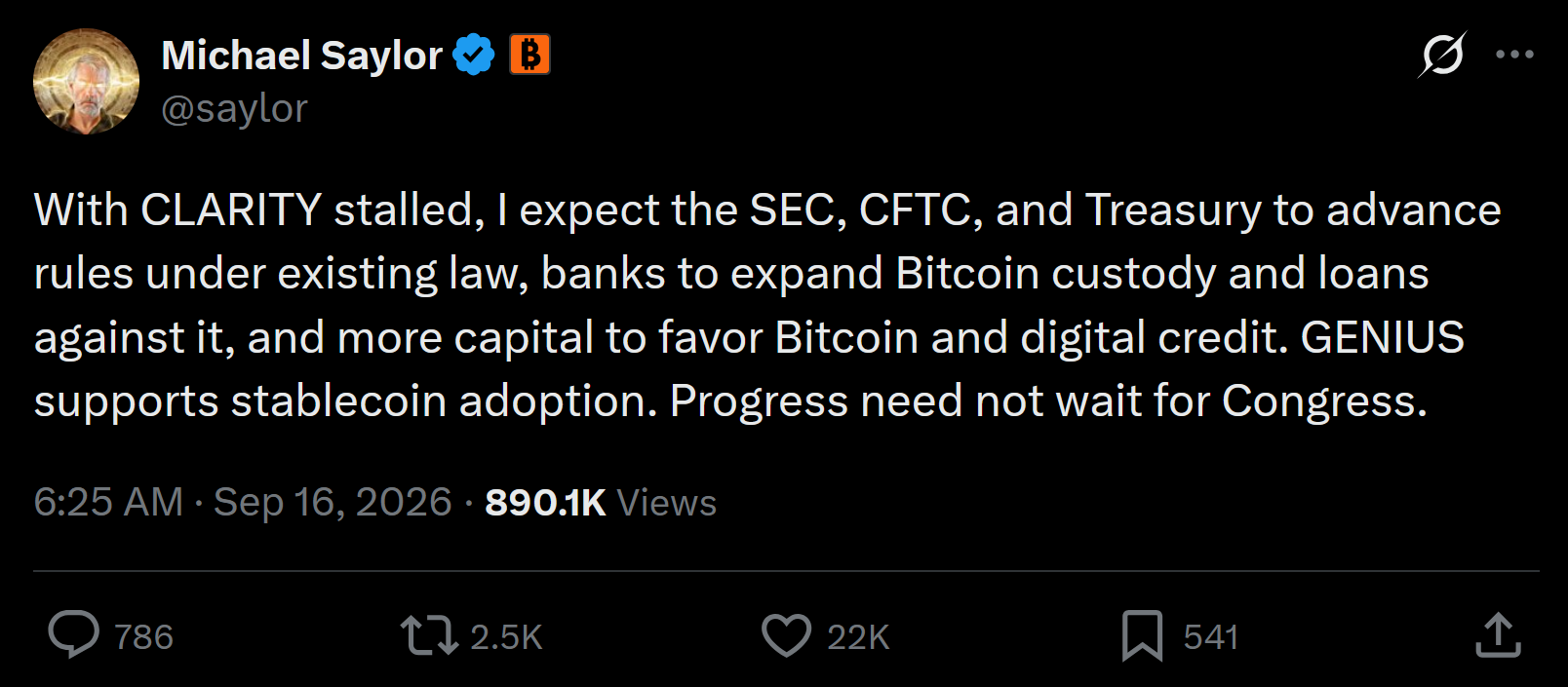
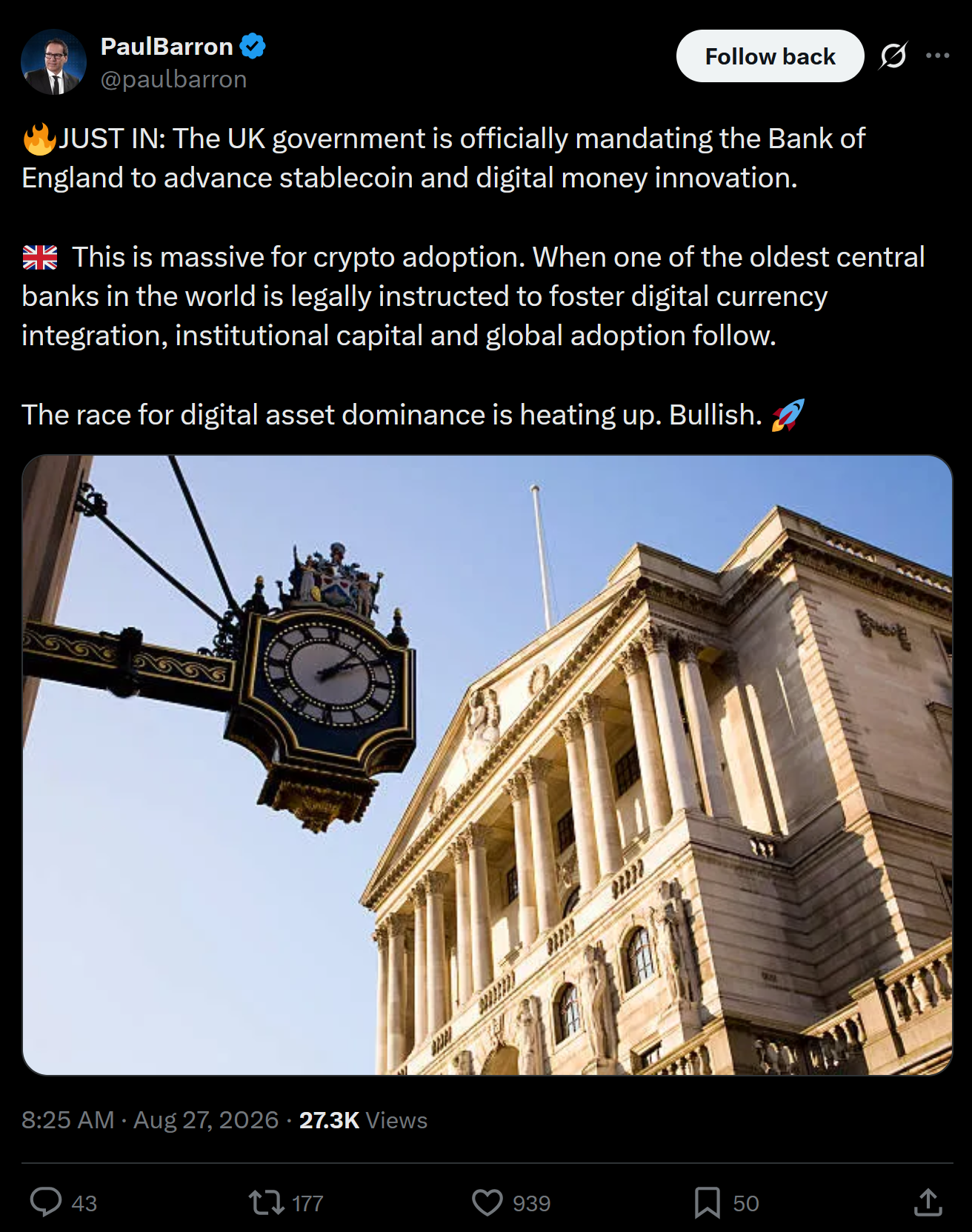
The United Kingdom is moving in a similar direction from a regulatory standpoint. The Bank of England published draft rules for systemic stablecoins in June, and the government announced in August that it intends to give the Bank a secondary objective supporting innovation in payment systems and emerging digital money, while keeping financial stability as its primary objective.
There has been less of sudden embrace of crypto, and more emphasis on regulatory normalization instead. Stablecoins are increasingly being discussed in the same policy conversation as payment networks, bank deposits and market infrastructure. The debate has moved from whether stablecoins should exist to how they should function safely at scale.
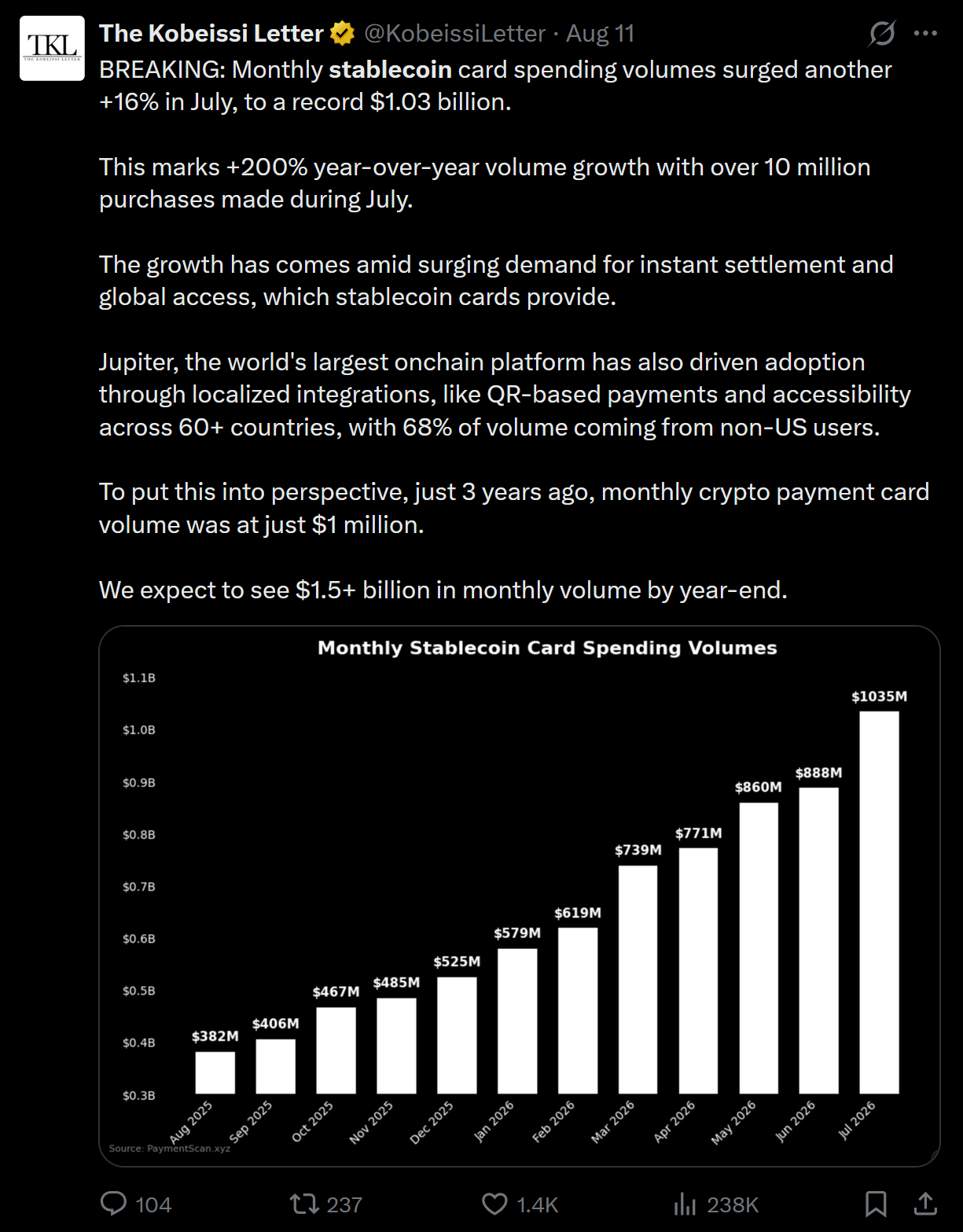
Institutional announcements are important, but stablecoins ultimately need users. One of 2026’s most revealing statistics came from payment cards. Stablecoin-funded card purchases reached roughly $1.03 billion in July, up 16% from June and almost 200% from a year earlier, with more than 10 million purchases recorded during the month.
A stablecoin used as trading collateral can generate enormous blockchain volume without ever entering the real economy. A stablecoin being spent for groceries, subscriptions, travel or merchant payments represents a different form of adoption. Reuters reported that stablecoin card spending could reach $50 billion annually by 2028 if current adoption trends continue, with particularly strong usage emerging in Latin America and Africa.
This is where 2026 feels different. Stablecoins are simultaneously becoming exchange liquidity, bank settlement assets, merchant balances, cross-border payment tools, tokenized savings products and settlement rails for other tokenized assets. Those use cases reinforce one another. More regulated issuance makes institutions more comfortable. More institutions create integrations. More integrations give consumers and businesses places to actually use the tokens.
And the competitive advantage is increasingly distribution, not simply the ability to create a token that holds $1. USDC has Circle and major exchange relationships. PYUSD has PayPal. RLUSD has Ripple’s financial-services network. USDG has a partner consortium. USDS and USDe have DeFi ecosystems. That gives newer stablecoins much stronger launchpads than the first generation had.
Stablecoin conversations across X and Reddit have generally cooled from the extreme levels seen around 2025. Discussions involving stables have historically become louder when crypto markets are running hot. As we see below, discourse around stablecoins was noticeably stronger around the market’s elevated periods in 2025, then cooled as prices and speculative enthusiasm faded. That relationship makes sense because stablecoins become especially interesting to traders when large amounts of money are moving between risk and safety.
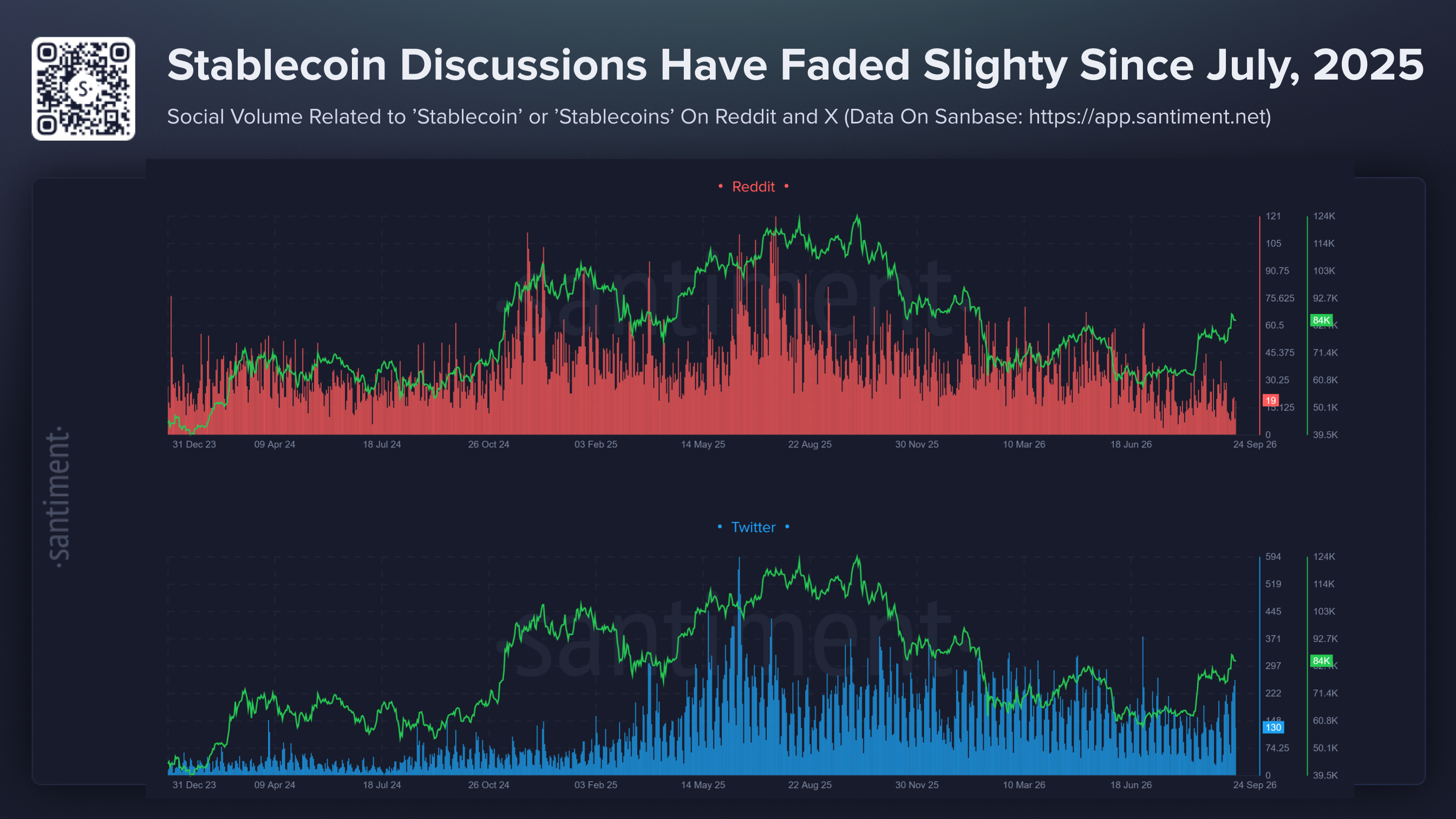
Retail traders often treat stablecoin activity as a clue about what happens next. Rising stablecoin balances can be framed as “dry powder” waiting to buy Bitcoin and altcoins. Heavy conversions into stablecoins can also signal profit-taking after a rally. Both interpretations can sound bullish depending on the narrative, which is exactly why stablecoin chatter can accelerate when traders are already highly engaged and searching for confirmation that prices have more room to run.
That enthusiasm can also make the crowd a poor forecasting tool. Retail traders tend to discuss stablecoins most aggressively after major price moves have already happened, then extrapolate those conditions forward. Large stablecoin reserves are often interpreted as guaranteed future buying pressure, while rising stablecoin supply gets treated as evidence that another rally is imminent. In practice, that capital can remain sidelined for weeks or months, move into yield products, or simply represent investors reducing risk.
This makes unusually high stablecoin discussion more useful as a sentiment indicator than a direct price prediction. When everyone suddenly begins talking about sidelined liquidity, fresh buying power and money “waiting to enter,” the market may already be much closer to an overheated stage than the crowd realizes. Meanwhile, declining stablecoin chatter should not be confused with declining adoption. Banks, payment companies and institutions can continue expanding stablecoin usage even while retail attention shifts somewhere else.
Stablecoins still require trust, even when that trust is expressed differently. Fiat-backed issuers need reliable reserves, audits or attestations, redemption systems and regulatory access. Crypto-backed systems need transparent collateral and resilient liquidation mechanisms. Synthetic models need hedging systems and counterparties that continue working during extreme market conditions.
That is one reason 2026’s institutional developments are so consequential. Tether completed a full audit. Circle is embedding USDC deeper into regulated financial infrastructure. Paxos publishes regular USDG reserve reports. Ripple obtained regulatory approval for RLUSD in Japan. PayPal is connecting PYUSD to an enormous consumer network. None of those eliminates stablecoin risk, but they represent a different stage of development from the days when market capitalization alone was treated as proof of credibility.
The emerging challengers still have an enormous distance to travel before genuinely threatening USDT or USDC. A $4 billion stablecoin can double several times and remain far below Tether. But the important trend is that several contenders now have reasons to exist beyond speculative incentives. USDG has network economics. PYUSD has payments. RLUSD has institutional settlement. USDS has decentralized capital markets. USDe offers a synthetic savings architecture. USD1 is building exchange and regulated-finance distribution.
The strongest argument for stablecoins in 2026 is no longer simply that their market capitalization keeps rising. It is that the surrounding infrastructure is beginning to resemble a functioning financial system. Banks are issuing tokens. Payment giants are distributing them. Asset managers are integrating them. Merchants are accepting them. Governments are building regulatory frameworks around them. Consumers are spending them.
USDT and USDC remain overwhelmingly ahead, and that lead should not be understated. But the next generation is no longer fighting only for exchange market share. It is competing for payroll, remittances, merchant settlement, institutional treasury management, tokenized securities, DeFi liquidity and cross-border banking. That makes the stablecoin race in late 2026 considerably more important than a leaderboard of dollar-pegged tokens.
The question heading into 2027 is therefore less about which token can temporarily mint the most supply. It is which stablecoins can earn durable trust, maintain reliable redemption, survive stress, secure major distribution channels and become useful enough that people stop thinking of them as “crypto” every time they use them. If 2026 has shown anything, it is that this transition is already underway.
—–
Free two-week trials to Sanbase PRO (to access all mentioned Santiment data in this article, and plenty more) are AVAILABLE HERE!
—–
Disclaimer: The opinions expressed in the post are for general informational purposes only and are not intended to provide specific advice or recommendations for any individual or on any specific security or investment product.