
Provisions that govern
The framework arrived with the Finance Act, 2022. “The key governing provisions are Section 2 (47A) of the Income Tax Act, 1961 (corresponding Section 2 (111) of the Income Tax Act, 2025) which defines VDAs; Section 115BBH (corresponding Section 194 of the new law) which taxes income from transfer of VDAs at 30%; and Section 194S (corresponding Section 393 of the 2025 Act) which mandates 1% TDS on specified transfers,” says Raghav Bajaj, Partner, Khaitan & Co.
Two more provisions complete the picture: Section 56 (2)(x) taxes gifted crypto, while Section 285BAA requires exchanges to report crypto transactions to the tax department.
The VDA definition is deliberately wide: cryptocurrencies, non-fungible tokens (NFTs) and anything the government may notify. Excluded are Indian and foreign currency, Central Bank Digital Currency, and—via Central Board of Direct Taxes (CBDT) notifications of 30 June 2022—gift cards, vouchers, mileage and loyalty points, and NFTs whose transfer conveys ownership of an underlying tangible asset.
ALSO READ | Income tax return: How to report capital gains correctly to avoid ITR filing mistakes
30% flat tax on transfer
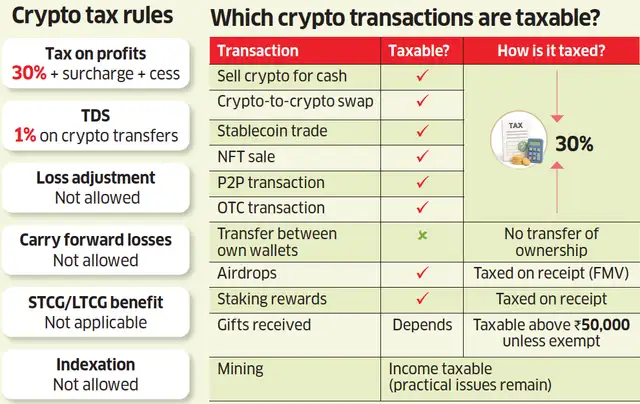
Income from transferring a VDA is taxed at a flat 30%, plus surcharge and cess, no matter how long you held it. “The conventional concepts of shortterm capital gains and long-term capital gains do not apply to crypto assets, and taxpayers cannot benefit from concessional long-term capital gains rates or indexation,” says Sanjiv Malhotra, Senior Advisor and Head of Tax Practice, Shardul Amarchand Mangaldas & Co.
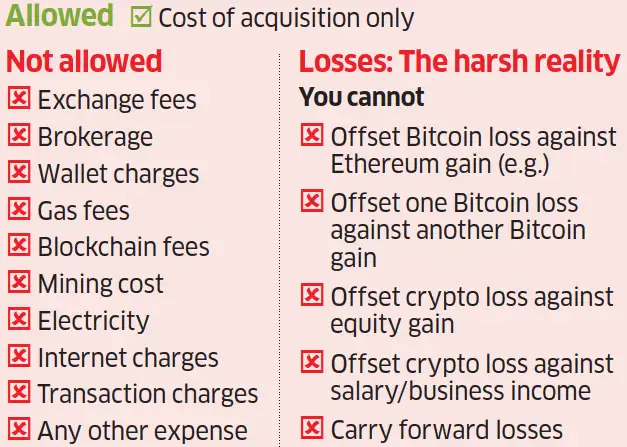
Only the cost of acquisition can be deducted. Malhotra explains that no deduction is permitted for transaction charges, mining costs, brokerage, electricity, internet expenses or any other expenditure. The loss rules are harsher: a loss on Bitcoin cannot be set off against a gain on Ethereum and even another bitcoin, cannot offset equity or any other income, and cannot be carried forward. “Government’s taxation policies are visibly cautious and not investorfriendly in the crypto space,” Malhotra says.
One relief, however, exists. “Wallet-towallet transfers between accounts held by the same person are not taxable transfers, as there is no change in ownership,” according to Bajaj. Everything else—sale for fiat, crypto-to-crypto swaps, P2P (peer-to-peer) or OTC (over-the-counter) trades—is taxed identically at 30%. On when an investor becomes a trader with business income, Bajaj observes that the Act provides no crypto-specific test; the call “should ideally depend on factors such as frequency, volume, intention and manner of holding.”
What investors need to know
What expenses can you deduct?
How 1% TDS works
The TDS net
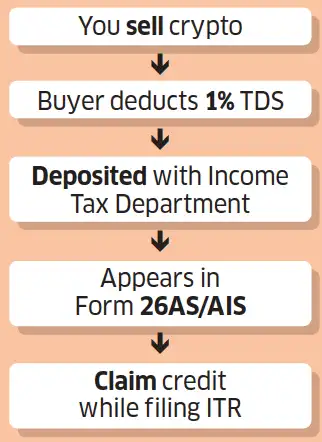
Section 194S requires 1% TDS on consideration paid to residents for VDA transfers — above Rs.50,000 a year for ‘specified persons’ (broadly, certain individuals and HUFs) and Rs.10,000 for others. The net covers cryptocurrencies, NFTs, stablecoins, swaps, OTC and P2P deals; gifts fall outside it as they involve no consideration. “TDS deducted under Section 194S is not an additional tax, but merely an advance collection mechanism,” says Malhotra, credit is available against final liability once it reflects in Form 26AS or the AIS, and excess is refundable. Skip it, and failure to deduct or deposit TDS can render the deductor an assessee-in-default, attracting interest and penalty.
ALSO READ | ITR filing 2026: Foreign income and overseas assets? Avoid these 7 costly disclosure mistakes
Special situations
Airdrops and staking rewards are taxed as income at fair market value on receipt; that value becomes the acquisition cost for the eventual sale, itself taxed at 30%. With no prescribed valuation method, Bajaj says “taxpayers typically rely on the rate quoted by the exchange through which the asset was received.” Gifted VDAs over Rs.50,000 a year are taxable in the recipient’s hands unless from specified relatives or occasions. Worthless tokens offer no escape: Bajaj adds, “the Income Tax Act provides no mechanism to claim a loss merely because a token’s value has fallen to zero in the absence of an actual sale, transfer, or extinguishment of rights.”
Overseas holdings
Resident taxpayers face tax on global income; an overseas exchange changes nothing.
Non-disclosure many invite provisions of the Black Money Act. Scrutiny has turned data-driven, with the department matching TDS filings, exchange reporting under Section 285BAA, Form 26AS and the AIS against returns, and drawing inputs from agencies like the Financial Intelligence Unit and Directorate of Revenue Intelligence.
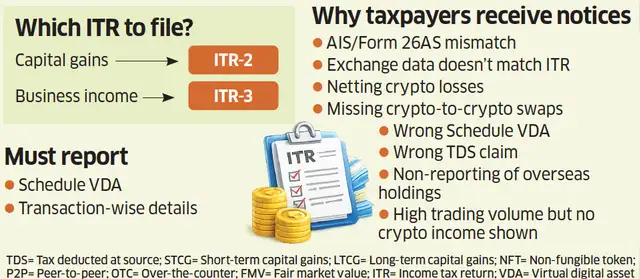
Crypto investors cannot use ITR-1 or ITR-4; ITR-2 or ITR-3 will apply. Schedule VDA demands transaction-wise reporting — dates, cost, consideration — not aggregates. Common slip-ups include netting losses across VDAs and TDS mismatches with the AIS, a frequent notice trigger. Non-compliance risks reassessment, interest, Section 270A penalties and, for wilful concealment, prosecution. As Malhotra puts it, “There are already certain tax matters pending before the courts…. it will be interesting to see how courts interpret these new-age assets.”