
Key Takeaways
- Traditional stablecoin models gave all yield to issuers; STBL’s model returns it to users via yield stripping.
- Separating yield (YLD) from the stablecoin (USST) lets businesses use it for incentives, payments, and growth.
- The CLARITY Act may limit passive ‘hold-to-earn,’ pushing the market toward ‘use-to-earn’ systems.
- Despite competition, digital dollars are expanding globally and could scale to multi-trillion adoption.
The stablecoin market is worth over $320 billion. Monthly volumes have crossed $2 trillion. And for most of that history, the people generating all that value have gotten none of the yield. Joe Vollono at STBL wants to change that.
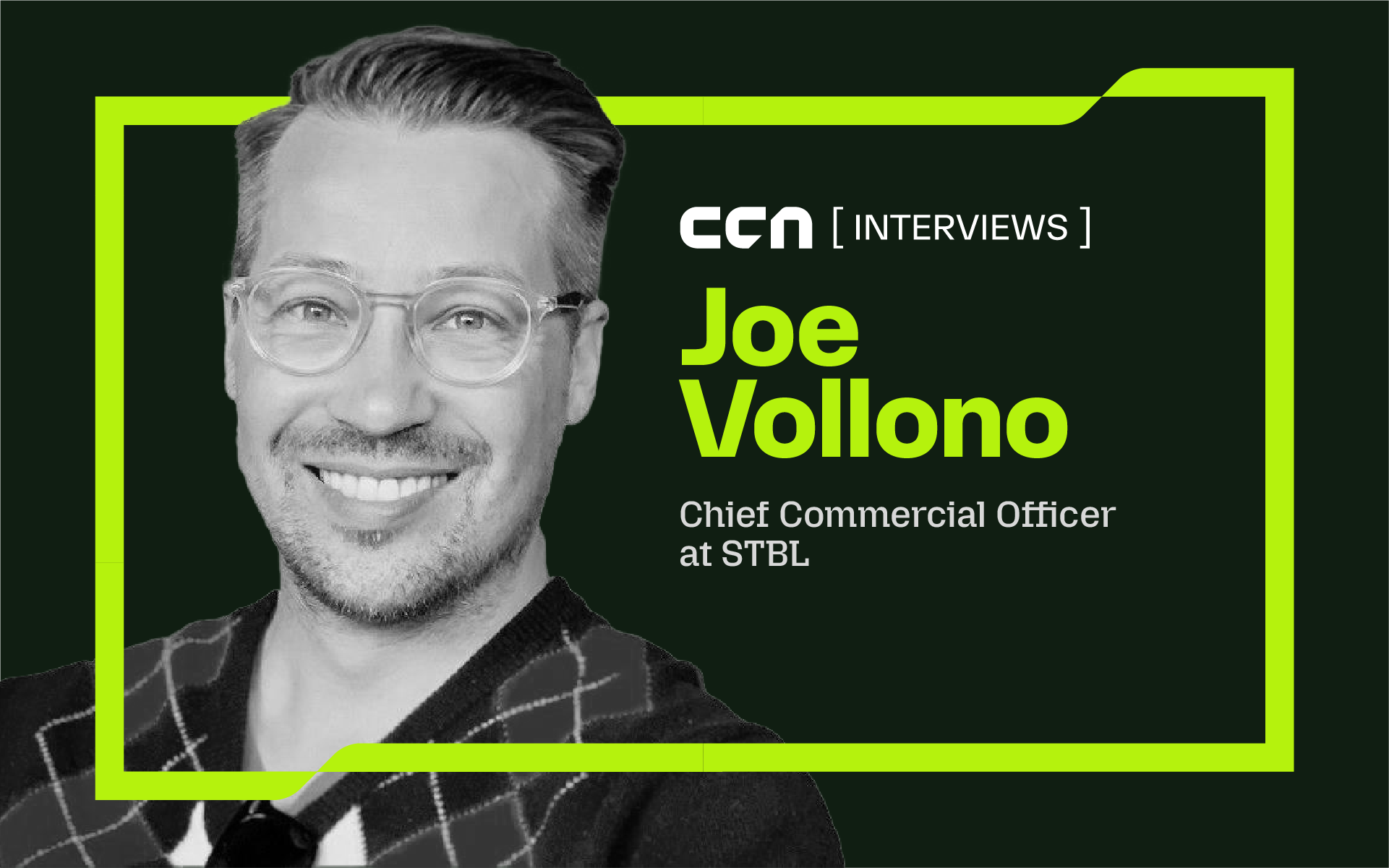
Vollono is the Chief Commercial Officer of STBL, a non-custodial decentralized protocol positioning itself as the infrastructure layer for what the team calls Stablecoin 2.0. He arrived at the role from an unusual direction: close to a decade on Wall Street and in Palo Alto, stints at Morgan Stanley and Ripple, and before any of that, the US Navy. He is one of those rare figures in crypto who actually lived through the plumbing of traditional capital markets before deciding it needed to be rebuilt entirely.
At Consensus 2026 in Miami, CCN’s Maxwell Moeller sat down with Vollono to talk yield stripping, the Clarity Act compromise reached just days earlier, digital dollarization, and why he thinks the next 12 months will be the most important in the industry’s history.
From Wall Street to Web3
Vollono spent nearly a decade in highly regulated and closely supervised environments at Morgan Stanley, where he developed a genuine appreciation for prudential regulation. What wore on him was not the rules. It was the pace, and the distance from where things were actually being built.
“The other side of that excessive oversight is stifling,” he says. “It’s very hard to be entrepreneurial and be a builder in those kinds of environments.”
He wanted to go further upstream. To where the problems were still unsolved, not where the products had already been packaged, positioned, and sold downstream. For him, that meant decentralized finance, where his traditional finance foundation turned out to be a competitive advantage rather than a liability.
“I’m never looking back. I love this space.”
What Tether Got Right, and What It Left on the Table
To understand what STBL is building, you have to understand what came before it. The model most people know, what Vollono calls Stablecoin 1.0, is the model Tether invented. You give an issuer a dollar. They give you a digital dollar. They take your dollar, buy a treasury, and keep the yield. You get the utility of the stablecoin. You give up the return entirely.
That model made Tether, as Vollono notes matter-of-factly, the most profitable company on a per employee basis on the planet. Tether reported $10 billion in net profit in 2025.
“The people that are putting value into that ecosystem aren’t stakeholders in economics,” he says. “In some ways, it’s a rent-seeking model.”
STBL’s co-founder Reeve Collins was also a co-founder of Tether. He put the dollar on a chain over a decade ago. Vollono is careful not to speak for Collins, but frames the new project simply: they are taking the best of what Collins architected twelve years ago and rebuilding it with the technology that now exists.
Collins has put it this way: “Our mission at STBL is to evolve stablecoins from corporate products into public infrastructure. For the first time, minters, not issuers, retain the value of reserves.”
Yield Stripping, Explained
The mechanism at the center of STBL is yield stripping, a concept borrowed from traditional finance’s zero-coupon bond market, where principal and interest have long been separated and traded independently.
When users deposit collateral into STBL, they receive USST, a 1:1 dollar-pegged stablecoin for spending, and a separate YLD token, an NFT that represents the right to the yield generated by the underlying collateral. The stablecoin remains fully fungible and spendable, while the yield accrues to the YLD holder, typically the original depositor.
“Now I get the benefit of a fully fungible stablecoin just like USDT,” Vollono says, “but I also get the benefit of keeping the yield.”
The composability element is where he gets animated. The yield stream, once it belongs to the user rather than the protocol, becomes an asset that enterprises can actually do things with. They can share it across an ecosystem, use it to fund product launches, or build loyalty programs on top of it. They also retain the data on how their money is moving, which Vollono describes as enormously valuable information for corporate treasuries and payments companies.
“This yield stream is now an asset that you can do a lot of different things with that you didn’t have before.”
A Platform, Not an Issuer
STBL’s native stablecoin is USST, but the protocol itself does not custody assets. It provides the infrastructure for enterprises, sovereigns, municipalities, and institutions to mint USST or launch their own branded stablecoin backed by USST.
The sales conversation almost writes itself. Vollono describes it repeatedly: a payments company or sovereign entity has already spoken to Tether and Circle, sees the value, and then hits the same wall. They are the ones providing all the value into the partnership. They are going to hand all the yield to someone else. Then they find STBL.
“The value proposition sells itself,” he says, though he is quick to add there is a real learning curve in working out where a given enterprise wants to sit in the market. His job as CCO is to walk through that with each partner. There is no dominant objection, he says. There is a lot of learning, and learning goes both ways.
STBL has announced a partnership with X Layer, OKX’s layer-2, alongside Hamilton Lane and Securitize, with a product expected to arrive on mainnet in June 2026. More announcements, he says, are coming shortly.
The CLARITY Act and What Comes Next
The GENIUS Act became the first federal law to create a comprehensive regulatory framework for payment stablecoins, signed into law following bipartisan passage in July 2025. But in Vollono’s telling, a potentially more consequential piece of legislation is still being debated: the Digital Asset Market CLARITY Act.
Senators Thom Tillis and Angela Alsobrooks recently reached an agreement on stablecoin yields under the CLARTY Act, with the revised language stating that rewards must not resemble or function like interest from a traditional bank deposit.
Vollono sees this not as a restriction but as a catalyst. The legislation will push the industry from what he calls “hold to earn” toward “use to earn.” Passive yield on stablecoins will be constrained. But yield earned through genuine activity, through payments, minting, staking, loyalty programs, and similar use cases, is expected to be permissible.
“What that’s going to mean is you’re going to see a lot of solutions enter into this vacuum,” he says. “Compliant yield solutions that will take this otherwise idle capital and make it productive.”
He calls it a middle layer. Money as a service. And he thinks it will scale enormously over the next twelve months. That is precisely where STBL sits.
Prediction markets reflected the momentum: odds of the Clarity Act passing in 2026 jumped from 46% to 64% on Polymarket following the Tillis-Alsobrooks compromise.
Dollar, the Globe and the Long Game
Vollono describes the stablecoin market that is 90% dollar-denominated and heading toward multi-trillion dollar scale once institutional capital comes off the sidelines after the CLARTY Act passes.
He points to the eurodollar market, historically around $15 trillion in offshore dollar holdings, as the analog for where this is going. Stablecoins are, in his framing, a digital eurodollar system. A Trojan horse for treasuries.
The tension that creates is real. In the global south and in high-inflation economies, populations are adopting stablecoins because they want dollar exposure. The BIS and IMF have warned about digital dollarization, and banking regulators have flagged the risk that customers might abandon traditional deposit accounts for stablecoins paying substantially higher yields.
Other nations are developing their own responses. Vollono describes a digital yuan with yield properties designed to compete with the dollar. Sovereigns denominating their own domestic treasuries to launch stablecoins in local currency. A cascade of reactions, each one triggering the next.
“It’s global game theory,” he says. “Country A does something and Country B says, oh no, this is going to be a problem for me. So Country B does something.”
He does not see the dollar losing reserve currency status in the near term. If anything, he thinks stablecoins will strengthen it, largely because of network effects that are now almost impossible to displace.
“Everybody accepts dollars. Everybody wants dollars.”
The information provided in this article is for informational purposes only. It is not intended to be, nor should it be construed as, financial advice. We do not make any warranties regarding the completeness, reliability, or accuracy of this information. All investments involve risk, and past performance does not guarantee future results. We recommend consulting a financial advisor before making any investment decisions.

OS Singh has three years of experience as a digital finance content creator. Throughout his career, he has collaborated with various DeFi projects and crypto media outlets. In his leisure time, he enjoys fitness activities at the gym and watching movies across different genres. Balancing his professional and personal interests, Onkar continues to contribute to the digital finance landscape while pursuing his hobbies.


Max Moeller is a Chicago‑based writer and video editor passionate about games, tech, and crypto. Whether it’s crafting clear, insightful articles or piecing together engaging video retrospectives, he’s driven by curiosity and takes pride in keeping things human. Since 2017, Max has been published in a variety of notable crypto magazines.
Contact Max: [email protected], reach out on LinkedIn or Youtube.