
Research Highlights Article
July 31, 2025
Did development aid in Afghanistan help counter the Taliban’s insurgency?
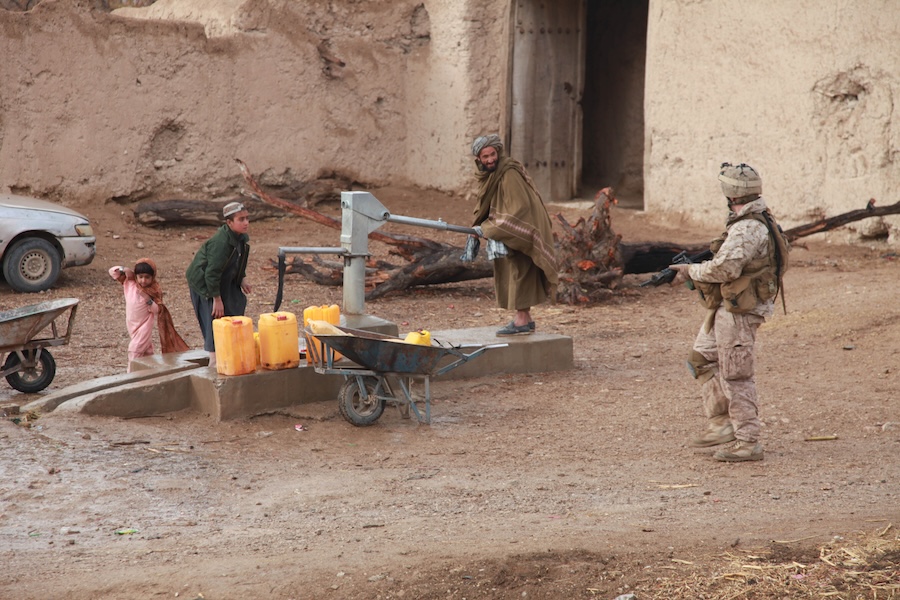
Source: Marines from Arlington, VA, United States
During the Afghanistan War, the United States poured billions of dollars into development programs. The hope was that improving people’s lives through schools, roads, and basic services would increase support for the fledgling Afghan government among the populace and counter the Taliban insurgency. Despite the enormous costs—both in lives and money—it was unclear at the time that such a “hearts and minds” strategy was actually working.
In a paper in the American Economic Journal: Applied Economics, authors Andrew Beath, Fotini Christia, and Ruben Enikolopov show that although development aid in Afghanistan helped to suppress insurgencies in some regions, it may have been counterproductive in areas where insurgents came from outside the local communities.
The researchers’ work began in graduate school, when they were inspired by the randomized controlled trials being pioneered at MIT’s Poverty Action Lab and saw an opportunity to apply gold-standard evaluation methods to a war zone.
“There was something really exhilarating about being able to offer a rigorous evaluation in such a context because there was so much at stake,” Christia told the AEA in an interview.
The team studied Afghanistan’s National Solidarity Program (NSP), a $2 billion initiative and the country’s largest development program. The authors’ experiment exploited the randomized rollout of the program between 2007 and 2011 across 500 villages in ten districts. Half the villages were randomly selected to receive the program, while the other half served as a control group.
Afghanistan sample villages
The map below shows the location of treatment villages, marked in green, and control villages, marked in red. The ten districts used in the experiment are outlined in orange.
The NSP provided villages with block grants of up to $60,000 to fund infrastructure for irrigation systems, roads, electricity, and sanitation. The aid was also paired with a requirement that villages elect gender-balanced Community Development Councils, giving locals a voice in how the money was spent.
The researchers combined multiple data sources to track the program’s effects over four years. They measured violence using declassified US military incident reports, tracking everything from firefights to improvised explosive devices within 15 kilometers of each village. They also conducted three rounds of household surveys with nearly 14,000 villagers to measure changes in economic conditions, government support, and security perceptions.
Comparing the treatment and control villages revealed a clear geographic split in the effectiveness of development aid. In eight districts in Afghanistan’s interior, the program worked as hoped: violence decreased, economic conditions improved, and support for the government increased, with the effects persisting for four years.
But in two districts near the Pakistani border, the opposite occurred. Despite delivering aid, the program actually increased violence.
The difference wasn’t about ethnicity, opium production, or initial violence levels—factors the researchers carefully tested. The crucial factor appeared to be whether the insurgents were embedded in the local communities or were outsiders who could operate independently.
Development aid seems to be a sensible way to win people over in locally driven insurgencies, but it’s not a useful tool for externally driven insurgencies.
Fotini Christia
In the interior regions of Afghanistan, the Taliban insurgents were predominantly locals, who depended on local support for shelter, food, and intelligence. When development improved people’s lives and attitudes toward the government, communities became less willing to support insurgents.
But in the eastern border regions, the insurgency was dominated by outside fighters, who could retreat to safe havens across the border in Pakistan. And because they didn’t need local support to operate, they could afford to attack development projects to nullify their economic benefit—as well as intimidate locals— and prevent government influence from growing.
The findings help explain why previous studies of development aid in conflict zones have produced contradictory results: the effectiveness of aid depends on the nature of the insurgency. Moreover, the conclusions may provide a valuable lesson for development efforts in war zones.
“Development aid seems to be a sensible way to win people over in locally driven insurgencies, but it’s not a useful tool for externally driven insurgencies,” Christia said.
♦
“Can Development Programs Counter Insurgencies? Evidence from a Field Experiment in Afghanistan” appears in the July 2025 issue of the American Economic Journal: Applied Economics.