
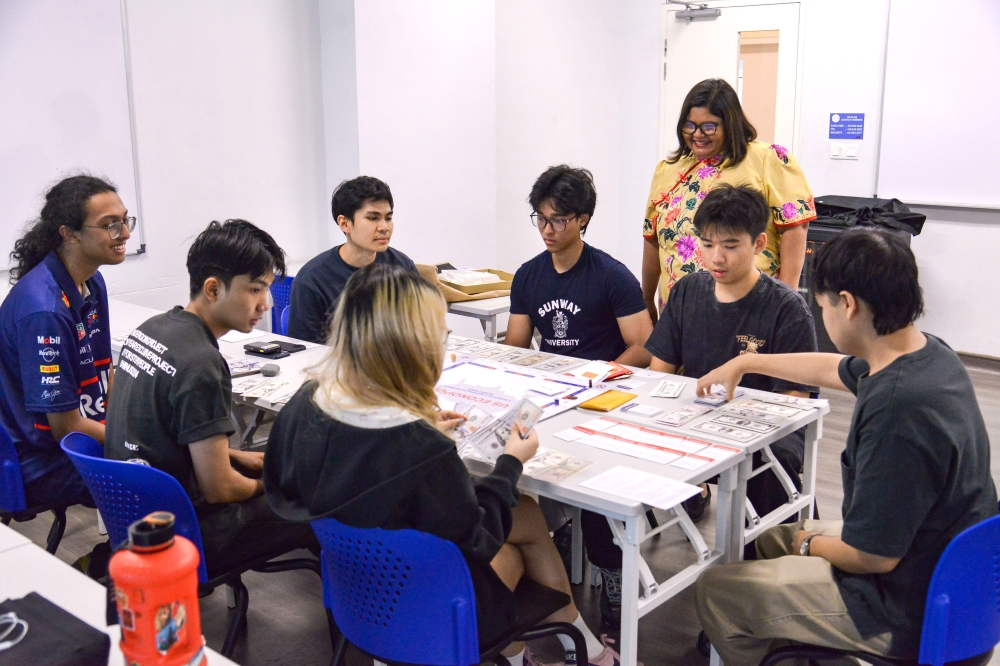
KUALA LUMPUR, June 29 — After 25 years teaching economics and business, Dr Janitha Nadarajah came to the realisation that understanding economic theories requires more than just poring through lecture notes and text books.
Her relentless search for a new approach to help students get closer to the subject – often perceived as difficult – finally led to the creation of US Econopoly, an interactive board game that transforms economic concepts into actual learning experience.
Janitha, who is a a lecturer in economics and business under the American Degree Transfer Programme (ADTP) at Sunway University, said the game is designed to help students grasp the concepts of microeconomics, macroeconomics, and financial literacy through real world simulations based on the United States (US) economic model.
Janitha said US Econopoly, which drew inspiration from the popular board game Monopoly, is however different in that it includes economic elements such as actual property and stock markets mapped according to US states based on 2025 market values.
“Other than that, among the economic features included are inflation, unemployment, dividends, bonds, tariffs, bank loans, and others. This board game has many economic features which I have adapted according to class,” she said when met by Bernama recently.
The US Econopoly board game can be played by six to seven students with one playing the role of a banker, with a particular objective to help elucidate students on economic concepts.
Janitha said the trigger for the creation of the board game took place while she was a participant of the Study of US Institutes (SUSI) for Scholars programme organised by the US government for six weeks in Boston, New York, and Washington last year.
Upon returning to Malaysia, Janitha got busy and completed the board game project within three months beginning January, financed by the grant specially provided for the alumni of the programme.
As for the game mechanics, it is different from conventional property board games, in that US Econopoly emphasises on the process of making financial decisions when players buy assets, invest in stocks, and manage risks, thereby seeing how economic decisions affect their wealth.
Janitha said at the end of the game, players are required to calculate their accumulated wealths in the forms of cash in hand, property values, and stock values.
“Players who focus on buying property are safe long-term investors. But if they are more into buying shares, they are high-risk short-term investors,” she added.
The interactive game which is also in dedication to the 250th anniversary of the US Declaration of Independence, or Freedom 250, is also in support of the America 250 vision by inculcating civic consciousness and history awareness through experience-based learning.
Although Janitha intended for the project to be for education purposes only and is currently in the process of applying for copyright protection, she welcomes corporate sponsorships to expand and adapt the game for the local market.
“I am open to collaborations. If there are companies willing to sponsor, we can create special games for the Malaysian economy or to collaborate with entities such as Bursa Malaysia to teach stock market literacy,” she said.
The economics lecturer also is planning to create a secondary board game for global businesses and international economies such as property buying and overseas franchise.
Meanwhile, the hands-on, interactive approach of this educational board games has resonated deeply with students, who view US Econopoly as a game-changer in translating complex classroom theories into real-world applications.
For Kavin Parhar, an 18-year-old ADTP student majoring in Business Management, the game provides a practical lesson in managing limited capital under pressure.
“It was really fun because it made you think about how to manage your money properly because you’re only given 1,500 at the start of the game. So it pushes you to use your money wisely and it can apply to the real world as well. So I think the board game is quite good in that sense.
“I think after playing this board game, I could score better on my economics exam because it helps me understand the concepts that I learnt during classes better,” he said.
Philip Yip, a 19-year-old ADTP Economics student who has attended Janitha’s classes for five semesters, highlighted that physical interaction with economic concepts drastically improves retention compared to passive learning.
“It actually not just about playing the game but it also teaches you the basic fundamentals of economics. So we get to learn what are bonds, how to buy property and then we get to buy shares from large companies, MNCs, and learn a lot.
“I think it’s a pretty interesting game that is quite similar to other games but I think out of all the games I played this one was definitely one of the better ones. I think instead just learning you actually get to interact with it so some people will like learn the concept better this way and for me it does help quite a lot as well,” he said. — Bernama