

August—a summer month for Europe—has begun with volatility in financial markets coexisting with risk appetite. “The momentum from the final stretch of the previous month was led by the tech sector on Wall Street, whose solid earnings offset inflationary rigidity. Despite this, the S&P 500 recorded a slight monthly dip for the second consecutive month, standing 2% below its all-time highs, while the Fear and Greed Index positioned itself at 39/100. Regarding energy, the U.S. Strategic Petroleum Reserve (SPR) fell to 308 million barrels, its lowest level since 1983, and pushed crude oil to its largest monthly gain since March,” notes Felipe Mendoza, market analyst at EBC Financial Group.
For this expert, in the coming weeks we will see a two-phase volatility scenario: “A first half of August dominated by technical adjustments, profit-taking, and pressure toward fixed-income assets, followed by a second half of the month where Nvidia’s guidance and the digestion of inflation data could reactivate the bullish trend toward the final quarter of the year.”
In his view, the main risk to this projection is concentrated in the military escalation with Iran, the contradictory narrative surrounding the Strait of Hormuz, and its potential repercussions on global crude oil supply. Given this context, two asset classes take center stage: gold and the dollar.
Gold: From All-Time Highs to Readjustment in Six Months
Attention on gold stems from its start to the year as one of the most attractive and top-performing assets, only to close out the first half of 2026 by registering a significant correction. “Gold has experienced a remarkable trend reversal during the first half of 2026. After reaching an intraday all-time high of $5,595 per ounce on January 29, prices suffered a sharp correction and, at the time of writing in early July, are trading below the level at which they began the year. Although the magnitude of the correction has unsettled investors, we consider it a healthy readjustment rather than the end of the structural bull market,” explains Nitesh Shah, Head of Commodities and Macroeconomic Research at WisdomTree.
According to his analysis, the extraordinary valuation premium generated during the 2025–26 rally has largely unwound, leaving gold much closer to its estimated fair value. “We anticipate that gold’s next phase will be determined primarily by macroeconomic fundamentals, rather than exceptional investor demand,” he clarifies.
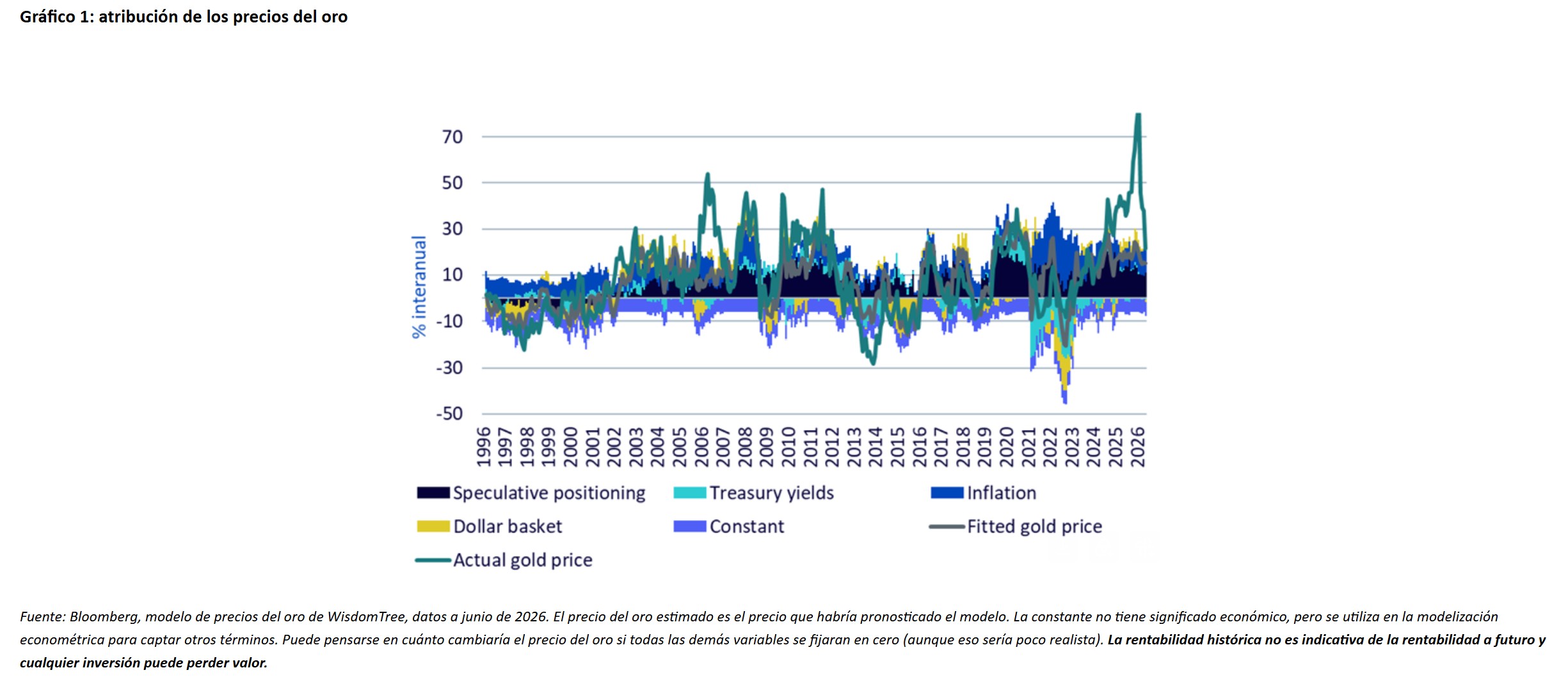
For Shah, now that valuations have normalized, their outlook turns back to the macroeconomic variables that historically have accounted for most of the variation in gold prices. “Gold could face intermittent short-term headwinds as markets continue to reassess the outlook for U.S. monetary policy. The latest forecasts from the Federal Open Market Committee (FOMC) and the accompanying communications were interpreted as a sign that the Fed would adopt a somewhat more hawkish stance, leading futures markets to price in rate hikes as early as September,” the WisdomTree expert points out.
Consequently, according to current consensus forecasts, the firm’s model points to a recovery reaching $4,563 per ounce by the second quarter of 2027, “although sensitivity analysis shows how different macroeconomic scenarios could substantially alter that trajectory,” Shah adds.
Macroeconomics and the Dollar Outlook
These reflections on gold are connected to the behavior of the dollar. As Shah acknowledges, a large part of gold’s weakness during 2026 can be explained by the appreciation of the U.S. dollar. “The dollar strengthened to reach its highest level in over a year, driven by the relative energy security of the United States during the conflict with Iran, outperforming many other currencies typically considered safe havens,” he recalls.
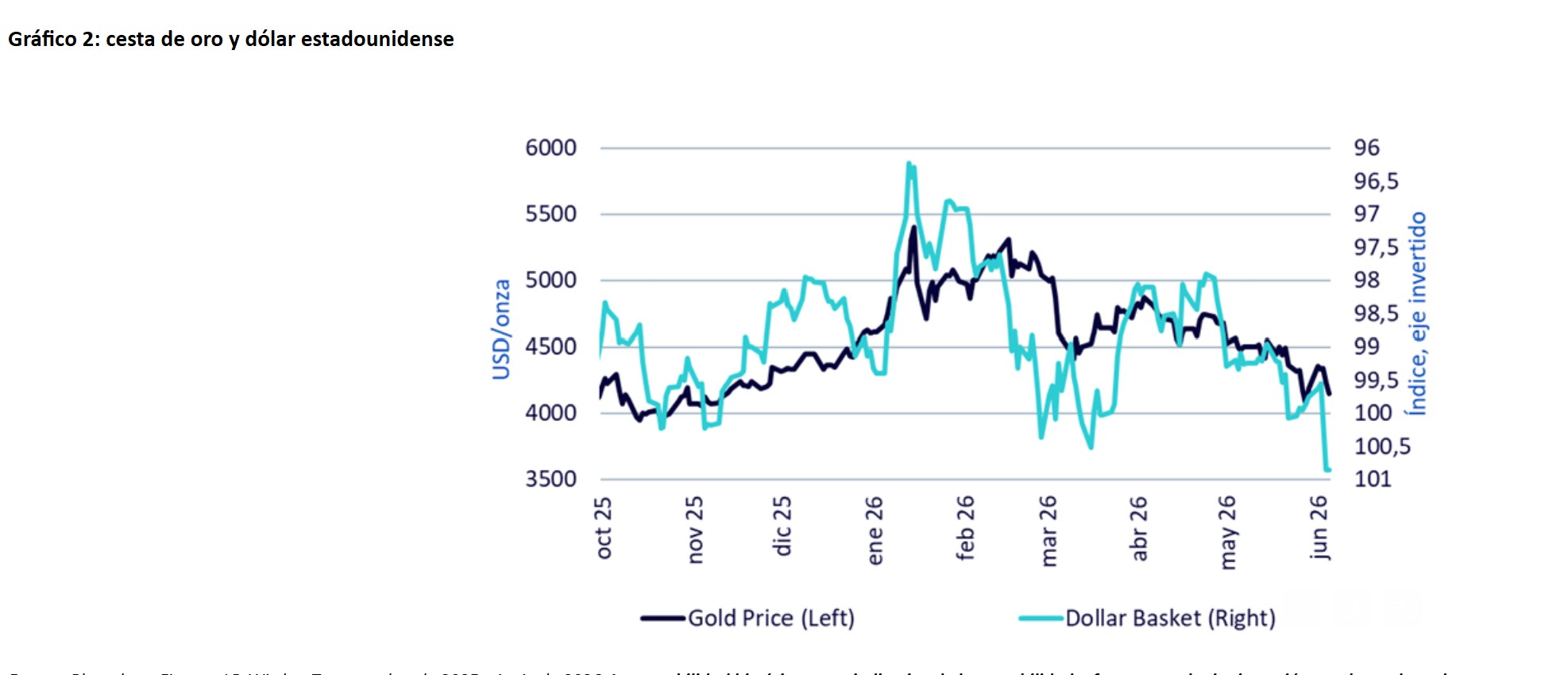
Looking ahead to the remainder of the year, most experts agree that the short-term macroeconomic outlook remains positive for the dollar. “U.S. economic activity has held up better than that of other major economies, but inflation remains persistent and the market has had to price in a tighter Fed path. This movement in relative yields has already contributed to the dollar breaking above its previous trading range and is, broadly speaking, consistent with our central scenario of riding dollar strength through the end of 2026,” argues David Rees, Head of Global Economics at Schroders.
In this regard, Schroders’ baseline forecast projects the dollar to rise throughout 2026 before easing slightly in 2027. “Our assumptions for year-end 2026, published at the time, were: GBPUSD at 1.21, EURUSD at 1.07, USDRMB at 7.09, and USDJPY at 167.8. Our working hypothesis for year-end 2027 anticipates the dollar giving back part of those gains—reaching 1.27, 1.12, 7.03, and 162.5, respectively—as weakening inflationary pressures provide relief to a hawkish Fed, and a shift toward a more forward-looking policy agenda reinstates rate cuts in 2027,” Rees notes.
Furthermore, according to Rees, more broadly speaking, if the euphoria in U.S. markets comes to an end, there are good reasons to believe the dollar could suffer the consequences. “A weaker dollar carries significant implications for all investors globally. These range from immediate portfolio impacts to longer-term effects on asset returns as economies, sectors, and individual companies adapt to a lower-value dollar,” he indicates.