
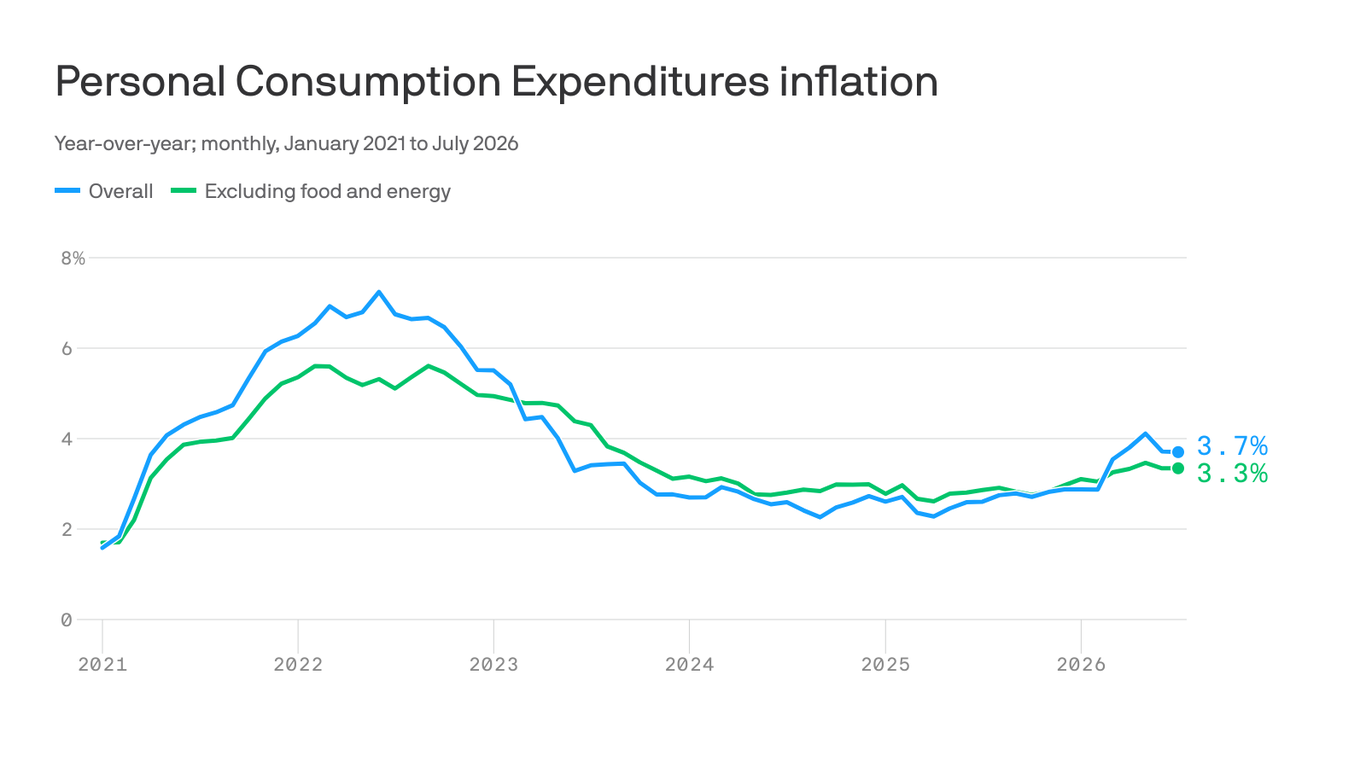
What they’re saying: “The best thing that can be said is that at least core inflation didn’t go higher,” Brian Jacobsen, chief economic strategist at Annex Wealth Management, wrote in a note, referring to the inflation gauge that strips out food and energy costs.
- The inflation fear is that “instead of reversing, it’s plateauing,” Jacobsen added.
The good news: Americans’ disposable income rose 0.5% in July. Those gains still held up after accounting for inflation for the third consecutive month, with real disposable income increasing 0.4%.
- Spending slowed notably, with personal consumption expenditures rising just 0.2% in July and essentially flat after adjusting for inflation, compared with a 0.4% real increase in June.
- The weakness was concentrated in goods, where spending fell at a roughly $50 billion annualized rate, partly offsetting an $86 billion increase in services spending.
- With income growth outpacing that of spending, the personal saving rate advanced for the first time this year, to 3%, up 0.4 percentage point from June.
The other side: The core personal consumption expenditures price index rose 0.2% in July and was up 3.3% from a year earlier, unchanged from June.
- Over the past three months, core inflation ran at a 3% annualized pace, down from a recent peak of 4.5% in May, but still well above the Fed’s 2% target.
The intrigue: Revised GDP figures suggest the economy entered the summer with stronger momentum than previously known, before signs of more subdued consumer spending emerged in July.
- Topline GDP growth was unchanged at a 1.5% annualized rate in the second quarter.
- But real final sales to private domestic purchasers — a gauge of underlying private sector demand that sums up consumer spending and business investment — grew at a robust 4.2% annualized rate, the strongest pace since the third quarter of 2019, excluding the pandemic-era swings.
- That was upgraded from an initial estimate of 3.9%, pointing to greater underlying economic strength than initially estimated.
What to watch: Inflation worries have become more pronounced inside the Fed. Boston Fed president Susan Collins said Tuesday that interest rates may need to rise “soon” without evidence of sustained progress on inflation.
- Her warning comes after three Fed officials backed a rate hike in July, while the minutes from the meeting showed that “many” policymakers saw further tightening as likely if inflation failed to decline.
- Fed chairman Kevin Warsh speaks at Jackson Hole Friday morning, giving him a chance to weigh in on the Fed’s path forward.