
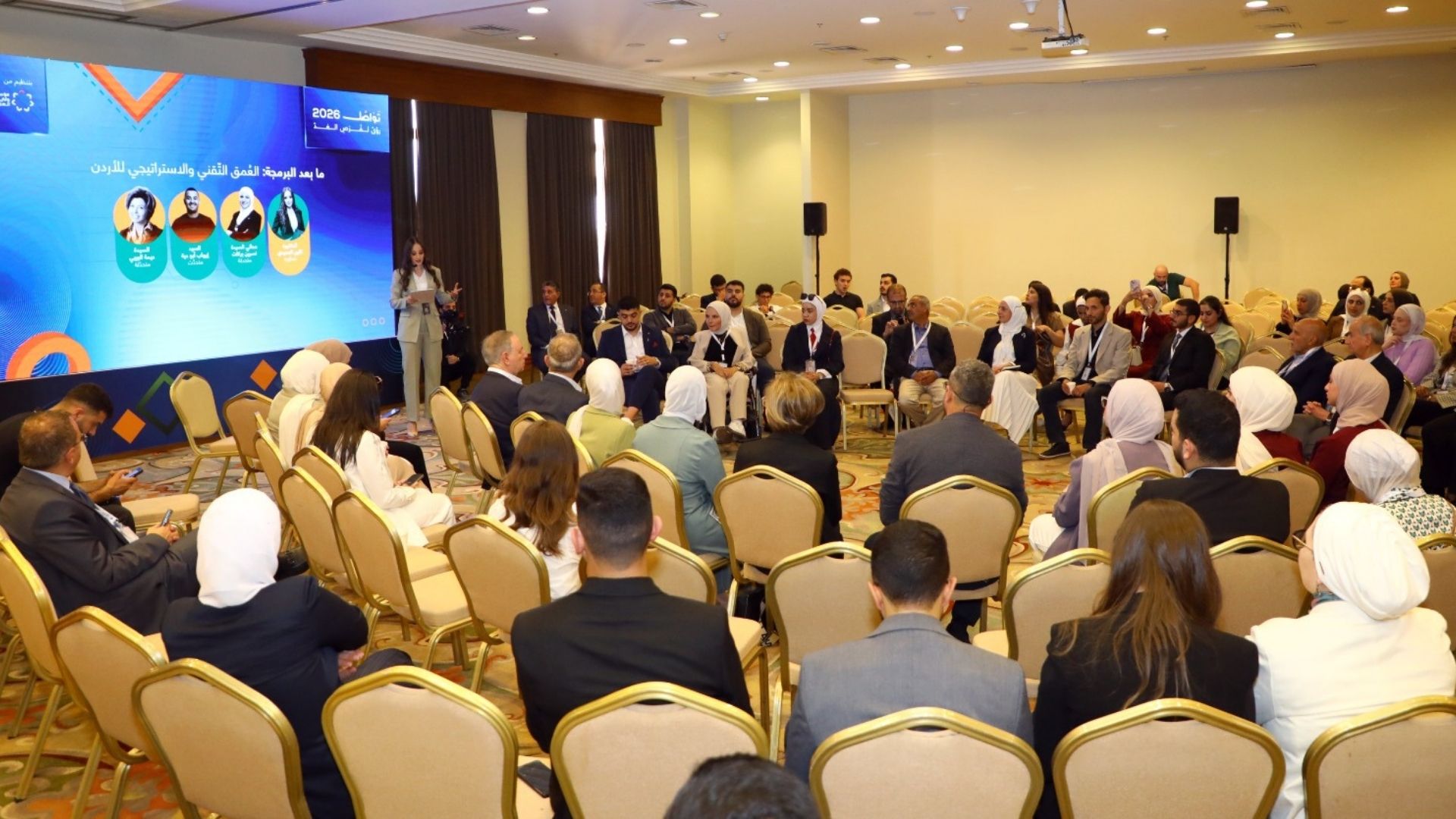
 Dead Sea, May 16 (Petra) – Policymakers, labor economists, and platform founders convened today, Saturday, at the fourth edition of the Tawasol Forum 2026 to analyze the structural evolution of the freelance economy. The panel, titled “The Gig Economy: Diversifying Income Sources and Its Impact on Growth Opportunities,” was organized by the Crown Prince Foundation under the thematic banner “Visions for Tomorrow’s Opportunities.” The discussion centered on institutionalizing remote independent labor, reforming social safety nets, and equipping Jordanian youth to compete in a boundaryless, high-skill global marketplace.
Redefining Job Security: Individualized Social Safety Nets Nesreen Barakat, CEO of the Jordan Strategy Forum (JSF), addressed the profound transformation of workplace geography, noting that fields such as app-based delivery services, graphic design, digital marketing, content management, remote accounting, and specialized consulting are expanding rapidly. Furthermore, telemedicine and digital healthcare platforms have emerged as high-growth sub-sectors, accelerated by systemic shifts in remote production.
Barakat argued that transitioning toward a gig economy does not necessitate abandoning job security; rather, it requires a complete overhaul of how labor protections are conceptualized. She emphasized that current social security and health insurance paradigms must decouple from corporate employers and instead link directly to the individual worker based on professional identity and output metrics. To achieve this, Barakat called for a comprehensive modernization of Jordanian labor contracts to legally shield independent contractors, alongside legislative amendments to state insurance frameworks to mitigate income volatility during emergencies, illness, and aging. Ultimately, this requires transitioning from corporate-sponsored benefits to portable, individualized public protection portfolios that follow the worker regardless of their contract status.
Global Regulatory Benchmarks and Platform Microeconomics Ehab Abu Diyah, Founder of the Maksoub platform, Co-Founder of the Handed e-commerce store, and Head of the International Academy for Electronic Commerce, examined the shifting mindset of Jordanian youth. While highlighting the benefits of the freelance model – such as temporal and spatial flexibility, unconstrained creativity, and diversified income stream architectures – Abu Diyah noted significant operational vulnerabilities, including early-stage revenue volatility and psychological burnout from unstructured workflows.
To integrate freelance labor into the formal economy without imposing prohibitive cost barriers, Abu Diyah called for targeted tax reforms and streamlined legal registrations for sole proprietorships, ensuring legal protection without complex overhead. He cited the successful institutional frameworks of the Philippines, Bangladesh, and Pakistan as global benchmarks where the state formalized independent digital labor to drive national GDP. He identified social media management, e-commerce, application development, artificial intelligence implementation, and digital content production as the highest-density growth corridors, urging youth to accumulate deep technical skills over short-term financial expectations.
Skill Equity, Localization, and Academic Agility Deema Bibi, CEO of Injaz, emphasized that while digital connectivity provides structural access to global freelancing platforms, technical infrastructure alone does not guarantee economic opportunity. True equity, Bibi digitalized, depends on skill competitiveness, which includes the mastery of digital reputation management, cross-border client negotiation, and advanced linguistic proficiency in English, alongside expanding Arabic freelance portals.
Bibi advocated for an integrated support ecosystem in Jordan’s governorates outside Amman, combining business incubators, mentor networks, universities, and subsidized co-working spaces to help rural youth land their first international contracts. Reflecting on Injaz’s 20-year history, she noted that educational adjustments over the last five years have outpaced the previous two decades. She called for educational institutions to continuously adapt to artificial intelligence disruptions, moving away from rigid vocational tracks toward teaching lifelong adaptive learning mechanisms.
//Petra// AA