
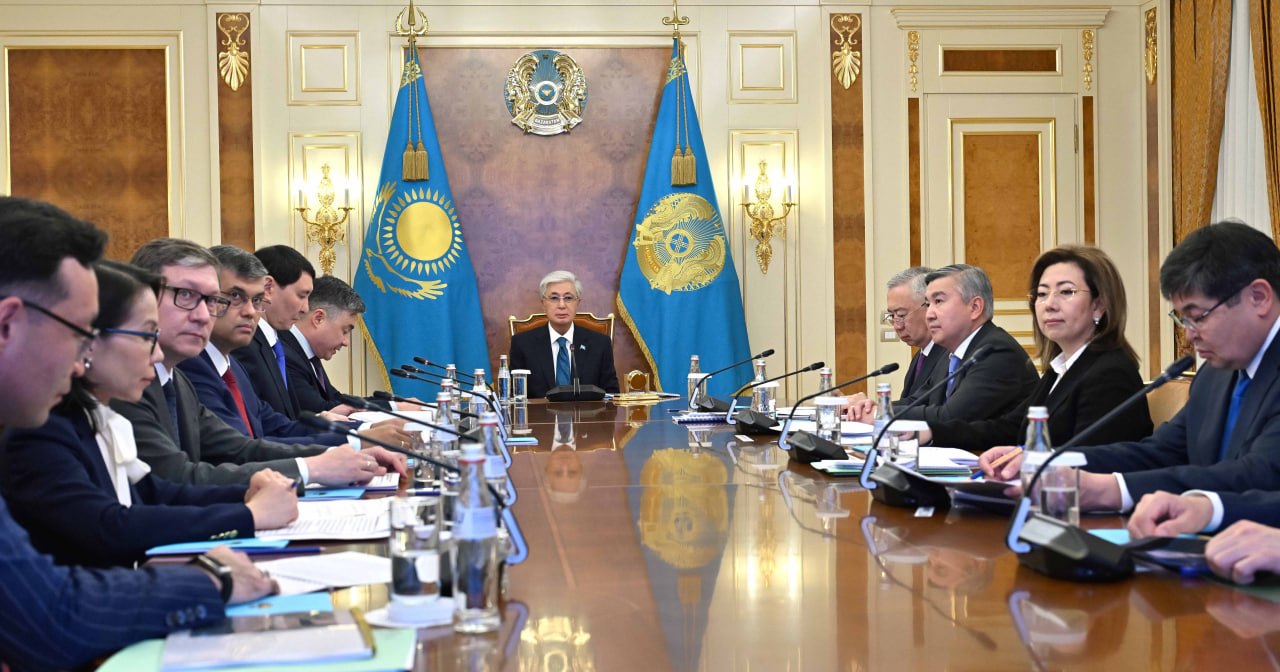
BAKU, Azerbaijan, June 4. The National Bank of
Kazakhstan plans to expand its macroeconomic stabilizing measures
and digital financial architecture following an official
operational report presented to President Kassym-Jomart Tokayev,
Trend reports via
Akorda.
The baseline financial strategy, reviewed during a high-level
briefing with National Bank Governor Timur Suleimenov, outlines the
monetary parameters achieved in 2025 and establishes core
development targets for the remaining quarters of 2026.
According to the official report, institutional regulatory
interventions successfully brought domestic consumer price
inflation down to 12.3% by the end of 2025, with further
deflationary trends driving the rate down to 10.4% at the end of
May 2026.
”The National Bank, jointly with the Government, continues
comprehensive work to further reduce inflation,” Suleimenov noted
during his presentation, highlighting record growth across
state-managed funds. By the end of 2025, the central bank’s gold
and foreign exchange reserves reached a historic milestone of $65.4
billion, while the foreign currency assets of the National Fund
expanded by $5.1 billion to reach $63.9 billion. Concurrently, the
assets under management of the Unified Accumulative Pension Fund
(UAPF) increased by 2.7 trillion tenge, bringing the total pension
asset pool to 25.1 trillion tenge.
Focusing on structural technology goals, the regulator detailed
the successful integration of a specialized legal regime for
digital assets, which supported over 30 pilot projects involving
real-world asset tokenization, fiat-backed stablecoin issuance, and
regulated crypto-fiat transactional channels. Moving forward, the
National Bank plans to scale up the newly deployed National Digital
Financial Infrastructure, which anchors biometric verification,
interbank settlements, and digital tenge services. Following the
review, President Tokayev directed the central bank to ensure
long-term financial system resilience and implement synchronized
anti-inflationary policies alongside the government.