
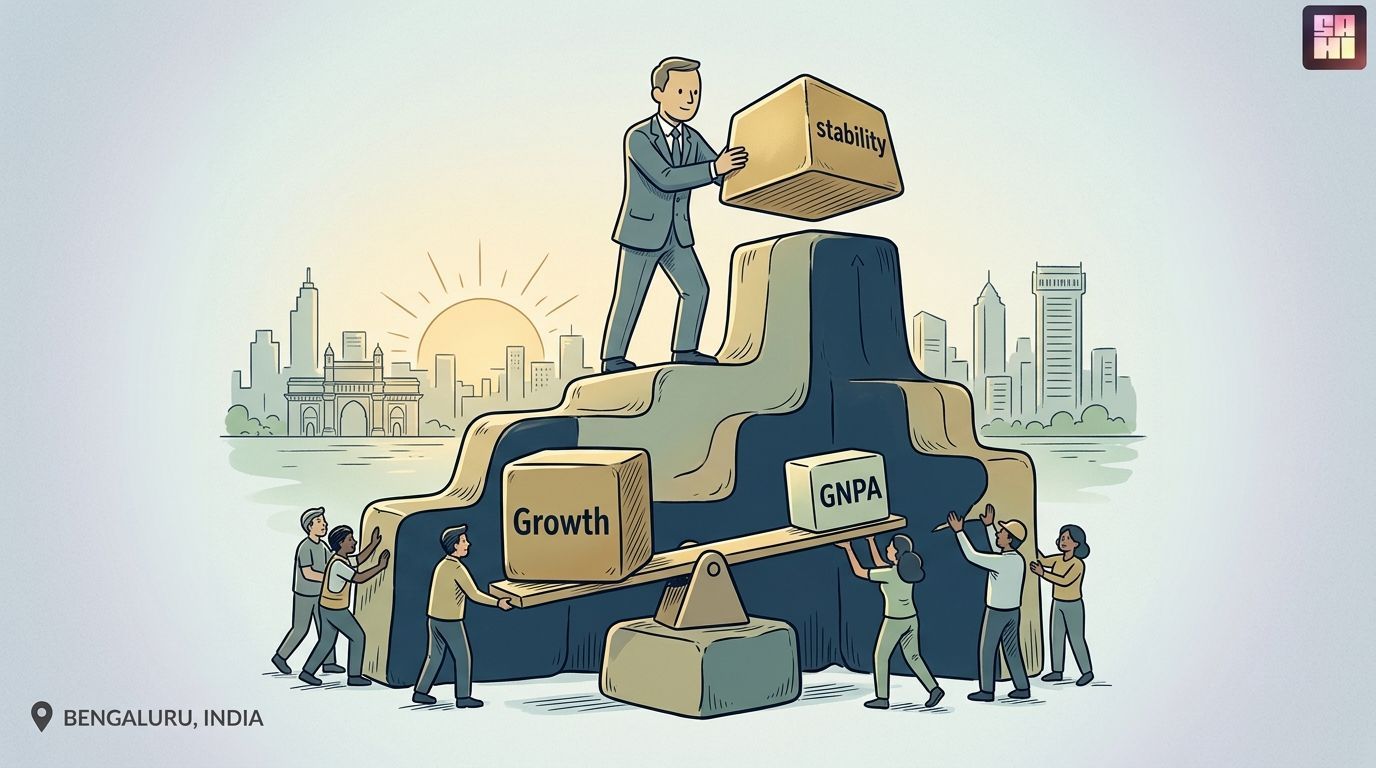
Market snapshot: The Reserve Bank of India (RBI) has released its latest assessment, confirming that India’s macroeconomic landscape remains robust. Supported by a 7.2% GDP growth projection and headline inflation aligning with the 4% target, the economy is anchored by healthy financial institutions and significant capital buffers. This stability is further reinforced by the lowest non-performing asset levels in over a decade.
Data Snapshot
- GDP Growth: Projected at 7.2% for FY27
- Gross NPA Ratio: Multi-year low of 2.8%
- Inflation (CPI): Trending towards the 4% medium-term target
- CRAR: Banks maintaining a healthy 16.8% capital ratio
- Forex Reserves: Maintained above $680 billion
What’s Changed
- Asset Quality Improvement: GNPA decreased from 3.9% last year to 2.8% currently.
- Buffer Expansion: RBI’s forex reserves and bank CRAR have reached new highs, providing a shield against global volatility.
- Policy Anchoring: Transition from an ‘inflation-watch’ to a ‘stability-maintenance’ phase as CPI converges to 4%.
Key Takeaways
- Financial stability is driven by improved balance sheets of Scheduled Commercial Banks (SCBs).
- Domestic consumption remains resilient despite global headwinds.
- The RBI’s dividend payout of ₹2.11 L crore has significantly bolstered the government’s fiscal headroom.
SAHI Perspective
The confluence of high growth and low credit risk creates a Goldilocks environment for Indian markets. The reduction in GNPA to 2.8% suggests that the credit cycle is at its healthiest in a decade, reducing the likelihood of systemic shocks and supporting long-term capital formation.
Market Implications
The positive macro data suggests a stable environment for BFSI and Infrastructure sectors. With inflation stabilizing, the yield curve is likely to flatten, providing a positive signal for long-term institutional investment and reducing the cost of capital for corporate expansion.
Trading Signals
Market Bias: Bullish
GDP growth at 7.2% and banking NPAs at 2.8% provide a strong fundamental floor for equity markets. Credit growth is expected to remain healthy at 13-15%.
Overweight: Banking, Infrastructure, Capital Goods
Underweight: Export-Oriented IT, Metals
Trigger Factors:
- Monetary Policy Committee (MPC) rate stance
- Quarterly GDP print vs 7.2% target
- Movement in global crude prices
Time Horizon: Medium-term (3-12 months)
Industry Context
The Indian banking sector has undergone a massive deleveraging phase, moving from twin-balance sheet problems to twin-balance sheet advantages. The RBI’s proactive supervision has ensured that financial intermediaries remain solvent even under severe stress tests.
Key Risks to Watch
- Geopolitical tensions impacting global supply chains.
- Unexpected spikes in international crude oil prices.
- Slower-than-expected recovery in rural demand.
Recent Developments
In May 2026, the RBI board approved the transfer of ₹2.11 L crore as surplus to the Central Government, a record dividend that eased fiscal deficit concerns. Additionally, the June 2026 MPC meeting maintained the Repo rate at 6.5%, citing a watchful eye on food inflation despite overall CPI cooling.
Closing Insight
India’s macroeconomic stability is no longer just a projection but a documented reality. As internal buffers reach record levels, the economy is well-positioned to navigate external uncertainties while maintaining a growth leadership position globally.
FAQs
What does a 2.8% GNPA ratio mean for the banking sector?
A Gross Non-Performing Asset (GNPA) ratio of 2.8% indicates that the quality of bank loans is at its best in ten years, reducing the need for high provisioning and allowing banks to increase lending for productive sectors.
How do higher forex buffers impact the Indian Rupee?
Forex reserves exceeding $680 billion allow the RBI to intervene effectively in currency markets to curb volatility. This stability makes the Rupee more attractive for foreign institutional investors (FIIs) and lowers the risk of ‘imported’ inflation.
What does this report mean for a regular retail borrower?
The RBI’s focus on stability and 4% inflation suggests that interest rates may remain stable or eventually decrease, potentially lowering the cost of home and auto loans in the medium term as the economy remains resilient.
High Performance Trading with SAHI.