
Key Messages
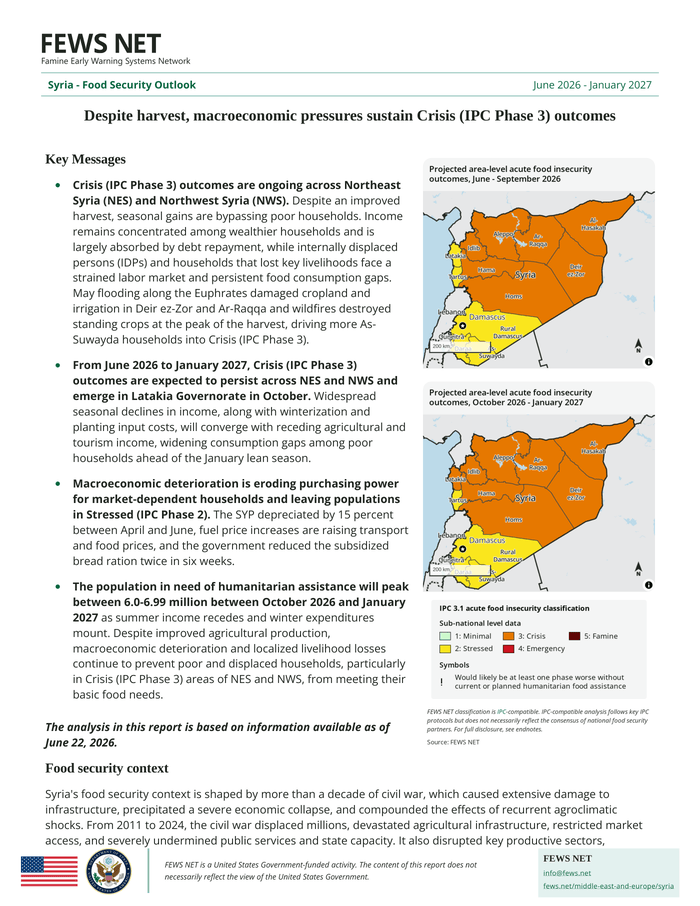
- Crisis (IPC Phase 3) outcomes are ongoing across Northeast Syria (NES) and Northwest Syria (NWS). Despite an improved harvest, seasonal gains are bypassing poor households. Income remains concentrated among wealthier households and is largely absorbed by debt repayment, while internally displaced persons (IDPs) and households that lost key livelihoods face a strained labor market and persistent food consumption gaps. May flooding along the Euphrates damaged cropland and irrigation in Deir ez-Zor and Ar-Raqqa and wildfires destroyed standing crops at the peak of the harvest, driving more As-Suwayda households into Crisis (IPC Phase 3).
- From June 2026 to January 2027, Crisis (IPC Phase 3) outcomes are expected to persist across NES and NWS and emerge in Latakia Governorate in October. Widespread seasonal declines in income, along with winterization and planting input costs, will converge with receding agricultural and tourism income, widening consumption gaps among poor households ahead of the January lean season.
- Macroeconomic deterioration is eroding purchasing power for market-dependent households and leaving populations in Stressed (IPC Phase 2). The SYP depreciated by 15 percent between April and June, fuel price increases are raising transport and food prices, and the government reduced the subsidized bread ration twice in six weeks.
- The population in need of humanitarian assistance will peak between 5.0-5.99 million between October 2026 and January 2027 as summer income recedes and winter expenditures mount. Despite improved agricultural production, macroeconomic deterioration and localized livelihood losses continue to prevent poor and displaced households, particularly in Crisis (IPC Phase 3) areas of NES and NWS, from meeting their basic food needs.
The analysis in this report is based on information available as of June 22, 2026.
Food security context
Syria’s food security context is shaped by more than a decade of civil war, which caused extensive damage to infrastructure, precipitated a severe economic collapse, and compounded the effects of recurrent agroclimatic shocks. From 2011 to 2024, the civil war displaced millions, devastated agricultural infrastructure, restricted market access, and severely undermined public services and state capacity. It also disrupted key productive sectors, including agriculture, oil production, and trade, leaving the economy fragile and eroding household purchasing power. The fall of the Al-Assad regime in December 2024 and the formation of a transitional government in March 2025 ushered in a period of transition, during which governance has fragmented across multiple authorities while localized violence involving multiple non-state armed groups (NSAGs) continues to trigger displacement. In NES — much of Al-Hasakah, Ar-Raqqa, and Deir ez-Zor — the Kurdish-led administration and its armed forces, the Syrian Democratic Forces (SDF), retain de facto control amid ongoing negotiations over integration with Damascus; NWS, comprising Idlib and northern Aleppo, Hama, and Homs, has been the primary destination for displaced populations, with Idlib and northern Aleppo hosting the country’s largest concentration of IDP camps and returnee movements; the coastal governorates of Latakia and Tartus have experienced episodes of sectarian violence targeting the Alawite community; and southern Syria remains contested among local armed factions, with periodic Israeli military operations.
Displacement remains a defining feature of Syria’s food security context. Although 2.04 million IDPs have returned to their areas of origin since December 2024, more than 5.87 million people remain internally displaced, and 4.6 million Syrian refugees remain outside the country. IDP site populations in NWS have declined by approximately one third since February 2026 as camp residents depart — though many returning households arrive to damaged housing, contaminated land, and depleted productive assets that keep their food security situation closer to that of displaced households than of host communities. Most IDPs live outside formal camps, typically in host communities where access to basic public services, stable sources of income, and affordable food is limited. Displacement continues to disrupt agricultural production, labor markets, and social support systems, while Syria’s fragmented governance landscape and competing sub-national authorities create administrative barriers and operational constraints for food and nutrition assistance delivery.
Livelihoods vary across Syria’s diverse ecological and economic zones. Rural households rely primarily on crop and livestock production, seasonal agricultural labor, petty trade, remittances, and food assistance, while urban households depend mainly on wage labor, small trade, and limited formal employment (Annex 3). Markets supply the majority of food for both urban and rural populations, making household purchasing power a central determinant of food access. Other major expenditures include fuel, electricity, health care, housing, and transport. Agricultural labor demand typically peaks during planting and harvest periods, and livestock production depends on seasonal pasture availability between October and April. However, conflict-related damage to infrastructure, movement restrictions due to insecurity, drought, and high input costs have reduced cultivated area and limited agricultural labor opportunities in many areas. At the same time, the impacts of conflict, drought, and high fodder prices have constrained livestock production, forcing many herders to sell animals or exit the sector. The 2024/25 rainy season was among the driest in decades, with rainfall more than 50 percent below average, sharply reducing cereal output and pasture conditions in key rainfed wheat areas. These overlapping shocks continue to constrain agricultural activity, disrupt trade flows and market functioning, and weaken household income and purchasing power across many parts of the country.
Syria’s economy remains fragile in the post-Assad transitional period. Although some macroeconomic improvements occurred in 2025, including modest increases in remittance inflows and public-sector salaries and an easing of food inflation in localized areas, purchasing power remains constrained by persistently high prices for food, fuel, and other essential goods. Heavy reliance on imports, past years of currency depreciation, and weak domestic production continue to sustain elevated staple food prices. High fuel costs, transport constraints, liquidity shortages, and limited livelihood opportunities also restrict economic activity and income generation across much of the country. As a result, relative improvements in economic conditions are fragile and uneven, especially in drought‑affected or insecure regions.
Humanitarian food assistance has become an important component of household food access following years of conflict, displacement, and poor economic conditions. However, the scale, coverage, and consistency of assistance have varied over time due to operational constraints, funding availability, and access challenges associated with Syria’s fragmented governance landscape.