
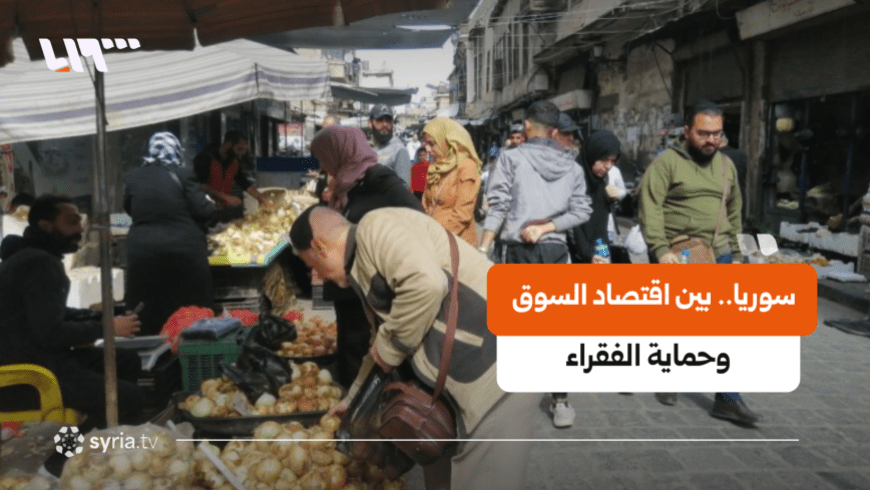
Syria is navigating a difficult post-conflict transition after the fall of the Assad regime. Beyond repairing the physical and financial devastation of war, the country faces a deeper structural challenge: redefining the state’s economic role and its relationship with citizens. As the government moves toward a more open, market-driven model with reduced state intervention, a central question has emerged over who will shoulder the costs of this shift, particularly amid widespread poverty and collapsing purchasing power.
These issues were the focus of a recent episode of Syria TV’s program Al-Muntada, featuring Jihad Yazigi, editor-in-chief of The Syria Report; Abdel Nasser Al-Jassem, professor of business administration; and Khaled Al-Hamdi, an expert in economic planning. Their discussion examined the future of government subsidies, the evolving role of the state, and the policies needed to protect Syrians during this critical transitional phase.
From a Socialist-Leaning System to a Market Economy
Yazigi cautioned against framing Syria’s current trajectory as a sudden shift from socialism to free-market capitalism. He noted that long before 2011, Syria had already begun liberalizing its economy, with the private sector accounting for roughly seventy percent of GDP and operating private banks, insurance companies, and distribution networks.
What is unfolding today, he argued, is the dismantling of the remaining pillars of social welfare and public services. He warned that withdrawing support in a society marked by severe poverty risks triggering social unrest, especially as fuel and basic commodity prices continue to surge.
Al-Hamdi offered a different emphasis, arguing that the Syrian state is operating under extraordinary circumstances and attempting to build a new economic model rooted in investment, production, and expanded global economic ties. Yet he stressed that structural reforms must not come at the expense of essential services or leave the most vulnerable segments of society exposed.
Balancing Fiscal Sustainability and Social Protection
The future of subsidies formed the heart of the debate. While all three guests agreed that blanket subsidies impose an unsustainable burden on public finances, they differed on how to redesign them.
Al-Hamdi argued that subsidies should be understood not as an economic objective but as a tool to preserve purchasing power and social stability. He called for “smart subsidies” that precisely target vulnerable households and, where appropriate, link certain forms of assistance to employment for those able to work.
Al-Jassem agreed that reform does not mean elimination. Instead, he said, subsidies must be redesigned to ensure support reaches those who genuinely qualify. He warned that raising prices without raising real incomes will erode living standards. Social protection, he insisted, must cover low-income families, children, the elderly, and impoverished regions, supported by strict mechanisms to prevent nepotism and corruption.
Healthcare, Education, and Food Security as Red Lines
The participants concurred that a transition toward a market economy should not subject all essential public services to the forces of supply and demand.
Al-Hamdi stressed that education, healthcare, food security, and core infrastructure must remain insulated from full market exposure. Al-Jassem added that the state’s responsibilities during the transition extend beyond market regulation: it must guarantee basic energy, electricity, and water supplies, rebuild institutional frameworks, and implement sound fiscal and monetary policies that support reconstruction.
They agreed that the success of reform cannot be measured solely by deficit reduction. Citizens must feel that the burdens of reform are shared fairly and that savings from subsidy cuts are reinvested into public services, social safety nets, or high-impact development programs.
Evaluating Alternatives to Price Hikes
Al-Jassem criticized recent economic decision-making, arguing that raising fuel prices was not the only option available to the government. Effective management, he said, requires evaluating multiple alternatives and selecting the path that delivers the highest return at the lowest social cost.
He proposed domestic or external borrowing as one possible alternative, arguing that borrowing should not be dismissed outright but assessed according to its terms, costs, and expected returns. Al-Hamdi countered that external borrowing often comes with political conditions, prompting the government to favor solutions within its existing means, such as attracting foreign investment and activating the private sector.
Data Deficits: The Main Obstacle to “Smart Subsidies”
A major obstacle to any new subsidy system is the lack of accurate, up-to-date data on households, income levels, and poverty distribution.
Al-Hamdi proposed establishing a unified social registry linked to national identification numbers to accurately identify eligible families and facilitate a gradual shift from in-kind support to direct cash transfers. He also suggested creating a post-reform recovery fund tied to measurable performance indicators reviewed periodically. The experts agreed that successful implementation requires strong administrative capacity and oversight mechanisms to prevent corruption and exclusion.
Trade, Production, and Public Administration
Yazigi criticized trade policies that encourage consumption and imports at the expense of domestic production. He pointed to rising Syrian imports from Turkey and declining exports, warning of negative consequences for local industry, the trade balance, exchange rates, inflation, and employment—particularly in the textile sector, a major source of jobs.
Al-Jassem argued that economic reform must be accompanied by a comprehensive overhaul of public administration. He cited persistent bureaucratic inefficiencies and conflicts of interest, asserting that administrative reform is essential for effective decision-making and service delivery. He also emphasized the need to involve stakeholders—experts, labor unions, consumer representatives, and affected sectors—in the policy-making process.
Toward a Productive Social Economy
In closing, Al-Hamdi outlined a vision that combines the state’s duty to protect essential services with the private sector’s role as a driver of investment, employment, and production. He said a successful transition depends on three interdependent pillars: economic efficiency, social justice, and restoring public trust between citizens and the state.
Ultimately, Syria’s central question is no longer simply the degree of state intervention in the market, but the nature of that intervention, the populations it prioritizes, and the fair distribution of the costs and benefits of reform. As Syria pursues a more open economic model, its greatest challenge lies in building institutions capable of balancing investment, production, and financial stability with the state’s enduring obligation to protect its most vulnerable citizens.
This article was translated and edited by The Syrian Observer. The Syrian Observer has not verified the content of this story. Responsibility for the information and views set out in this article lies entirely with the author.