
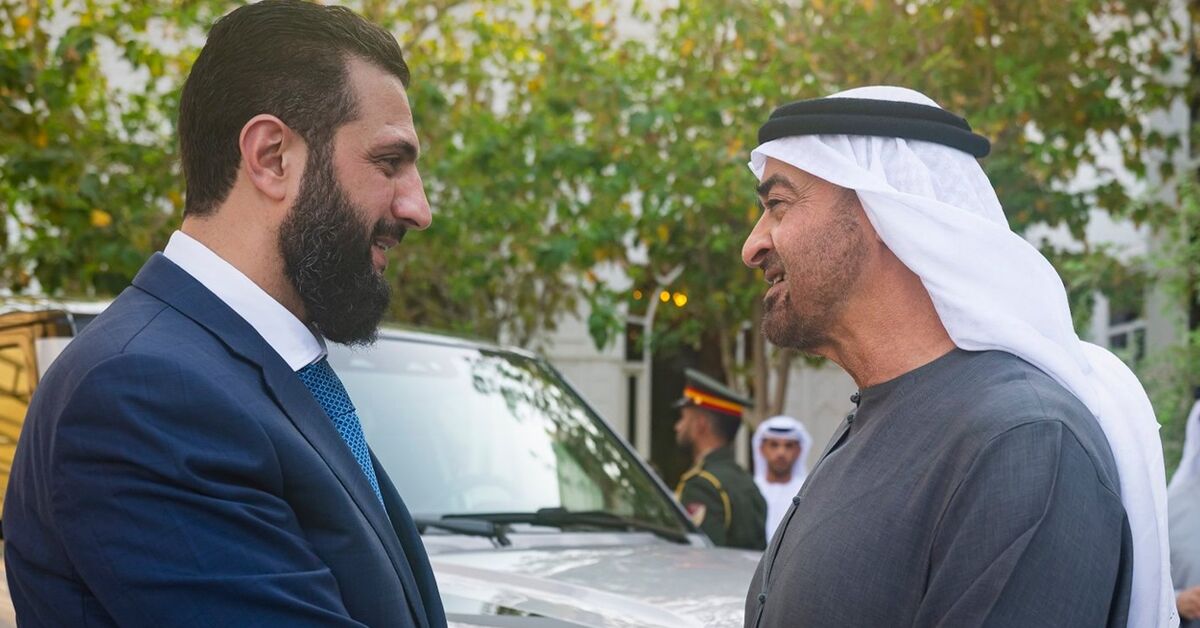
Syrian President Ahmed al-Sharaa and United Arab Emirates President Sheikh Mohammed bin Zayed discussed ways to boost economic ties on the sidelines of a summit in Dubai on Tuesday, marking the latest sign of improved relations between the two.
What happened: The conversation between Sharaa and Sheikh Mohammed focused on efforts to strengthen bilateral relations, “particularly in the economic and development fields.” They additionally discussed regional and international issues, according to readouts from both countries.
الرئيس أحمد الشرع يلتقي رئيس دولة الإمارات العربية المتحدة الشيخ محمد بن زايد آل نهيان، بحضور وزير الخارجية والمغتربين أسعد حسن الشيباني، ونائب رئيس مجلس الوزراء وزير الخارجية الإماراتي الشيخ عبد الله بن زايد آل نهيان، وذلك في العاصمة الإماراتية أبوظبي.
وبحث الجانبان العلاقات… pic.twitter.com/Fyj1sUaeok
— الوكالة العربية السورية للأنباء – سانا (@Sana__gov) September 15, 2026
Sharaa was in Dubai to attend the annual Arab Media Summit, which brings together political and media figures. In his speech, Sharaa touted Syria as a “secure trade corridor linking East and West” amid the regional upheaval. He said Syria aims for its economy to be valued at $50 billion at the end of the year, up from $32 billion last year and $20 billion at the end of the civil war in late 2024, the official Syrian news outlet SANA reported.
Earlier on Tuesday, Sharaa met with Dubai ruler and UAE Prime Minister Sheikh Mohammed bin Rashid.
Why it matters: UAE-Syria ties are progressing steadily, marked by Emirati interest in the country’s transportation and energy potential, as well as Damascus’ desire to court foreign investment as it rebuilds after years of war.
In late August, the UAE-based developer Arada signed a deal to develop a $7 billion mixed-use project in Damascus. In June, Syrian and Emirati officials met in Damascus to discuss a corridor linking Syria’s Mediterranean ports with Iraq’s Umm Qasr and the UAE’s Khalifa Port, among other projects. The first Syria-UAE investment forum was held in May.
The UAE is particularly interested in Syria’s potential as a trade corridor amid the crises in the Strait of Hormuz and the Red Sea. Syria’s position on the eastern Mediterranean and proximity to Iraq make it a potential gateway for energy exports to Europe, and the country began receiving Iraqi oil destined for foreign customers via trucks earlier this year.
Maritime traffic in the Strait of Hormuz has dwindled due to the conflict between the United States and Iran over the waterway, and the Houthi rebels seized the entirety of Yemen’s Red Sea coastline last week.
Syria nonetheless faces challenges in its efforts to become a transportation hub, and lacks an effective pipeline network. Stability in the country has improved since the end of the civil war in late 2024, but clashes between government forces and local Druze militias in the south are ongoing, among other issues.
The UAE initially moved cautiously on Syria after Sharaa came to power in late 2024, consistent with Abu Dhabi’s opposition to political Islam. Sharaa commanded the jihadist group Hayat Tahrir al-Sham during the civil war against former President Bashar al-Assad’s forces. The UAE had been instrumental in readmitting Assad’s Syria into the Arab League in 2023.
The UAE’s transportation plans in Syria were underway before the start of the US-Israel-Iran war in February. The Emirati logistics giant DP World said in November that its port in Syria’s Tartous had commenced operations. DP World announced an $800 million investment in Syria earlier that year.
UAE Minister of State for Foreign Trade Thani Al Zeyoudi said at the May investment forum that non-oil trade between the UAE and Syria reached a record $1.4 billion in 2025, up 132% from the year prior.
AL-MONITOR All-Access gives you unlimited access to all our journalism, the full Daily Briefing, exclusive interviews, premium newsletters, and live events — for less than $2/week.