
Key Takeaways
- The MRS measures the trade-off between two goods while keeping utility constant.
- It plays a key role in understanding consumer behavior in economics.
- A higher MRS indicates a greater willingness to substitute one good for another.
- The MRS is expressed as a ratio showing how much of one good is exchanged for another.
Understanding the Marginal Rate of Substitution (MRS)
The marginal rate of substitution (MRS) is the amount of one good that a consumer is willing to give up in exchange for a new good while maintaining the same level of utility. The MRS is used in indifference theory to analyze consumer behavior.
When someone is indifferent to substituting one item for another, their marginal utility for substitution is zero because they neither gain nor lose any satisfaction from the trade.
Madelyn Goodnight / Investopedia
Fast Fact
The marginal rate of substitution (MRS) represents how easy it is to replace one good with another and retain the same level of consumer satisfaction.
How to Calculate the Marginal Rate of Substitution (MRS)
The MRS formula is:
∣MRSxy∣=dxdy=MUyMUxwhere:x,y=two different goodsdxdy=derivative of y with respect to xMU=marginal utility of good x, y
What Does the Marginal Rate of Substitution (MRS) Tell You?
The MRS is a term used in economics that refers to the amount of one good that is substitutable for another and is used to analyze consumer behaviors for a variety of purposes. The MRS is calculated between two goods placed on an indifference curve, displaying a frontier of utility for each combination of “good X” and “good Y.” The slope of this curve represents quantities of good X and good Y that a consumer would be happy substituting for one another.
The MRS is a critical component for businesses to understand when analyzing consumption trends or for government entities to understand when setting public policy. Consider an example of a government wanting to analyze how offering electric vehicle incentives may spur more environmentally friendly purchases. Understanding how the MRS is impacted before and after a tax incentive can allow for the government to analyze the financial implications of the plan.
Marginal Rate of Substitution (MRS) and the Indifference Curve
The slope of the indifference curve is critical to the MRS analysis. The MRS is the slope of the indifference curve at any single point along the curve. The slope will often be different as one moves along an indifference curve.
Most indifference curves are usually convex because, as you consume more of one good, you will consume less of the other. Indifference curves can be straight lines if a slope is constant, resulting in an indifference curve represented by a downward-sloping straight line.
If the MRS is increasing, then the indifference curve will be concave to the origin. This is typically not common since it means a consumer would consume more of X for the increased consumption of Y (and vice versa). Usually, marginal substitution is diminishing, meaning a consumer chooses the substitute in place of another good, rather than simultaneously consuming more.
Important
The law of diminishing marginal rates of substitution states that the MRS decreases as one moves down a standard convex-shaped curve, which is the indifference curve.
Example of the Marginal Rate of Substitution (MRS)
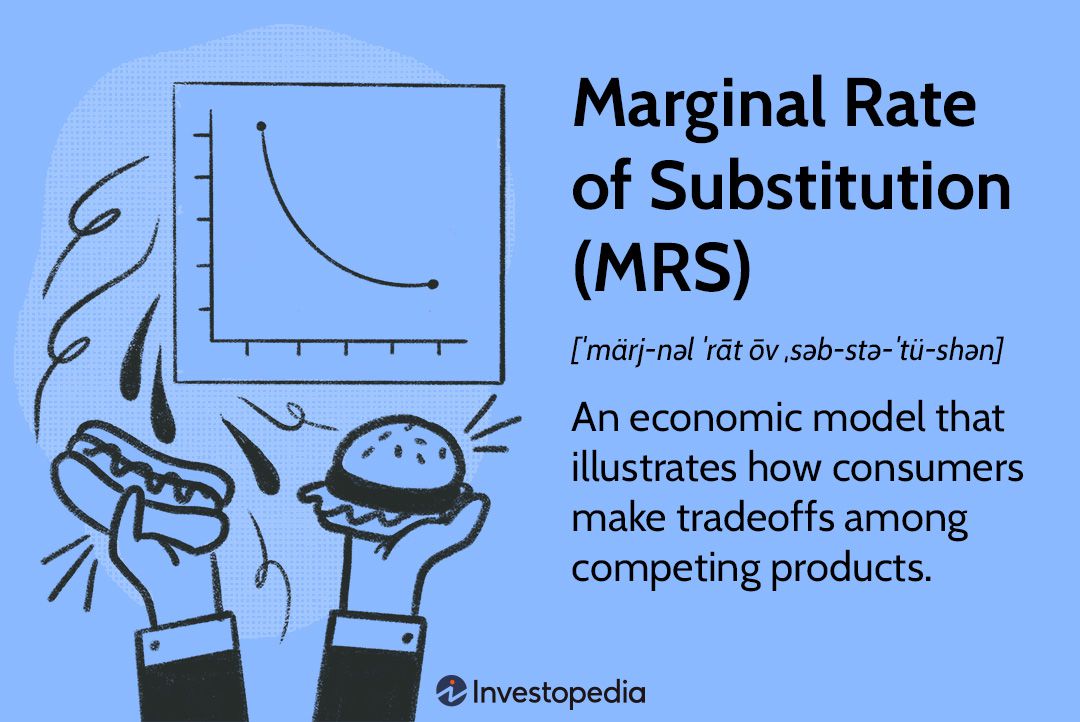
For example, a consumer must choose between hamburgers and hot dogs. To determine the MRS, the consumer is asked what combinations of hamburgers and hot dogs provide the same level of satisfaction.
When these combinations are graphed, the slope of the resulting line is negative. This means that the consumer faces a diminishing MRS: The more hamburgers they have relative to hot dogs, the fewer hot dogs they are willing to consume. If the MRS of hamburgers for hot dogs is -2, then the individual would be willing to give up two hot dogs for every additional hamburger consumption.
Julie Bang / Investopedia
Limitations of the Marginal Rate of Substitution (MRS)
The MRS has a few limitations. The main drawback is that it does not examine a combination of goods that a consumer would prefer more or less than another combination. This generally limits the analysis of the MRS to two variables. As this is most often graphically depicted using only x and y variables, other variables that may still factor consumption may not be appropriately considered.
The MRS does not necessarily examine marginal utility since it treats the utility of both comparable goods equally, though in actuality, they may have varying utility. In the example above, consider how the utility of a hamburger (with its potential lettuce, onion, or other vegetable dressings) may vary from that of a plain hot dog.
Fast Fact
If the slope of the indifference curve is -1, then the goods are perfect substitutes: Consumers will happily consume one instead of the other, with the same level of satisfaction.
Marginal Rate of Substitution (MRS) vs. Marginal Rate of Transformation (MRT)
The MRS is tied to the marginal rate of transformation (MRT). Whereas the MRS focuses on the consumer demand side, the MRT focuses on the manufacturing production side.
Often, the two concepts are intertwined and drive each other. For example, consider a global shortage of flour. A manufacturer may be more inclined to bake fewer cakes and more bread, as bread is a more efficient product to make based on material constraints.
As a result, consumers may find that the cake shortages result in much higher prices, resulting in a stronger MRS between cake and bread due to the lower costs of the overproduced item. On the other hand, if consumers don’t prove to have any reason to substitute bread for cake, a manufacturer may be handcuffed into producing a less-efficient good to meet market demand.
Simplified Explanation of the Marginal Rate of Substitution (MRS)
The marginal rate of substitution (MRS) measures how easy it is to replace a good with an alternative, without reducing consumer satisfaction. When consumers choose between Coca-Cola and Pepsi, or between chicken and beef, they are performing a mental calculation to decide how much of one good it takes to make an acceptable substitute for the other.
An indifference curve is a chart that shows all the different combinations of two goods that provide the same level of consumer satisfaction. The MRS is the slope of the indifference curve. When the slope is very high (or low), it takes a large quantity of one good to make an acceptable substitute for the other. If the slope is exactly -1, then the goods are perfect substitutes: A unit of one good provides the same satisfaction as a unit of the other good.
What Is the Relationship Between the Indifference Curve and the Marginal Rate of Substitution (MRS)?
Essentially, the MRS is the slope of the indifference curve at any single point along the curve. Most indifference curves are usually convex, because as you consume more of one good, you will consume less of the other. So, the MRS will decrease as one moves down the indifference curve.
This is known as the law of diminishing marginal rate of substitution. If the MRS is increasing, then the indifference curve will be concave, which means that a consumer would consume more of X for the increased consumption of Y and vice versa. However, this is not common.
What Are Drawbacks of the Marginal Rate of Substitution (MRS)?
The MRS has a few limitations. The main drawback is that it does not examine a combination of goods that a consumer would prefer more or less than another combination. This generally limits the analysis of the MRS to two variables. Also, the MRS does not necessarily examine marginal utility because it treats the utility of both comparable goods equally, though in actuality, they may have varying utility.
What Is Indifference Curve Analysis?
Indifference curve analysis operates on a simple two-dimensional graph. Each axis represents one type of economic good. The consumer is indifferent between any of the combinations of goods represented by points on the indifference curve, because these combinations provide the same level of utility to the consumer. Indifference curves are heuristic devices used in contemporary microeconomics to demonstrate consumer preference and the limitations of a budget.
The Bottom Line
For economic and financial planning reasons, businesses must understand how consumers may substitute one good for another. This concept, called the marginal rate of substitution (MRS), measures the relationship between two products and how willing a consumer is to buy one instead of the other. This information is useful in setting manufacturing levels or gauging public policy.