
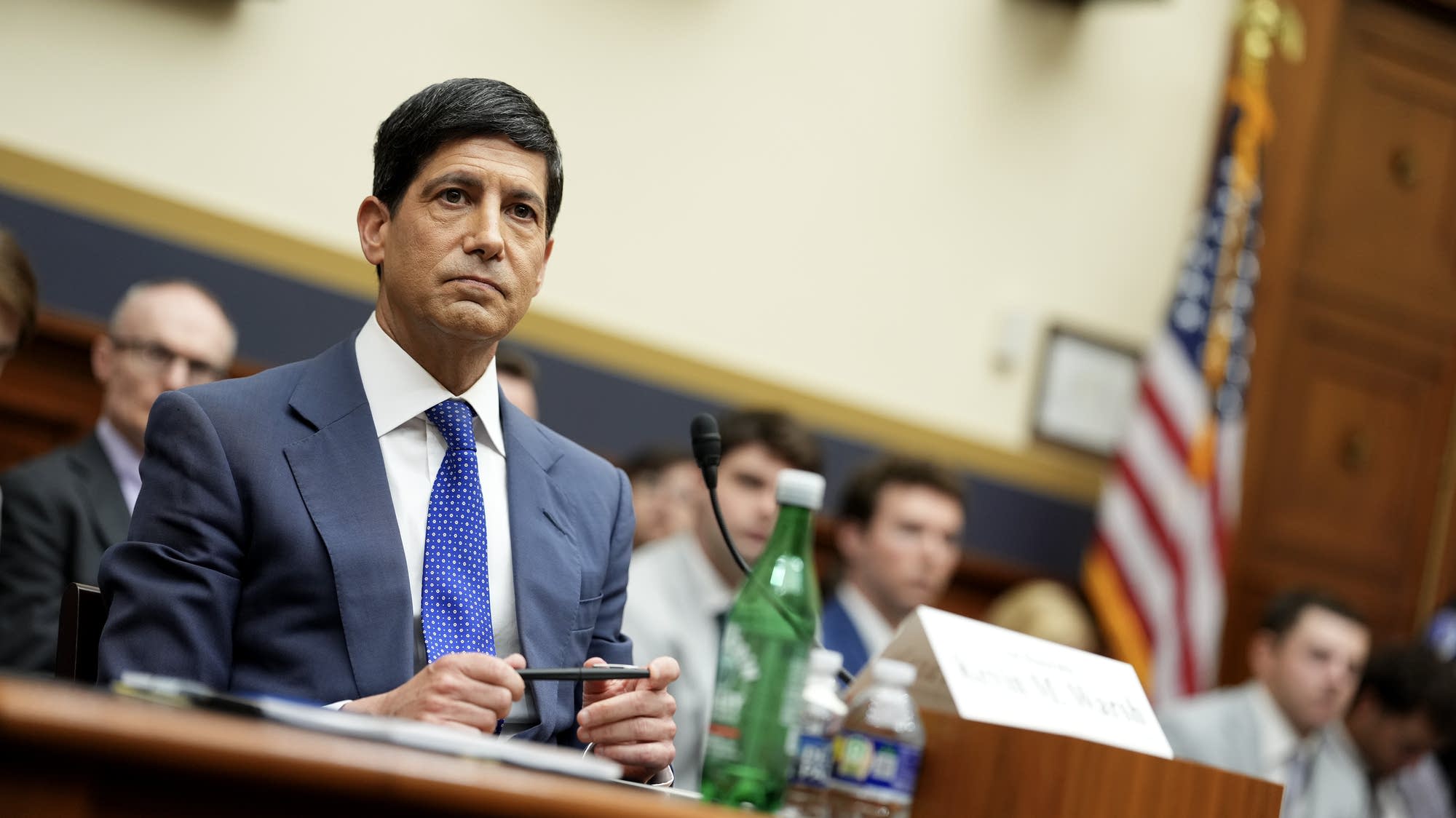
The Federal Open Market Committee meets this week to decide whether to adjust interest rates. Fed watchers expect the central bank will hold rates steady, and that Federal Reserve Chairman Kevin Warsh will be a lot less loquacious than his predecessor.
The Fed delivered a much shorter statement after Warsh’s first meeting in June, and Warsh said he’s scrapped what’s known as forward guidance — a brief summary of where members of the Fed’s leadership think rates are likely headed.
Still, even if the Fed stays mum on rate projections, analysts certainly have forward guidance of their own.
For example, markets are thinking the Fed will hike rates at its next meeting, in September, said Randy Vogel, head of fixed income at Wilmington Trust.
“If the Fed sees that inflation data moving higher instead of lower, then the probability that they take action in September, I think is pretty high,” he said.
At the Fed’s last meeting, Chair Warsh made it clear that keeping inflation contained is his primary objective. “He put much more focus on inflation than the labor market,” Vogel said.
But, Vogel said, the Fed could also hold rates steady in September.
Winnie Cisar, global head of strategy at CreditSights, doesn’t expect the Fed to hike rates until at least early next year. There’s just too much uncertainty about the economy right now.
“So long as we have the Middle East conflict going on, new rounds of tariffs, AI disruption, especially as it relates to the labor market, it makes it really difficult to get a clear picture of what appropriate policy should be,” she said.
If the war in the Middle East settles down by next year, Cisar said inflation could cool off.
“And that is really what’s going to determine the path of energy prices, and then de facto, the path of inflation,” she said.
There are plenty of other factors that could bring down inflation, according to Bernard Yaros, lead U.S. economist at Oxford Economics.
“A labor market that’s not overheating, that’s not a source of inflation. Weak inflation on the housing side, so a lot of rent, shelter prices remain relatively subdued,” he said.
Yaros expects the Fed to hold rates steady until September of 2027. He said even if oil prices remain high, or go even higher, consumers might cut back.
“Because you don’t have those tax refunds going out the door, you have already a very low savings rate. Consumers would just be in a tougher position,” Yaros said.
If consumers pull back, the economy would slow down. And the central bank might go from holding rates steady to cutting them.