
DSP Mutual Fund has recently released ‘Thodi Meherbaniyan’, a five-part documentary series featuring people and communities for whom caring for animals or people has quietly become a part of everyday life.
These stories span different forms of kindness – from caring for animals and supporting people who may need companionship, to communities coming together to solve problems around them. The first episode features Deepa Talib, founder of the Anubis-Tiger Foundation. Her work with abandoned breed dogs began after the loss of a street dog she had tried, but was unable, to save.
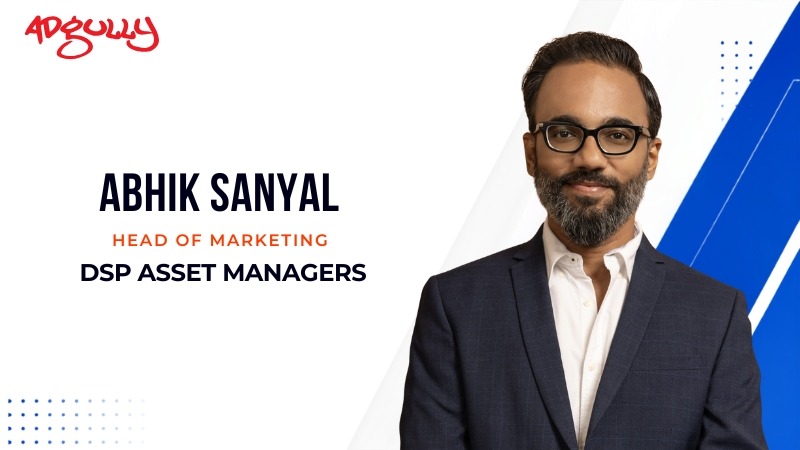
In conversation with Adgully, Abhik Sanyal, Head of Marketing, DSP Asset Managers, shares additional insights regarding the idea of these films and a lot more.
Mutual fund communications typically revolve around financial planning, wealth creation, or market cycles. What inspired DSP Mutual Fund to step completely outside traditional financial narratives and champion a documentary series centered on grassroots empathy and kindness?
I don’t really see it as stepping away from who we are. Our core work will always be about investing, investor behaviour, products and helping people make better financial decisions. That is where almost all our time and resources continue to go. But I also believe a brand like ours cannot only be functional if it wants to be remembered meaningfully.
DSP has been associated with wildlife and environment conservation for decades, and we have supported causes around education, adolescent and women empowerment, health, mental wellness and more over the years.
Works like ‘The Immortals’ and ‘Garuda Rakshak’ earlier, and now ‘Thodi Meherbaniyan’, allows us to explore something more human in that broader space.
We wanted to find people for whom kindness had quietly become part of everyday life and simply let their stories be seen. DSP’s role in this kindness space is deliberately to enable the storytelling and then step back.

From an individual adopting 17 rescued cats to a community organizing medical care via WhatsApp, the series covers diverse forms of kindness. What were the key criteria your team used to select these specific stories and ensure they felt authentic rather than overly dramatized?
These had to be stories of normal, everyday individuals who simply chose kindness daily. We were not looking for people doing something dramatic for social media, or for stories we could manufacture into an emotional arc.
We wanted people who had been doing these things consistently, long before anyone was paying attention to them – whether spending time at old-age homes, helping people in need in their own way, feeding street animals, making room for rescues or solving problems in their communities.
We also wanted a range of stories, because kindness can take many forms. Therefore, some of our stories are about animals, some about people, others about community.
And then, during production, we just wanted the stories to be largely unscripted and let the protagonists speak naturally, unprepared. That was really it.
The initiative brings together content producer Ruminator Studios, creator-advocate Aditya Saran as host, and musician Kanishk Seth for an original soundtrack. How did you approach assembling this creative team to ensure the message resonated across both video and audio platforms?
The starting point for us was simply: who can help us preserve the honesty of these stories?
Given our earlier experience on ‘The Immortals’, the conversation with Ruminator Studios was a natural one. Kuber Sarup, who led the work from Ruminator on this project, really understood the pulse of what we were trying to do and helped us preserve that observed, unobtrusive quality beautifully.
Aditya Saran was a natural fit because he has both a creator’s ease on camera and a genuine connection with animal welfare, and some of us have followed him for years.
Kuber then helped us connect with Kanishk Seth, who created a song that genuinely has a life of its own rather than feeling like a conventional brand anthem or jingle.
The stories came first. The song grew out of the emotions running through them, almost completely unplanned. In fact, we did not start by saying we needed a song or music video; that part of the project unfolded organically.
Hopefully, the documentaries do what we wanted them to do in the first place, and inspire a few more acts of kindness around us.

By releasing the documentary series on the Stories For Good YouTube channel alongside a multi-platform music release on Spotify and Apple Music, what specific audience demographics are you targeting, and how does this multi-channel approach fit into your broader content ecosystem?
We started this project with all heart, not with a narrow demographic definition, because kindness cuts across pretty much any cohort one can think of.
We feel it can travel across age groups, geographies, genders, socioeconomic groups and psychographics. A young person may discover the music first, someone else may connect with a particular documentary story, while another person may encounter a short video on social media.
That is why the different formats matter. Our Stories For Good YouTube channel is where the fuller human stories, presented by DSP Mutual Fund, can live. The song gives the project another route into people’s lives through streaming platforms, in a simple but meaningful way. Shorter social content can help people discover individual moments and then find their way to the longer films.
So, rather than using multiple channels simply to maximise reach, we are allowing people to encounter the same underlying idea in the form that feels most natural to them. We would do the same for investment content too – horses for courses.
Is ‘Thodi Meherbaniyan’ a one-off campaign, or does it signal a broader, long-term shift toward building a dedicated platform for socially conscious storytelling under the Stories For Good umbrella?
‘Thodi Meherbaniyan’ should not be seen as some dramatic shift in DSP’s content or marketing strategy. Our core focus remains exactly where it should be: behaviour that unlocks good outcomes, investors, products, distribution and growth.
What we are trying to do with this project is build a deeper emotional relationship with people.
We already have our Stories For Good YouTube channel as a home for human stories, and over time we would like to keep discovering and supporting work that feels genuine enough to belong there. But the bar should remain high, even when the content is investment-related. We would rather do fewer stories with real emotional truth than turn ourselves into an average content factory.
For me, the principle is simple: if there is an investing, behavioural or human story worth sharing, and DSP can help more people see it without making itself the hero, that is worth exploring.