

Call it the “Groundhog Day” dynamic. Recovery deferred … again.
A year ago at this time, the private equity industry was poised for an upturn that never really took hold. Early-year optimism was dashed by tariff turmoil—just the latest in a long line of market dislocations dating back to the Covid-19 pandemic.
This year: more of the same. Coming into 2026, the buyout market had largely shaken off tariff concerns, and dealmaking was on the rise. But then three more shocks arrived in rapid succession: the AI-driven “SaaSpocalypse” in software, redemption stress in private credit, and the war in Iran with its attendant spike in oil prices.
The reduction in dealmaking has been sharp and wide-ranging (see Figure 1). Amid the new bout of uncertainty, bid-ask spreads have widened, investment committees have pulled back, and exit momentum has stalled out. Select transactions continue to clear—and at high prices—but mostly those involving A-plus assets.
Notes: Excludes add-ons, special-purpose acquisition companies, loan-to-own transactions, and acquisitions of bankrupt assets; based on announcement date; includes announced deals that are completed or pending, with data subject to change; deal value includes deals with disclosed value only and includes net debt where relevant; deal count includes deals with disclosed and undisclosed value; geography based on target’s location; Q2 2026 deal value and deal count estimated based on data through May 18
Source: Dealogic
Most frustrating is that there’s nothing fundamentally broken in the financial markets. Public equities, pumped up by (sometimes tentative) AI euphoria, continue to defy gravity. SpaceX, OpenAI, and Anthropic are lining up for trillion-dollar initial public offerings. The global economy remains in expansion mode, and there’s ample dry powder to do deals. The debt markets are open and functioning, despite the private credit jitters.
So, where does that leave private equity? Given the growing pressure to buy and sell companies, it wouldn’t take much to unlock a wave of new dealmaking in the year’s second half. But a truly sustained upturn in activity will likely depend on the market finding an equilibrium that lasts more than a quarter or two. There’s no question the fog will lift eventually—it always does. In the meantime, though, the general partners (GPs) positioning themselves to lead out of the slump are focusing on what they can control now, not what they can’t.
That starts with recognizing that private equity has entered a much more difficult and competitive era—one defined by higher interest rates, stubbornly high asset prices, and less of the multiple expansion that powered so many deals in the past. Generating consistent outperformance in the years ahead is going to require ever sharper strategic clarity and the value-creation system to back it up. It will also mean accelerating distributions to limited partners (LPs) by taking practical steps to boost exit momentum.
The firms best placed in today’s environment are concentrating scarce resources where they have a differentiated right to win. They’re building repeatable models for underwriting and value creation—both operational and strategic. They’re leaning hard into AI, not just as a risk to manage or a cost-cutting tool but also as a means to develop new products, create new revenue opportunities, and sharpen decision making at the firm level. With holding periods stretched, firm resources constrained, and disruption a constant, the premium is on specialization, operational capability, talent, and execution discipline. The hard work done in market troughs to develop these competitive attributes is often what determines who leads in the next cycle.
Here’s a look at how the first half unfolded.
Investments
The net impact of the early-year market dislocations is that investment activity has slowed overall for buyouts, but unevenly across sectors. The industry’s overhang of dry powder means GPs must continue to hunt for deals where they can find them. Yet there are “green zones” where conviction still exists and “red zones” where uncertainty is highest.
Technology falls somewhere in between. Uncertainty about what companies are worth today has caused tech deal value to drop 70% from the fourth quarter of 2025 to the first quarter of 2026, with fewer large software deals getting done (see Figure 2). Dealmaking didn’t come to a halt by any means—transactions like EQT’s acquisition of Adevinta’s Spanish business and Francisco Partners’ buyout of Jamf found their way to completion. But February’s nearly 30% drop in public market software valuations (and subsequent partial recovery) signaled the degree to which uncertainty around AI’s impacts is unnerving investors and clouding future prospects.
Notes: Excludes add-ons, special-purpose acquisition companies, loan-to-own transactions, and acquisitions of bankrupt assets; based on announcement date; includes announced deals that are completed or pending, with data subject to change; deal value includes deals with disclosed value only and includes net debt where relevant; Q2 2026 includes deals announced prior to May 18
Source: Dealogic
The first real look at how that uncertainty translated into private company valuations comes from a proprietary MSCI analysis of first-quarter buyout marks. Through the end of March, software valuations in private equity portfolios declined roughly 8% overall—far less than the public market correction but still meaningful. The decline was notably more muted in Europe, where software marks fell just 4.2% vs. 8.9% in the US (see Figure 3). Both the MSCI and public company data also point to a wide dispersion of outcomes beneath the surface.
Notes: Global and US calculated in US dollars, Europe in euros; changes in marks are capital weighted
Source: MSCI Private Capital Solutions
Tech-focused GPs are clearly adjusting to a new reality and transforming how they diligence assets and underwrite both risk and revenue opportunity in an AI-inflected world. The question is, have they learned enough about AI’s disruptive potential—both good and bad—to safeguard their portfolios and comfortably underwrite new investments? Tech funds that raised money with a mandate to invest in software have to get more confident in assessing the risks and opportunities AI presents for software assets. So, the race is on to learn what you can from current investments and successfully apply that knowledge to future ones, especially companies trading at a discount to where they were when the SaaS panic hit in February.
Other firms, meanwhile, are rotating both capital and investment resources toward businesses perceived as less exposed to near-term AI disruption and global volatility. Buyers showed greater interest in companies with physical or labor-intensive components that are less susceptible to automation, as well as those with domestically oriented revenue insulated from geopolitical disruption. In a market defined by uncertainty, underwriting confidence mattered more than sector labels.
Deals are arguably as expensive today as at any other point in the industry’s history. While entry multiples have occasionally been higher in the past, and interest rates have certainly been higher, the two have never been as elevated simultaneously as they’ve been recently (see Figure 4). This “deal cost index”—combining purchase multiples and financing costs—is in record territory, which dramatically underscores the imperative to generate operational value creation and earnings growth. Investors need conviction not only around the risks they are taking but also around the long-term value and exit potential of the businesses they are buying.
Notes: TEV is total enterprise value; deal cost index is loan yield multiplied by median TEV/EBITDA; US large corporate defined as LBOs with more than $50 million in EBITDA; median TEV/EBITDA multiple includes fully, partially, and not realized deals and all equity check sizes; data as of Q3 2025
Sources: PitchBook, a Morningstar company; SPI by StepStone
A useful early signal on where dealmaking may be headed in the coming months comes from nondisclosure agreement (NDA) activity. Ontra, an AI workflow platform for private markets, has developed the first leading indicator for private equity deal activity from a proprietary NDA data set that is the largest in the industry. Historically, there has been a strong correlation between NDAs and deal closings roughly three months later. Looking ahead, the latest NDA data points to deal activity remaining essentially flat through July 2026—stable, but still far from a broad-based recovery (see Figure 5).
Note: Deal volume includes buyout, infrastructure, and real estate deals
Source: Ontra
Exits
Like investments, exit activity in the first quarter had yet to hit its stride. Despite year-end optimism, the industry has made little progress toward easing the liquidity crunch that has slowed down the capital cycle for years now (see Figure 6).
Notes: Includes partial and full exits; excludes special-purpose acquisition companies and bankruptcies; IPO value represents offer amount and not market value of company; data as of May 18, 2026; Q2 2026 exit value and exit count estimated based on data through May 18
Source: Dealogic
The numbers haven’t changed: The industry is coming off a four-year stretch of record-low distributions as a percentage of net asset value (NAV), and a growing number of companies are essentially trapped in portfolios. The implied capital cycle is now approximately seven years, which is well beyond historical norms (see Figure 7).
Source: MSCI Private Capital Solutions
Exits have been dragged down by the same market uncertainty that is plaguing investments. That’s not to say the market isn’t still clearing selectively. High-quality assets with strong strategic value continue to attract buyers, and a second tier of assets can still transact, but often only if sellers are willing to bend on valuations or pursue structured liquidity solutions like continuation vehicles. For the broader population of older or more challenged assets, however, skepticism around future performance and valuations remains too high for buyers to engage at proposed marks. Even continuation vehicles, once viewed as an increasingly reliable outlet for liquidity, are becoming harder to execute as LP scrutiny intensifies.
These dynamics leave many GPs reluctant to bring anything but their best-placed portfolio companies to market for fear of risking a failed process or a subpar return.
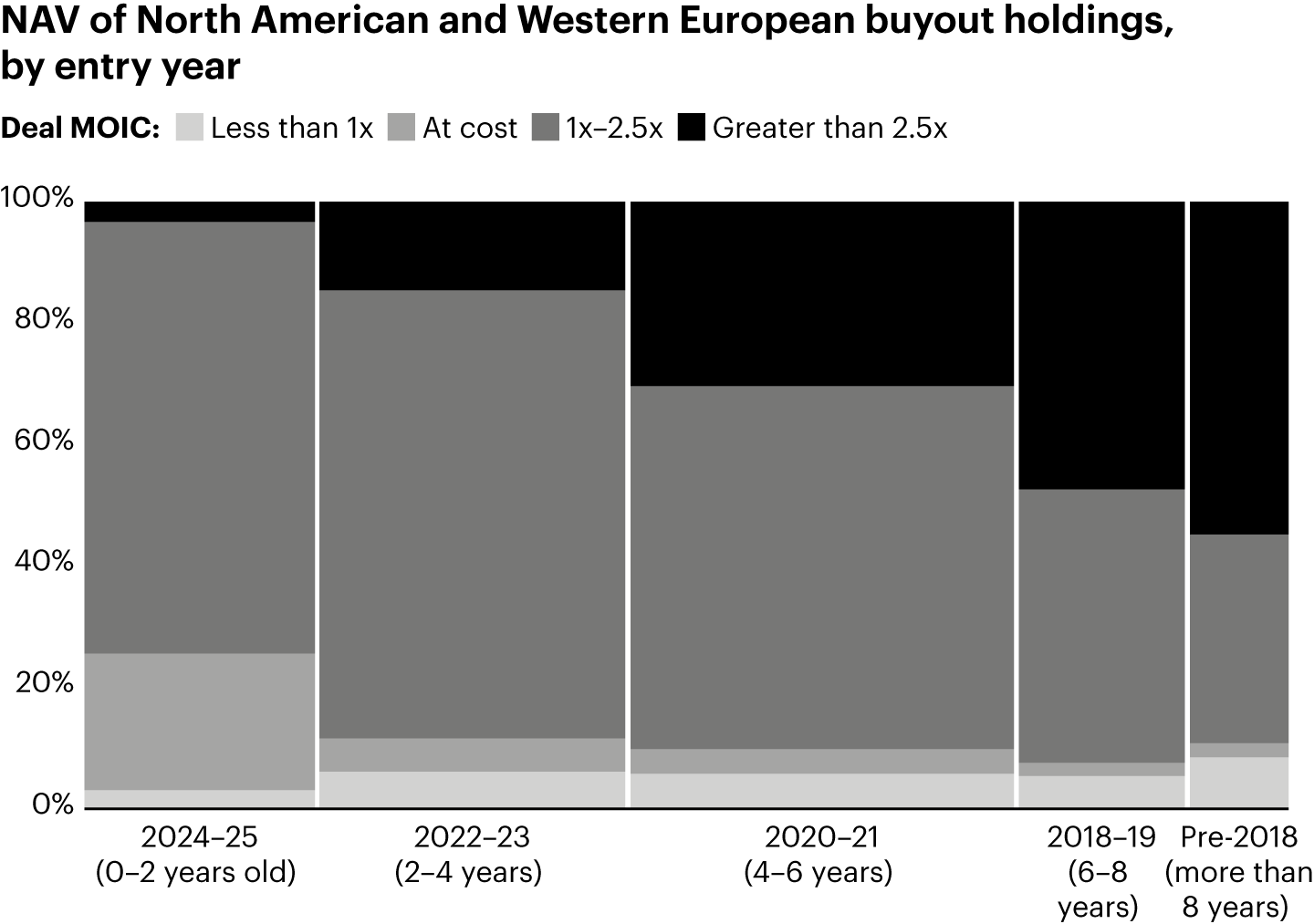
But that tends to erode LP confidence in stated valuations. A majority of assets sitting in buyout portfolios (both by count and value) were acquired in 2021 or earlier (see Figure 8). They were underwritten during or before the pandemic and have been through a gauntlet of market shocks—rising inflation, interest rate hikes, trade turmoil, and AI disruption. The longer they sit, the more LPs question whether their marks truly reflect intrinsic value.

Notes: MOIC is multiple on invested capital; at cost includes holdings with value of 1 ± 0.05x MOIC; data as of Q4 2025
Source: MSCI Private Capital Solutions
Growing tension around valuations exposes a structural dynamic within the GP-LP model that is self-reinforcing in times of stress. Large investors want cash back, but they have limited tolerance for markdowns. A recent ILPA poll showed that the majority of LPs start to lose confidence in a GP when the discount to the last mark exceeds 5% on a full exit (see Figure 9). For GPs concerned about what they might get on the open market, this creates an incentive to hold onto portfolio companies and wait for them to “grow into” their marks. The alternative is stark: “If I realize average outcomes, then I could be dead in fund-raising.”
Source: ILPA Webcast Poll, April 2026
So far, the available data suggests the relationship between marks and realized exit values has remained more stable than many LPs perceive. Historically, companies have tended to exit at a premium to their next-to-last quarterly mark—the valuation preceding the final mark before sale. That distinction matters because, particularly for larger assets, the final quarterly mark tends to already incorporate substantial market feedback from an active sale process and therefore converges toward the expected clearing price. A proprietary MSCI analysis shows that more than 75% of buyout assets are still exiting above their next-to-final mark, broadly consistent with historical patterns (see Figure 10). In other words, despite growing skepticism around private market valuations, the “pop” above marks that buyers have historically paid on exit does not appear to have gone away.
Notes: Each bar shows exit proceeds, including residual escrow value, vs. the GP marks at the start of that quarter, with cumulative distributions and contributions from that quarter through exit; includes global buyout holdings exited between 2021 and 2025
Source: MSCI Private Capital Solutions
Fund-raising
One thing is evident: As long as exits drag, fund-raising will, too. Although there were several headline-grabbing fund closings in early 2026, like KKR’s North America Fund XIV and Bain Capital’s Asia Fund VI, overall momentum remains uninspiring (see Figure 11).
Notes: Includes closed-end and commingled funds only; buyout category includes buyout, balanced, coinvestment, and coinvestment multimanager fund types; includes only those funds with final close data available and attributes funds to the year in which they held their final close; distressed PE includes distressed debt, special situations, and turnaround funds; other includes fund of funds, mezzanine, and natural resources; discrepancies in bar heights displaying the same value are due to rounding differences; data through May 14, 2026
Source: Preqin
Fund-raising, of course, is the last part of the capital flywheel to recover; it takes 12 to 18 months of sustained improvement in exits and distributions to spur a meaningful uptick in new allocations. LPs tend to be patient, and surveys consistently indicate that they haven’t lost faith in the buyout asset class. Yet their patience isn’t endless.
Indeed, there’s growing evidence that some LPs are shifting commitment levels as they go through the strategic asset allocation (SAA) process. While the large majority of LPs in a recent ILPA poll indicated they are currently maintaining or increasing allocations, one in five LPs indicated they are reducing allocations through the SAA process due to liquidity pressures or long-term return expectations (see Figure 12).
Source: ILPA Webcast Poll, April 2026
The fund closings that garnered headlines earlier this year tend to be the winners in an increasingly bifurcated market. Funds with strong distributed to paid-in capital and internal rates of return can still hit their goals quickly amid strong demand. But for most others, fund-raising remains a grind, and LPs are stepping up demands for more favorable economics. Negotiating leverage continues to shift in LPs’ favor (see Figure 13). For the average GP, that means it costs more and more in terms of fees or coinvestment to win a fresh funding commitment.
Source: ILPA LP Sentiment Survey 2025–26 Edition
Controlling the controllable
Amid these persistent unknowns, the only recourse is to focus on what you can control: improving the performance of portfolio companies. There are four key principles to keep in mind.
12 is the new 5. Well before any of the dislocations visited upon private equity in early 2026, rising interest rates and shifting market dynamics had already changed deal math dramatically. A deal that might have gotten by with 5% growth in earnings before interest, taxes, depreciation, and amortization 10 years ago would now require 12% to generate a target 2.5x return over a 5-year holding period. The implication is clear. Maintaining or improving upon past performance will require an increased focus on value creation and the specialized capabilities needed to execute rapidly.
Lean into AI. For private equity, AI is rapidly becoming one of the most important value-creation opportunities across the portfolio. Inaction, in fact, has become a strategic choice, not a neutral decision. The companies seeing the greatest impact are not simply layering AI tools onto existing processes. They are moving quickly to redesign workflows, strengthen the data foundation, and reshape the operating model to change the economics of the business. Cost reduction efforts are often an early focus, but AI is also accelerating product development, improving sales and customer acquisition, enhancing pricing sophistication, and unlocking entirely new revenue streams. Firms are also adopting AI-enabled data, analytics, and workflows internally to get smarter, faster, and more efficient.
Don’t get caught in the middle. The middle of the holding period is often where value creation gets lost. The longer a company is held, the more likely the initial value-creation plan (VCP) runs out of steam or market conditions change. At a time when duration risk has to be managed aggressively, it’s critical to take a disciplined approach to refreshing the VCP in a way that is consistent with a portfolio company’s unique set of circumstances.
Sponsors need to both sharpen performance now and demonstrate clear potential upside for the next owner. But the premium on leadership here has never been higher. Resetting performance mid-hold is rarely straightforward. Many management teams are already fatigued after years of operating through disruption, while stretched holding periods have left some management incentive plans with little remaining value. Re-underwriting a business and launching a fresh VCP requires not only a credible strategy but also the talent and organizational energy to execute it. Making it work demands bold, firmwide commitment.
Focus on the winners. It also calls for making hard choices. For some assets, extra holding time allows you to stack incremental improvements or, if possible, create a new vector of growth or transformation. For others? It might very well be time to let go. The truth is, portfolio resources are limited, and active portfolio company counts have roughly doubled over the last decade. GPs are always reluctant to give up on a deal. But not every squeaky wheel can (or should) get greased. There’s more value in turning a 3x deal into a 5x deal than a 1x into a 1.5x. The biggest overall return may come from making the winners even better, not trying to spread resources evenly.
The bottom line in a market this challenging is that top-tier performance will continue to be rewarded. The uncertainty slowing down dealmaking will resolve eventually. But the opportunity right now is to determine where you can win and dig in to make it happen.