

India’s mutual fund map is changing.
States traditionally seen as financially conservative are now putting a larger share of their mutual fund money into stock market-linked investments than India’s financial capital.
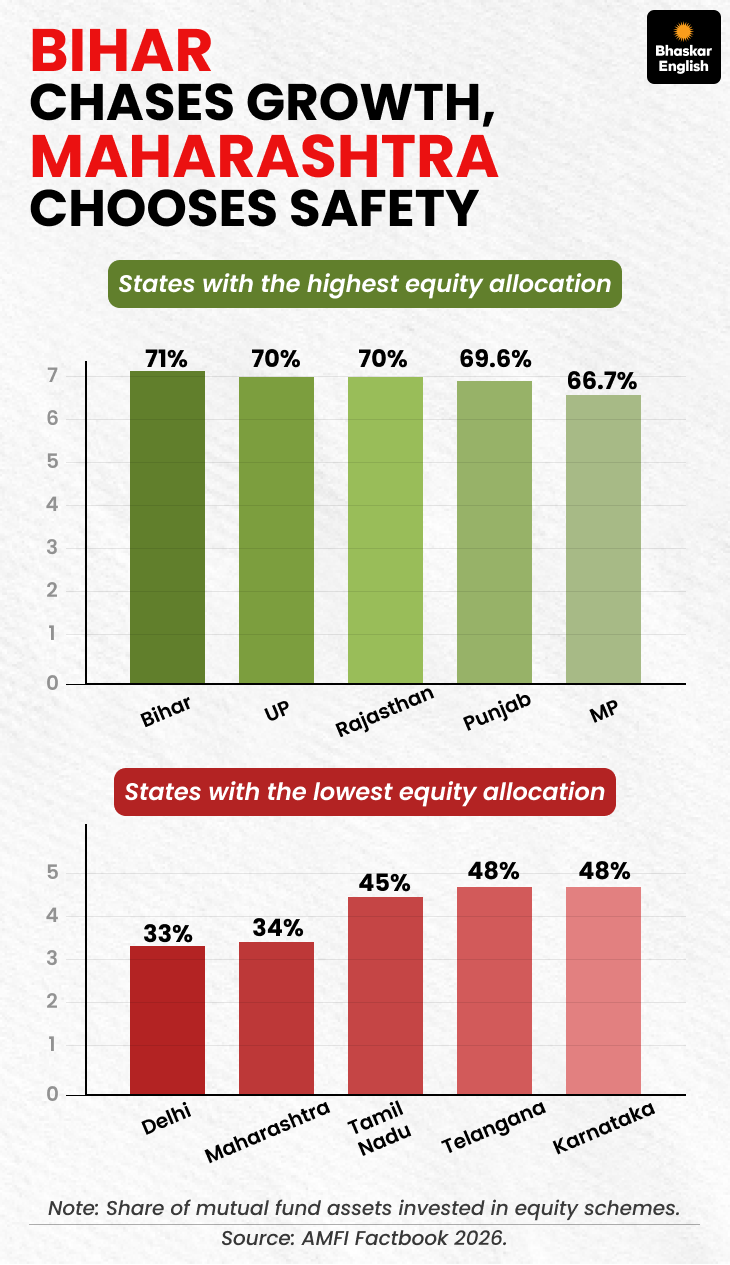
According to the latest mutual fund data by the Association of Mutual Funds in India (AMFI), Bihar, Rajasthan, Madhya Pradesh and Uttar Pradesh allocate a much larger share of their mutual fund assets to equity schemes than Maharashtra and Delhi.
The shift is being driven by Gen Z investors and people from smaller towns. Most are investing through Systematic Investment Plans (SIPs).
The trend could help a new generation build wealth. But it also raises an important question: what happens when markets fall?
In today’s Explained, we look at what the data shows, why more investors are choosing equity, and whether they are prepared for a market downturn.
What is a mutual fund?
A mutual fund collects money from many investors.
- This money is invested in shares, bonds and other assets.
- A professional fund manager handles these investments.
- Investors can start with small amounts. Many begin with SIPs of ₹500 a month.
- They get units of the fund. They also share the profits and losses.

Dalal Street in Mumbai is home to the Bombay Stock Exchange and is regarded as the heart of India’s financial markets (Photo: PTI)
What does the latest mutual fund data show?
Bihar puts 71% of its mutual fund money into equity funds, the highest in India, according to the Association of Mutual Funds in India (AMFI).
- It is followed by Uttar Pradesh and Rajasthan (70% each) and Madhya Pradesh (66.7%).
- At the other end, Maharashtra puts 34% of its mutual fund money into equity, while Delhi puts 33%.
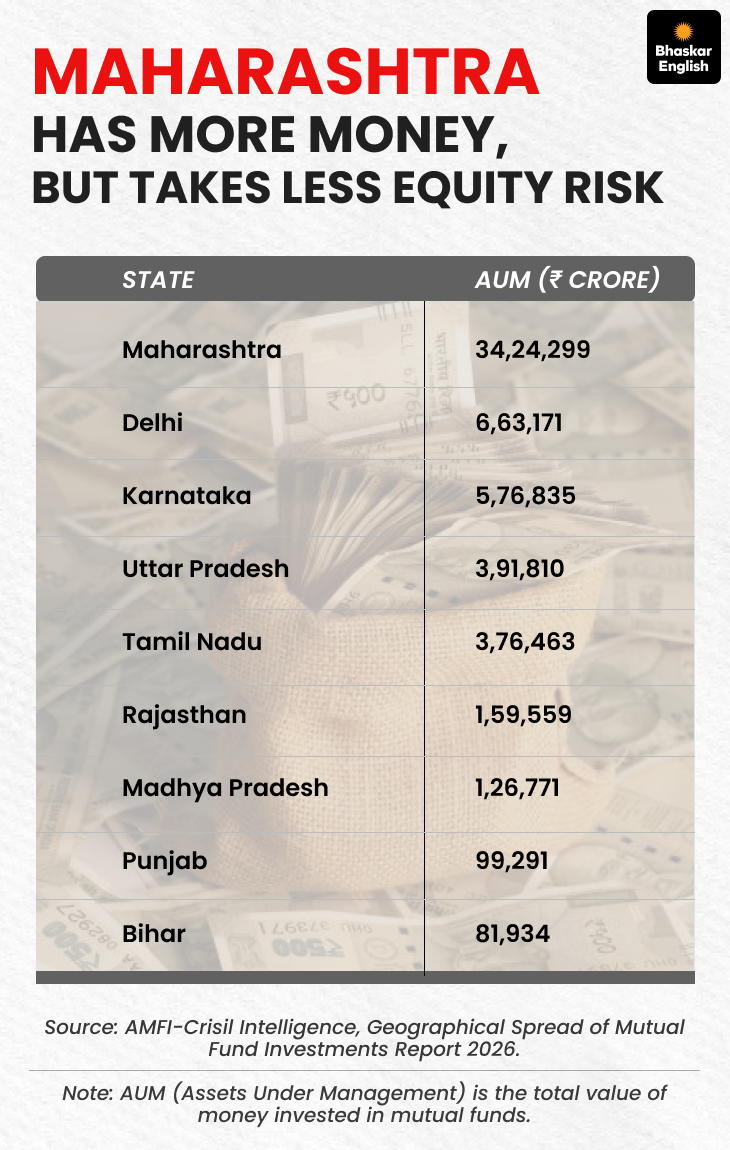
- This does not mean Bihar has more money invested than Maharashtra. It simply means a larger share of Bihar’s mutual fund investments is going into the stock market.
- The trend shows that investors in smaller states are increasingly moving towards equity funds, looking for higher returns over the long term.
- Meanwhile, states with larger financial markets like Maharashtra and Delhi still have a higher share of investments in debt and other non-equity schemes.
Why are Bihar, UP, Rajasthan and MP investing more in equity?
The biggest reason is the rise of first-time investors.
- Smartphones, online KYC and investment apps have made investing easier than ever. People can now start a SIP within minutes without visiting a bank branch or financial adviser.
- Mutual fund companies have also expanded beyond metros through regional-language campaigns and digital platforms.
- As a result, investors from tier-2 and tier-3 cities are entering the market in large numbers. Many are choosing equity funds because they offer the possibility of higher long-term returns than traditional savings products.
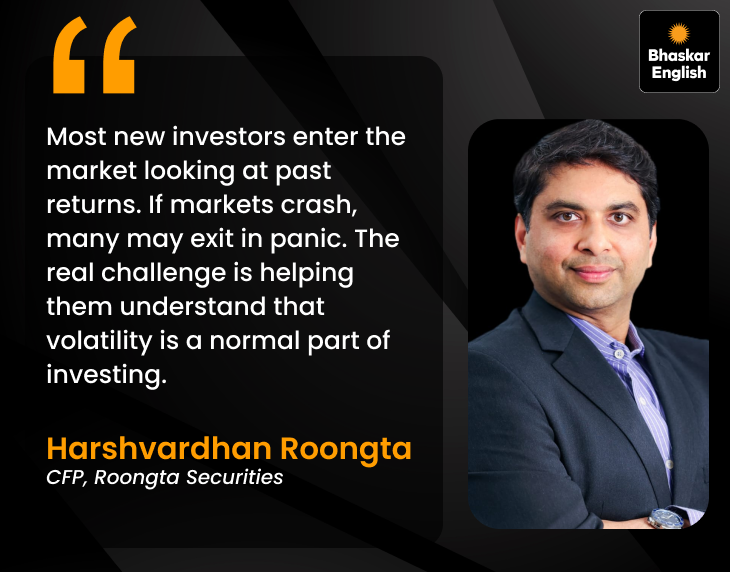
- Harshvardhan Roongta, Certified Financial Planner (CFP), Roongta Securities, says the growth is being driven by both awareness and accessibility. Campaigns promoting mutual funds and advances in technology have made investing easier than before.

Why is Maharashtra investing less in equity?
Maharashtra leads the country in debt fund allocation. Around 30% of its mutual fund assets are invested in debt funds, compared with only 4% in Bihar.
- Experts say this reflects the maturity of the market rather than a lack of confidence in equities.
- Many investors in Maharashtra already have sizeable portfolios and therefore allocate a larger share of their money to debt and other relatively safer assets.
- In simple terms, younger investors often focus on building wealth, while older and wealthier investors focus more on preserving it.
How important is Gen Z in this shift?
The latest data shows that Gen Z is becoming a major force in mutual fund investing.
- Their share among investors has risen from about 25% in FY20 to nearly 40% in FY25. People under 35 opened around 40% of all new SIP accounts in 2025, and nearly 84% of Gen Z SIP investors prefer equity funds.
- Harshvardhan Roongta says many young investors are no longer starting with traditional options such as fixed deposits. Instead, they are putting money directly into equity mutual funds in the hope of earning higher returns.
- However, most of them have only seen markets go up. Unlike older investors, they have not experienced a major market crash. The real challenge will be whether they stay invested when markets fall sharply.
What is the biggest risk behind this trend?
The biggest risk is not investing in equity. It is investing without understanding risk.
- Many first-time investors are unfamiliar with how markets behave during sharp downturns. Some rely on social media, friends or relatives for investment advice rather than professional guidance.
- When markets rise, risk often feels invisible. During a correction, however, panic selling can turn temporary losses into permanent ones.
Roongta says many investors who entered after the pandemic have only seen rising markets. If markets go through a prolonged downturn, many new investors may leave because they are not familiar with market cycles.
What happens if stock markets crash?
Sanjay Chawla, Chief Investment Officer – Equity at Baroda BNP Paribas Asset Management India Private Limited, says a market crash does not automatically mean SIP investors lose money.
- Because SIPs invest a fixed amount regularly, investors buy more units when prices fall and fewer when prices rise. Over time, this helps reduce the average purchase cost.
- However, crashes can be emotionally challenging. A portfolio that suddenly falls 20% or 30% can trigger panic. Investors who stop SIPs or withdraw money during a downturn may lock in losses and miss the recovery that often follows.
- The biggest risk is usually not the crash itself. It is the reaction to it.
What should investors do?
Chawla recommends four simple rules:
- Don’t stop SIPs during a market fall.
- Understand whether losses are due to market conditions or problems with a specific fund.
- Gradually reduce equity exposure as financial goals get closer.
- Review portfolios periodically rather than reacting to daily market movements.
Above all, he says, investors should avoid panic and stay focused on long-term goals.
What is the right age to start saving and investing?
Roongta says there is no fixed age to start investing. The right time is when a person begins earning and has surplus money after meeting essential expenses.
However, the habit of investing can start even earlier. Students can begin with small SIPs from their college days, even with ₹100 a month from their pocket money, to understand saving and build financial discipline from a young age.
Mathpal takes a more aggressive view. He says children can start learning about saving and investing as early as 13 or 14 years of age.
- For those who are already earning, he says the best time to start is with the very first pay cheque.
- Every few years of delay can make wealth creation significantly harder because investors lose the benefit of compounding.
- For example, investing ₹10,000 a month for 20 years at 12% annual returns can create a corpus of roughly ₹1 crore. Delay by five years and the required monthly investment roughly doubles to reach the same target.
- His message is simple: starting early matters more than starting big.