
Close Menu
Aspire Market Guides
  • Home
  • Alternative Investments
  • Cryptocurrency
  • Economics
  • Equity Investments
  • Mutual Funds
  • Real Estate
  • Trading
What's Hot

Goldman Drops as $11.7 Billion Fundraise Tests Its Private-Market Scale

September 15, 2026

Trading Day: No hiding place | The Mighty 790 KFGO

September 15, 2026

How would One Nation’s immigration plan affect the labour market and economy?

September 15, 2026
Facebook X (Twitter) Instagram
Trending:
  • Goldman Drops as $11.7 Billion Fundraise Tests Its Private-Market Scale
  • Trading Day: No hiding place | The Mighty 790 KFGO
  • How would One Nation’s immigration plan affect the labour market and economy?
  • Is It Too Late to Buy Bitcoin at $75,900?
  • Hedged Equity as a Liquid Alternative
  • Stockbridge Shells out $87M for Suburban Chicago Warehouse
  • Why Leave Cash in a Money Market Fund When SGOV Pays About the Same and Skips State Income Tax?
  • Carney says Canada will pursue ‘unique security and economic alliance’ with EU amid US trade spat | Canada
  • NVIDIA Appoints Savannah Goodman as Global Lead of Energy & Infrastructure Sustainability
  • Private Equity Giant Apollo Taking ‘Hard Look’ at NFL Investment
Tuesday, September 15
Facebook X (Twitter) Instagram
Aspire Market Guides
  • Home
  • Alternative Investments
  • Cryptocurrency
  • Economics
  • Equity Investments
  • Mutual Funds
  • Real Estate
  • Trading
Aspire Market Guides
Home»Real Estate»Australian real estate: Hanging onto your home doesn’t guarantee a windfall when selling
Real Estate

Australian real estate: Hanging onto your home doesn’t guarantee a windfall when selling

By CharlotteApril 15, 20265 Mins Read
Share
Facebook Twitter Pinterest Email Copy Link


Dan F Stapleton

April 16, 2026 — 5:00am

You have reached your maximum number of saved items.

Remove items from your saved list to add more.

Save this article for later

Add articles to your saved list and come back to them anytime.

Conventional wisdom holds that hanging on to property for an extended period is a guaranteed way to make money, but new figures show that isn’t always true.

The small proportion of Australian home vendors who sold at a loss in the December quarter held their properties for almost as long as those who sold at a profit.

New figures challenge some conventional property selling wisdom.Wayne Taylor & Matt Davidson

Nationally, 95.9 per cent of dwellings exchanged in the three months to December delivered sellers a windfall in nominal terms, Cotality’s latest Pain and Gain Report finds.

Houses performed best, with 98.1 per cent of house resales recording a profit in the December quarter compared with 91.2 per cent of units. On average, profit-making resellers held on to their properties for 9.2 years, while those losing resellers waited almost as long: 8.2 years.

The median hold period among loss-making Sydney unit resellers was 8.4 years, compared to the median 10-year hold period for profit-making unit sellers.

It was even closer in Melbourne, where loss-making unit resellers held their properties for a median 9.6 years versus the median 10-year hold period of profit-making unit resellers.

The median return for vendors nationally who resold at a profit within two years of buying was $150,000, while profit-makers who held on for two to four years netted $215,000, on average.

The median return jumped significantly, to $325,000, for profit-making resellers who waited four to six years. Those who resold for a profit after 30 years or more made $898,500, on average.

Related Article

The auction market weakened in March.

Gerard Burg, Cotality head of research, said resellers who did best in profit-per-year terms had held their properties for four years or more.

“An example is Kiama on the NSW South Coast, where successful resellers made $730,000 and held their properties for 10 years, on average.

“If you’d resold a property in Kiama that you’d held for just four years, you would have been looking at a loss because values there are still well off the peak that we saw during the COVID period.”

While holding property for an extended period increased the odds of handing it off at a profit, Burg said it wasn’t always enough.

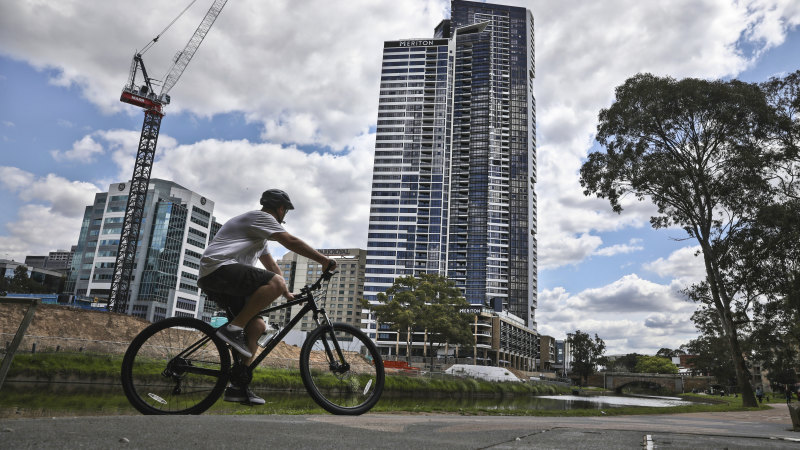
“If you look at Parramatta in Sydney’s west, for example, almost 24 per cent of homes sold at a loss, despite an average hold period of nine years.

“What we’ve seen there is a very rapid increase in the supply of units, which has really put pressure on overall values.”

A rapid rise in the supply of units can impact reselling values, experts say.Ben Rushton

Buyers’ agent Michelle May said, in her experience, the properties most susceptible to reselling at a loss were “dime a dozen” units in high-density areas.

“At any point in time, there will be another one exactly like yours for sale, and if it is owned by someone with more pressing needs than you, they could drop their price, which is also going to affect you.”

Related Article

The auction market has been mixed.

Brand new and off-the-plan properties were also a risk, May said, because they tended to lose value after the initial purchase.

“It’s like when you buy a new car: you’re paying for that new-car smell. The moment you drive it off the lot, you lose a couple of grand off the value. Buying a unit no one’s ever lived in is like that.”

To come out ahead in real terms, sellers should be prepared to wait at least five to seven years, May said.

“You need to allow enough time to pass to recoup your buying costs, like stamp duty, and the selling costs that people often forget about when making these calculations, like the agent’s commission and the marketing.”

The simplest way to ensure capital growth, May said, was to buy best-in-class property rather than a fixer-upper or a bargain.

Buying best-in-class property can be a way of ensuring capital growth.

“If you buy an A-grade property, it’s going to perform above the median growth of that suburb. But if you buy a dud, you’ll fall behind the median. You might make money in nominal terms, but in real terms you’re likely to lose out.”

Dr Shane Oliver, AMP’s chief economist, said as a general rule, the likelihood of property and other assets appreciating increased over time.

“In the short term, volatility can make prices go up and down, and it’s quite easy to be wrong-footed by that. That’s the nature of all assets.”

For example, many property markets, including Melbourne’s, Canberra’s and Hobart’s, were still off the peaks set in 2022, he said.

“But if you bought at the top of the market in 2008, just prior to the global financial crisis, you’d be ahead now, even though we’ve seen several cyclical downswings since then.”

Oliver said generic properties were more likely to stagnate in value than distinctive homes. But he cautioned those hoping for capital growth against buying too far outside the norm.

“If the appeal of a home is very specific, then the buyer pool is likely to be smaller.”

You have reached your maximum number of saved items.

Remove items from your saved list to add more.

Dan F StapletonDan F Stapleton writes on First Nations issues, visual art, property and more. His writing has appeared in The New York Times, the Financial Times and others. He is based in Sydney.

From our partners


Source link

Related Posts

Real Estate

Stockbridge Shells out $87M for Suburban Chicago Warehouse

September 15, 2026
Real Estate

VanTrust Real Estate Breaks Ground on 512,000 SF Spec Industrial Project in McKinney, Texas

September 15, 2026
Real Estate

Scenic Group offering early access to 2028 Europe River Cruising & Land Journeys

September 15, 2026
Real Estate

White Sox land first blow in AL showdown series against Guardians, win 7-3 to stay atop division

September 15, 2026
Real Estate

Israeli occupier families seize Palestinian land in Jordan Valley

September 15, 2026
Real Estate

Flight to Quality Continues Across Canada’s Office Market as Vacancy Forecast to Decline

September 14, 2026
Add A Comment
Leave A Reply Cancel Reply

Editors Picks

Goldman Drops as $11.7 Billion Fundraise Tests Its Private-Market Scale

September 15, 2026

Trading Day: No hiding place | The Mighty 790 KFGO

September 15, 2026

How would One Nation’s immigration plan affect the labour market and economy?

September 15, 2026

Is It Too Late to Buy Bitcoin at $75,900?

September 15, 2026
SUBSCRIBE TO OUR NEWSLETTER

Get our latest downloads and information first. Complete the form below to subscribe to our weekly newsletter.


I consent to being contacted via telephone and/or email and I consent to my data being stored in accordance with European GDPR regulations and agree to the terms of use and privacy policy.

Featured

Boot of Cortez: The Largest Gold Nugget Ever Discovered

July 4, 2026

India Inc’s cash hoard tops $200 billion in FY26 as companies hold back on expansion

June 14, 2026

Evernorth Says XRP Could Become the Settlement Engine for Modern Markets, Bridging Crypto and Wall Street

July 28, 2026
Monthly Featured

La Caisse and its developer partner bet $1 billion on Canadian industrial real estate

September 11, 2026

FP Trading Review 2026 – Investing.com

July 16, 2026

HNIs turn to hybrid debt funds, SIFs for higher post-tax returns

July 8, 2026
Latest Posts

Goldman Drops as $11.7 Billion Fundraise Tests Its Private-Market Scale

September 15, 2026

Trading Day: No hiding place | The Mighty 790 KFGO

September 15, 2026

How would One Nation’s immigration plan affect the labour market and economy?

September 15, 2026
SUBSCRIBE TO OUR NEWSLETTER

Get our latest downloads and information first. Complete the form below to subscribe to our weekly newsletter.


I consent to being contacted via telephone and/or email and I consent to my data being stored in accordance with European GDPR regulations and agree to the terms of use and privacy policy.

© 2026 Aspire Market Guides.
  • Contact us
  • Privacy Policy
  • Terms and Conditions

Type above and press Enter to search. Press Esc to cancel.

SUBSCRIBE TO OUR NEWSLETTER

Get our latest downloads and information first.

Complete the form below to subscribe to our weekly newsletter.


I consent to being contacted via telephone and/or email and I consent to my data being stored in accordance with European GDPR regulations and agree to the terms of use and privacy policy.