
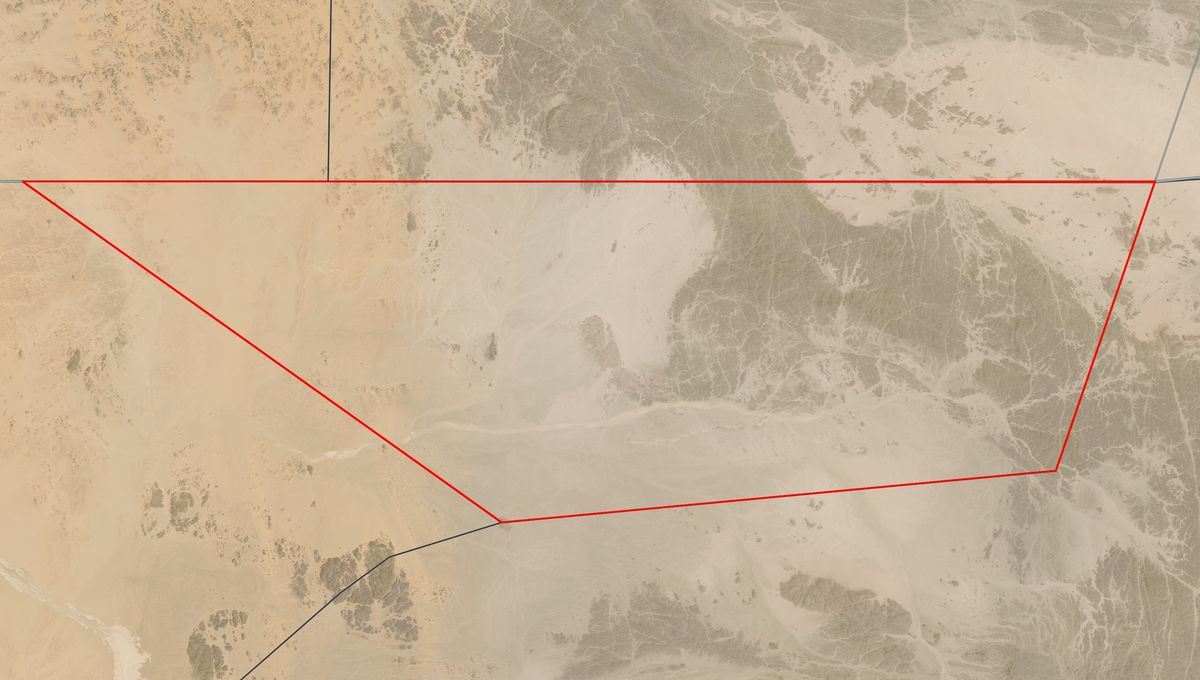
It’s a tale as old as time: one nation grabs some land from another; the previous residents take it back; someone else comes along and declares both of them wrong; rinse, repeat, and so on. But what if there was a place nobody wanted?
No, we’re not talking about places like Antarctica or the tippy top of Mount Everest. For one thing, those are both actually surprisingly contested, as territorial claims go – but also, neither is exactly the kind of place you could make a life. Bir Tawil, however, is – and yet no government wants to claim it.
So what’s wrong with it?
No Man’s Land
Search for Bir Tawil on Google Maps, and you won’t see anything particularly outstanding. It’s a small, irregular quadrilateral patch of land, only half the size of Rhode Island, indistinguishable from the sand and rocks of the two deserts that straddle it. “To the extent that this can be said of anywhere, Bir Tawil is empty,” declared journalist Jonn Elledge in his 2024 book A History of the World in 47 Borders.
It’s hard to access, being far from any transport hubs or highways. Once inside, it’s still hard: the place is mountainous, and rocky, and hot, and there are no roads or signposts with which to guide yourself. There’s no government, so there’s no law; no stores; no hotels; no phone signal; no population at all.
At least, that’s the theory. In reality, “far from being an unpopulated patch of desert, a people called the Ababda have had a presence there going back at least as far as the Roman Empire,” wrote Dean Karalekas, an associate research fellow in the University of Lancashire’s Centre of Austronesian Studies, who visited Bir Tawil, in 2020. “That this people have inhabited the area for millennia is without doubt.”
These indigenous nomadic people aren’t the only population you might meet. “We were surprised by how developed it was, with permanent encampments and caravans of trucks filled with labourers,” Karalekas wrote in his 2020 memoir of the journey into Bir Tawil, The Men in No Man’s Land. Gold has been mined in Egypt and Sudan since the time of the pharaohs, and today the mining industry in the region “range[s] from independent prospectors working with small, portable metal detectors, all the way up to advanced, industrial-level excavation operations, with back hoes, drills, trammels and separators,” Karalekas reported.
Serving the miners are a handful of tiny shops and restaurants, all nestled together in a “fully functioning settlement with a busy main street,” Karalekas wrote, and constructed from sheets of corrugated iron and a mishmash of old fabrics for shade. There are money changers, and even a phone booth, and an apparently enthusiastic band of Bedouin security guards patrolling for those who try to trespass into any of it.
Away from the mines and industry, you’ll find a land surprisingly lush in places – if you get there at the right time, that is. The land is peppered with wadis – valleys or riverbeds that are dry until the rainy season – so despite the region being one of the driest in the world by annual rainfall, it’s possible to find havens of life within the desert.
And then, of course, there are the flags.
Terra Non Nullius
There are, apparently, a lot of flags in Bir Tawil. “Bir Tawil […] is often described as the last unclaimed land on Earth. This is wrong,” pointed out Elledge. “Bir Tawil is not unclaimed. It is very, very claimed indeed.”
Indeed, at least nine people have claimed ownership of Bir Tawil over the years, none of them recognized by the UN and most never setting foot in the area they supposedly rule. The most famous is probably Jeremiah Heaton, a farmer from Virginia who in 2014 traveled to the region and declared it the Kingdom of North Sudan, with the King in question being himself. It was spun as a feel-good story at the time – his motive, he claimed, was to fulfill his young daughter’s dream of becoming “a real princess”, and who could sneer at that? But to the Ababda who live there – who have always lived there – it was little more than an insult.
“[The Ababda chiefs’] concern was that one of our number might be Jeremiah Heaton,” Karalekas recalled. “Quite understandably, they were keen to get their hands on this ‘silly man’, as they referred to him. They were not enamored with a man from a foreign country who claims to be their kind, and who apparently has spared no expense in promoting his right to rule online and in the international media.”
Other flags have been planted with less neo-Imperialistic ambition. Karalekas described flags planted in the name of Sealand; in honor of the state of, uh, statelessness; one simply had a gigantic dick on it. Childish? Perhaps – but as Jack Shenker, a journalist who once aspired to lay claim to the territory but changed his mind upon actually visiting it, pointed out, at least their owners made the effort.
“None of [the online claimants] had ever actually set foot in Bir Tawil, rendering their claims to sovereignty worthless,” he wrote in a 2016 report of his journey. “Few had truly grappled with Bir Tawil’s complex backstory, or of the bloodshed it was built upon.”
“Granted, [my companion] and I knew little of the backstory either,” he admitted, “but at least we had actually got to Sudan and were making, by our own estimation, a decent fist of finding out.”
The creation of Bir Tawil
So, by now you’re probably asking the obvious question: how does a place like Bir Tawil exist? And the answer is, basically, a lot of blood, and an admin mix-up.
“Inaccessible as it is, down the centuries Bir Tawil has been a distant outpost of assorted empires: Egyptian, Nubian, Ottoman, British,” explained Elledge. “It was the latter’s taste for drawing lines across the map of Africa that led to the territory’s unwanted status. Because the British weren’t content with just one line – they insisted on drawing two.”
The first came in 1899, a result of the Mahdist War between Sudan and “Britain and its definitely-not-a-secret-colony Egypt,” Elledge wrote. Nearly two decades of fighting led to a Sudanese defeat, the region was brought under British-Egyptian control, and the border between Sudan and Egypt was placed at the 22nd parallel.
Look at a map today, and you can still see this boundary cutting through the desert to separate the two nations – but you’ll also notice that the easternmost third or so of it is dotted, rather than solid. That’s no accident: it indicates a contested border, with the alternative boundary between the countries wiggling around it.
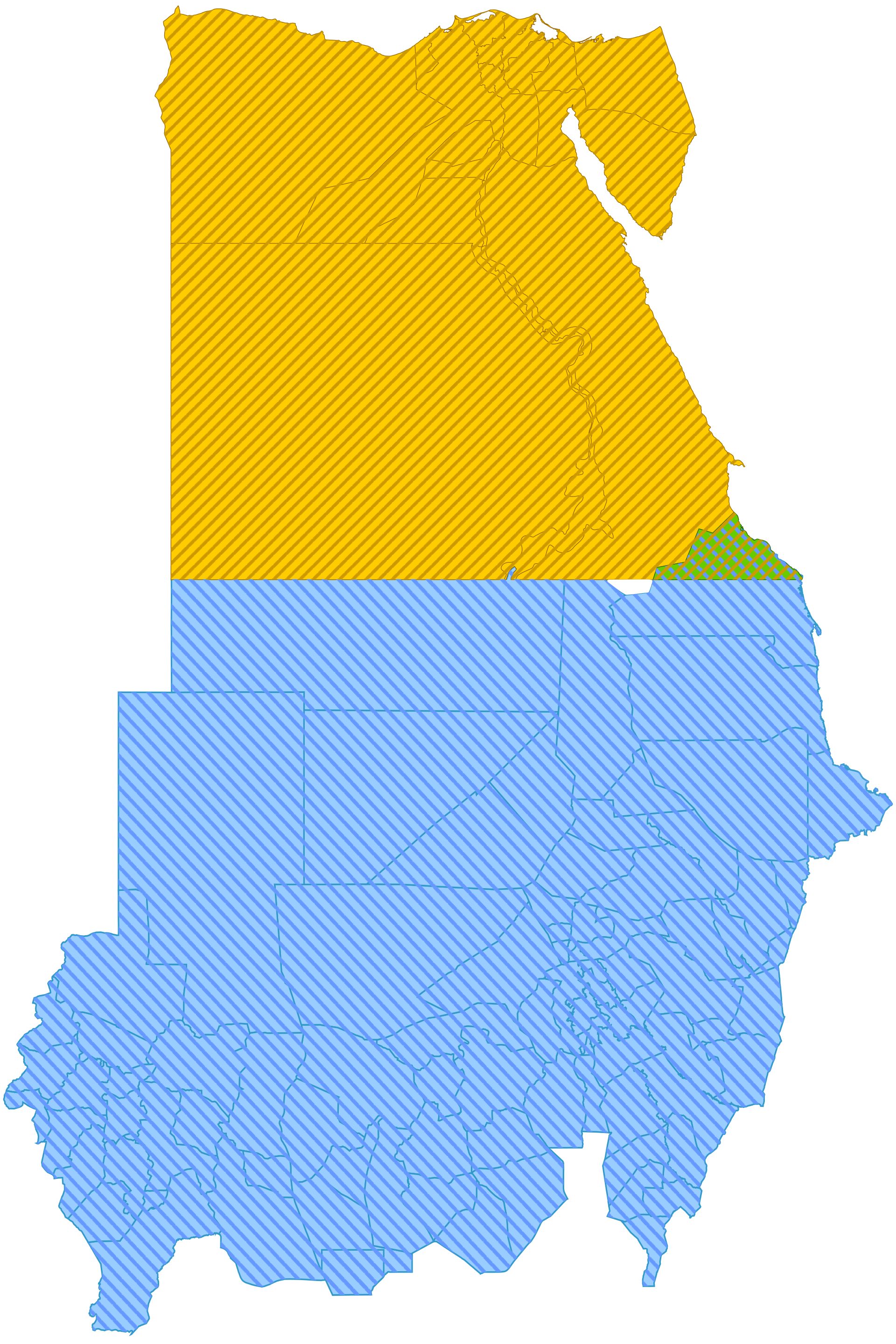
Bir Tawil is seen here in green, tucked between Egypt to the north and Sudan to the south.
“That is the second line created by the British,” Elledge explained. “The ‘administrative boundary’ drawn up in 1902.” It made sense at the time, kind of – after all, cultural ties and traditional settlements rarely comport to a ruler-straight line on a map – but unfortunately, nobody bothered to make it clear which line was now the official border.
“For a while, this didn’t matter, because – whatever language was used to half-heartedly disguise the fact – both territories were outposts of the British Empire,” Elledge wrote. “By the 1950s, though, both states were independent, and both – not unnaturally – decided they preferred the interpretation which gave them the larger territory.”
For Sudan, that meant the later, wigglier boundary; for Egypt, the earlier one was preferred. But that led to two areas of conflicting claims: first, the Hala’ib Triangle to the East, which both countries wanted; second, the much smaller Bir Tawil, which neither did.
One land dependent on another
The story of Bir Tawil is, really, the story of Hala’ib. The latter is large, and rich in minerals and resources; sheer square kilometers aside, there are clear reasons both Egypt and Sudan would want to own it. Indeed, both have sent in armies to the triangle over the years; both have held elections in the area, and for a while, the region was under joint control by both governments.
Since 2000, though, the area has effectively been Egyptian only, with Sudan’s claim being more de jure than de facto. So why, you might wonder, does Sudan just nab Bir Tawil anyway, since Egypt doesn’t want it?
Well, here’s the thing: they can’t. The only way either nation can claim Bir Tawil is by accepting a boundary that cedes Hala’ib to their opponent – and that’s something neither wants to do. Both want Hala’ib, and so both must renounce Bir Tawil, leaving a smallish patch of desert the only place on Earth outside of Antarctica to be claimed by no nation.
But while it may have no official government, Bir Tawil is far from the uninhabited wilderness it’s sometimes described as. “Although it lacks any permanent dwellings today, this section of desert is still used by members of the Ababda and Bisharin tribes who carry goods, graze crops and make camp within the sands,” Shenker pointed out. “Their ties to the area may be based on traditional rather than written claims – but Bir Tawil is not […] a ‘no man’s land’.”
“In truth, no place is a ‘dead zone’, stopped in time and ripe for private capture,” he wrote – “least of all Bir Tawil, which […] was clearly the site of considerable human activity in the past.”