
Scarcity and high cost of land, a growing population, and rapid urbanisation mean that urban development authorities and estate developers have to rethink and reimagine their approach to housing for residential and commercial purposes.
Over the last decade, a significant transformation in urban development has marked the era of high-rise buildings in Nigeria. Clearly, the country’s urban skylines are undergoing a dramatic change, with some of the towers rising 15, 20, 30 floors.
Real estate developers are not only breaking ground for new developments but also pulling down old structures to make way for new, high-density housing. This shift is driven by the need for more housing and commercial space as land has become scarce and very expensive.
Nigeria is currently experiencing what is, arguably, a boom in the construction of high-rise buildings as a response to growing demand for premium housing and commercial spaces, and also a global trend in urban development.
High-rise buildings or towers don’t come easy or cheap, which is why they are predominantly located in major cities such as Lagos, Abuja, and Port Harcourt in Nigeria, where they are, increasingly, transforming urban lifestyle and workplace attitudes.
The construction of high-rise buildings in Nigeria is a further testament to the evolution of the country’s architecture from traditional mud walls to modern glass towers, showcasing the nation’s constant reinvention.
These high-rise buildings are largely limited to major city centres. In Lagos, though there is a wave of development called ‘new urbanism,’ which is giving rise to new urban communities, high-rise buildings are only found in high-end neighbourhoods such as Ikoyi, Lekki, Banana Island, Eko Atlantic City, and Victoria Island.
However, as a city, Lagos keeps evolving with significant changes in its character and stature, which explains why, in recent times, developments have sprung up in locations where they were least expected. Those developments serve dual purpose of meeting a need and also contributing to the urban development efforts of the state authorities
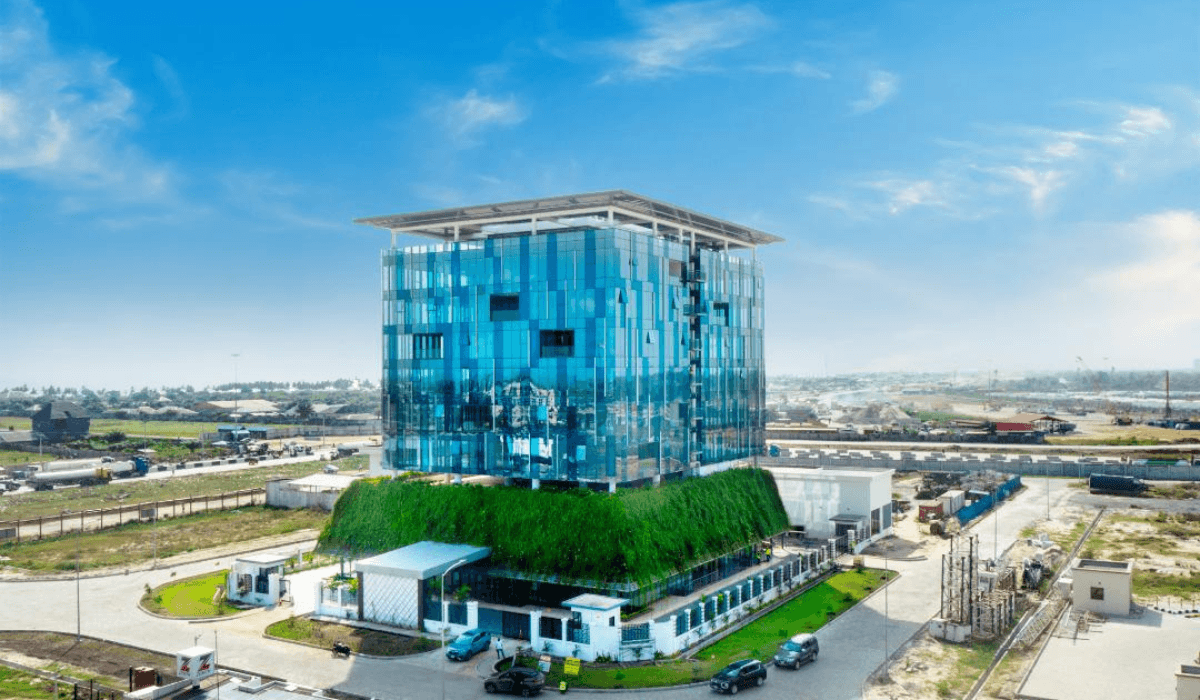
One of such emerging developments is the Irele Tower, the first commercial building within the Lagos Free Zone (LFZ), where, according to its promoters, ambition meets advantage. Its location within the LFZ, outside the traditional business nodes, makes it unique.
Unlike most towers in Lagos, which are either mixed-use or residential, Irele is purely for commercial purposes, offering exceptional opportunities for office and retail activities.
The LFZ, where the tower is located, is promoted by Singapore-based Tolaram. The zone is the first privately-held deep sea port-based free trade zone in Nigeria. It is centrally located in Lagos, the commercial hub of West Africa’s largest economy, and sits on 860 hectares.
As a word, Irele means humility in Yoruba language, and it represents the value of the organization and respect for local culture and language. It is equipped with modern amenities, with its best-in-class services designed to make a workplace ready for businesses, no matter what they are.
The Tower, according to its promoters, is a gateway to a world of access and opportunity. It is located in proximity to banks, which are less than 100 metres away. This excellent location sets an ideal stage for businesses to flourish, with every need taken care of.
The 9-floor Irele Tower is a newcomer in the Nigerian commercial real estate market. A major upside of the tower is that it is EDGE-certified, setting a new standard for sustainable workspace in Lekki, Nigeria’s fastest-growing economic corridor. EDGE means Excellence in Design for Greater Efficiencies.
The tower’s unique features present it as the epitome of art and architectural excellence. Its design concept reflects a maritime building akin to a stack of containers, representing the proximity to the deep seaport.
Features like an inclined perforated bio-wall screen envelop the parking floors, allowing for natural ventilation, and represent the strong commitment towards sustainability.
It is an eco-friendly building by reason of its EDGE certification. An innovation of IFC, a member of the World Bank Group, EDGE empowers emerging markets to scale up resource-efficient buildings quickly, easily, and affordably.
Irele is designed and developed as a sustainable ‘green building’ built for efficiency, with 26 percent less energy, 46 percent less water consumption, and 30 percent material saving.
Babajide Sanwo-Olu, the governor of Lagos State, who inaugurated the tower recently, described it as a significant milestone in the development of the economic zone in line with his administration’s THEMES agenda of making Lagos a 21st-century economy by boosting economic growth.
The governor noted that developments such as Irele Tower are critical to unlocking the full potential of the Ibeju-Lekki axis of the economic zone, particularly given the presence of the Lekki Deep Sea Port and other major industrial investments within the LFZ.
He assured that the state government will continue to collaborate with private sector players to drive sustainable urban development, create jobs, and position Lagos as a leading hub for commerce and industry in Africa.
“The commissioning of Irele Tower is a clear demonstration of what can be achieved through strong collaboration between the public and private sectors. This development not only enhances the infrastructure profile of the Lagos Free Zone but also strengthens our vision of making Lagos a premier destination for investment and economic activities.
We will continue to support initiatives that promote industrial growth, create employment opportunities, and improve the overall business environment in our state,” he said.
Adesuwa Ladoja, the managing director/chief executive officer of Lagos Free Zone, stated that the development reflects the zone’s commitment to creating an integrated ecosystem where businesses can thrive, supported by modern infrastructure, a strategic location, and efficient logistics.
Ladoja explained that the building was conceptualised to meet the growing demand for high-quality commercial spaces within the zone, particularly as investor interest continues to increase following the operationalisation of key projects in the Lekki axis.
“The commissioning of Irele Tower represents a defining milestone in our journey to build a world-class industrial and commercial hub. This development reflects our commitment to providing high-quality infrastructure that supports ease of doing business and enhances operational efficiency for our tenants.
As the first commercial tower within the Lagos Free Zone, Irele Tower, sets a new benchmark for quality workspace in this corridor and reinforces our position as a preferred destination for investment and enterprise,” she added.
Irele Tower blends elegance, functionality, and purpose, designed to facilitate seamless business operations. With a gross floor area of approximately 12,000 square metres, the development offers modern workspaces tailored to evolving business needs.
It also offers premium amenities, including office spaces, retail outlets, parking facilities, shared workspaces, and a rooftop cafeteria, creating a dynamic, integrated business environment.

