
Pierre Poilievre popped up before reporters who were waiting outside a cabinet meeting on Tuesday and in the span of 10 minutes the Conservative leader managed to use the word “recession” more than two dozen times.
“Mr. Trump’s policies are affecting all G7 countries, and none of them are in recession. Mexico shares a border with the United States. Mexico is not in recession. Only Canada, under Mark Carney’s Liberal policies, is in a recession,” Poilievre responded when one reporter asked whether voters might blame Donald Trump for the recent weakness in Canada’s GDP.
“France is not in a recession. The U.K. is not in a recession. Germany is not in recession. Italy is not in a recession. Japan’s not in a recession. Only Canada among G7 countries is in a recession. And only Canada among North American countries is in a recession. So it seems that the other countries, despite Mr. Trump’s unfair tariffs, have been able to craft policies to avoid recession. It’s only here, under Mark Carney’s policies, that we find ourselves in a recession.”
If this had been a drinking game, everyone within earshot would have been unfit to drive.
Technically, it is still only a “technical recession,” the term of art applied when the economy clears the technical definition of what constitutes a recession: two consecutive quarters of negative economic growth. Canada’s GDP fell by one per cent in the fourth quarter of 2025 and is now estimated to have fallen by 0.1 per cent in the first quarter of 2026.
By the narrowest definition of a recession, that is a recession. But the greater significance of the moment is a matter of both economics and politics.
The technical recession of 2015 that maybe wasn’t
Poilievre has been around long enough to know this is not the first time the technical definition of a recession has become a political matter.
After falling by 0.8 in the first quarter of 2015, Canada’s GDP fell by 0.5 per cent in the second quarter. That news fell in the middle of a federal election campaign and put Stephen Harper’s government on the defensive. Harper, an economist, declined to use the word “recession,” while a former Conservative cabinet minister ventured that Canada was only experiencing a “discrete sectoral downturn.”
The Liberals and New Democrats were less forgiving, framing the downturn as a repudiation of Harper’s economic agenda — and Harper’s fiscal policies would later be said to have “unduly sacrificed economic growth” in pursuit of a balanced budget.

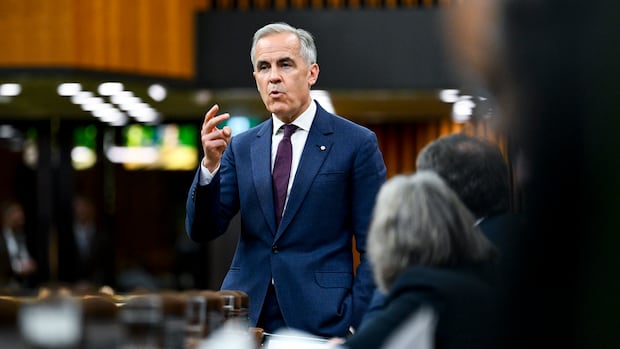
In an exchange during question period on Wednesday, Conservative Leader Pierre Poilievre asked Prime Minister Mark Carney whether Canada ‘is in a recession or a technical recession.’ In his reply, Carney said the government is ‘putting in place the foundations of an economy that will be stronger, more resilient, more independent.’
But an expert panel convened by the C.D. Howe Institute would ultimately decide in 2018 that the technical recession did not qualify as a real recession because the impact was not broad enough.
The technical recession of 2026 is similarly debatable. And as Douglas Porter, chief economist at the Bank of Montreal, suggested last week, a future revision to Statistics Canada’s estimate could ultimately wipe away that 0.1 per cent decline in the second quarter — thus eliminating the basis for even a technical recession.
What’s behind the weakness?
Speaking to reporters on Tuesday, Carney suggested that some of the “weakness” in Canada’s economic data could be attributed to reductions in government spending and the federal government’s moves to curtail immigration. Those two explanations have the benefit of being policy directions that Poilievre broadly supports, but suffice it to say the Conservative leader does not believe fiscal restraint and immigration policy are to blame.
“The recession was caused by taxes, anti-development laws, government red tape and the doubling of the deficit,” Poilievre told the House of Commons on Tuesday.
At question period on Wednesday, Poilievre asked if the only G20 leader facing a recession would please stand up. When the Speaker ruled that out of order, Poilievre stood and asked the prime minister to clarify whether Canada was experiencing a “recession” or a “technical recession.”
“This government is putting in place the foundations of an economy that will be stronger, more resilient, more independent,” Carney responded, broadly ignoring the Opposition leader’s demand.

Prime Minister Mark Carney defended his economic record after Canada slipped into a technical recession, saying the government is doing the work to strengthen the economy. The Opposition says the ongoing economic weakness is all Carney’s fault.
The Conservative leader persisted in asking what kind of recession Canada was in. The prime minister persisted in ignoring Poilievre’s terms. Eventually, Poilievre tried asking Carney what he would say to specific Canadians who were experiencing hardship, but by then Carney had turned questions over to other members of the government.
Poilievre is no doubt eager to tarnish Carney’s economic credentials and at least begin to chip away at the public support the prime minister has accumulated over the past year — according to a recent poll by Abacus Data, 47 per cent of Canadians think the country is headed in the right direction and 59 per cent approve of the Carney government’s performance.
“Our read of this data is that Canadians increasingly see inflationary pressure and economic uncertainty as being driven externally, particularly by instability emanating from the United States and decisions made by Donald Trump, rather than by domestic policy failures from Ottawa,” David Coletto of Abacus Data wrote in an analysis published before the latest GDP numbers were released.
Making the case that Carney, not Trump, is primarily to blame is a challenge for Poilievre. So is the fact the Carney government is moving to do some of the things, such as regulatory reform, that Poilievre is calling for. (Harper’s experience with a technical recession in 2015 might also suggest that simply cutting taxes, spending and regulation are not quite the economic magic they are sometimes made out to be.)
Don’t undersell the softness
But even if this recession proves to only be technical in nature — or even, after a revision to the data, turns out not to have occurred — there is still obvious cause here for the Carney government to be concerned. The technical recession of 2026 feels like a warning sign that responding to the “rupture” might not be perfectly easy.
“Time will ultimately tell, but data on the ground don’t have the markings of a true recession in Canada,” Robert Kavcic, a senior economist at the Bank of Montreal, wrote in a note last week. “Let’s not undersell this softness though — there are legitimate headwinds and structural adjustments dragging down both potential and realized growth in Canada as we head into the summer.”
As much as Canadians might view Trump as the primary source of trouble, Carney can’t take for granted that the support for his government will hold up if economic hardship persists — or if he seems not to understand what some Canadians are experiencing. The foundations that Carney says he’s building will presumably need to become more visible at some point.
But Carney might at least have the benefit of time.
The technical recession of 2015 hit during Harper’s 10th year in office, undercutting his claim to have been a steady manager of the national economy. Poilievre would insist that this technical recession is coming after more than a decade of Liberal government, but it is also coming just a year into Carney’s time as prime minister.
And with the benefit of a handful of floor-crossers from the Conservative side, it might technically be another three years before Carney has to put his economic record before voters for judgment.