
Close Menu
Aspire Market Guides
  • Home
  • Alternative Investments
  • Cryptocurrency
  • Economics
  • Equity Investments
  • Mutual Funds
  • Real Estate
  • Trading
What's Hot

Bitcoin falls to 20-month low of $58,000, wipes out $1.3 trillion in market value from peak

June 26, 2026

Trust questions IDC equity to ‘outsiders’

June 26, 2026

Bending Spoons tries out an odd kind of financial magic trick – Financial Times

June 26, 2026
Facebook X (Twitter) Instagram
Trending:
  • Bitcoin falls to 20-month low of $58,000, wipes out $1.3 trillion in market value from peak
  • Trust questions IDC equity to ‘outsiders’
  • Bending Spoons tries out an odd kind of financial magic trick – Financial Times
  • Microeconomics explains why people can never have enough of what they want and how that influences policies
  • Looking for regular income from mutual funds? These hybrid funds stood out over 3 years – The Economic Times
  • Cryptocurrency infrastructure company BitGo lays off about 15% of its staff, shifting its focus to AI and stablecoins
  • Gold price in Pakistan: Rates on June 26
  • Ripple’s RLUSD Breaks Into Japan With SBI After Regulatory Approval
  • 12 Industrials Stocks Moving In Thursday's Intraday Session – Benzinga
  • Global economy a mixed bag, horizon uncertain
Friday, June 26
Facebook X (Twitter) Instagram
Aspire Market Guides
  • Home
  • Alternative Investments
  • Cryptocurrency
  • Economics
  • Equity Investments
  • Mutual Funds
  • Real Estate
  • Trading
Aspire Market Guides
Home»Economics»Microeconomics explains why people can never have enough of what they want and how that influences policies
Economics

Microeconomics explains why people can never have enough of what they want and how that influences policies

By CharlotteJune 26, 20264 Mins Read
Share
Facebook Twitter Pinterest Email Copy Link


Economics is broadly divided into macroeconomics and microeconomics. The big picture, macroeconomics, concentrates on the behavior of a national or a regional economy as a whole: the totals of goods and services, unemployment and prices.

Then there’s a more detailed picture: the economic decisions that people and businesses make. Microeconomics analyzes behavior. It looks at how individuals and companies respond to incentives and allocate scarce resources efficiently.

People struggle to get as much as possible while spending as little as possible. The economist Thomas Sowell has said there is never enough of anything to fully satisfy all those who want it. This omnipresence of scarcity in our lives makes the study of human behavior compelling.

Microeconomics is divided into the theory of the consumer, which focuses on people’s behavior in market settings, and the theory of the firm, which concentrates on how businesses act, once again in market settings.

Consumers pursue their self-interest

In the 19th century, economists referred to consumers as “economic men” or homo economicus. Today they might call consumers economic people. All of these terms refer to the idea that individuals make decisions based upon the rational pursuit of their self-interest.

The meaning of self-interest is pretty clear, but it’s important to comprehend what economists mean by pursuing it rationally.

To an economist, behavior is rational if it helps attain goals. Economists do not pass moral judgment on a person’s goals. Behavior that may seem irrational to a non-economist is not necessarily so to an economist.

To see this, say that a man named Raj wants to rob a bank. Given that goal, economists would say that if Raj conducts surveillance on the bank to look for security cameras, that’s rational behavior — for Raj.

Or if a woman named Asha hates credit cards, economists pass no judgment on her thinking and would say that for her, it is rational to burn credit cards.

Consumers want the most they can afford

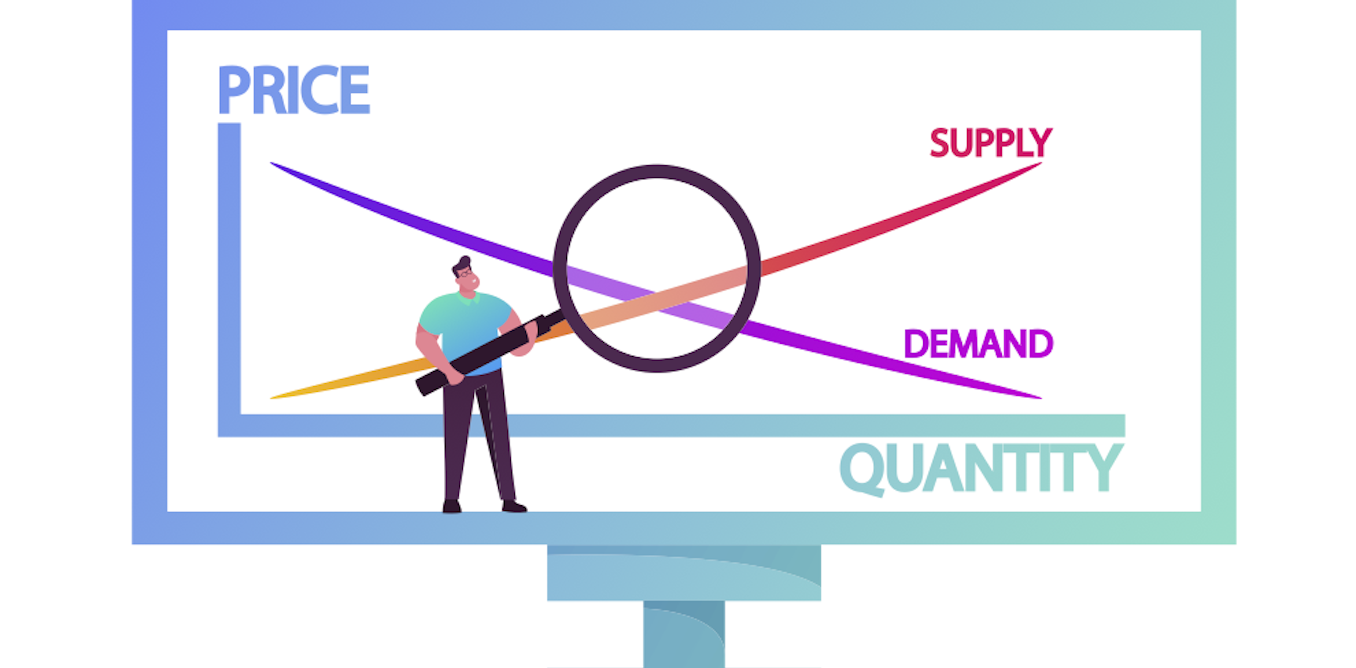
To buy anything, a consumer must interact with a producer — a seller — whether that seller is a mom and pop store or Amazon. Consumer theory says they examine prices because they are interested in getting those goods and services that will make their satisfaction as large as possible at the lowest possible price.

Microeconomists study that interaction mathematically in two ways. First, they try to gauge a consumer’s satisfaction level by assigning a number based on how much this consumer values the goods and services she chooses to buy in a market. They call this number utility.

Second, they interpret the act of seeking the most satisfaction as solving a maximization problem. In a maximization problem, a consumer seeks the biggest bang for their buck.

Therefore, the central problem in consumer theory is the study of how consumers go about maximizing their utility in market settings — buying as much of what they like with the money they have available.

What fascinates microeconomists studying utility maximization is that it nicely illustrates a central tension in economics: how best to satisfy unlimited wants with limited means. The “unlimited wants” are captured by the notion of utility, and “limited means” refers to a consumer’s finite income or budget. Economists call this a constrained maximization problem.

As an example, consider Sheila, who has a budget of $1,000 a month (her constraint) for apartment rent. The monthly rents for apartments A, B and C are $900, $1,000 and $1,500. Sheila rules out apartment C – it’s too expensive. Apartment A will save her money, but apartment B, within her budget, may be nicer.

Companies also pursue self-interest

An integral part of microeconomics is the theory of the firm, the term economists use for companies. Economists believe that businesses exist because team production is efficient and it minimizes the costs of contracting.

[Over 110,000 readers rely on The Conversation’s newsletter to understand the world. Sign up today.]

Economists study how businesses make as much profit as they possibly can. Companies, like individual people, try to solve a maximization problem: how to maximize their profit. Producer theory seeks to explain how businesses do that.

The study of profit maximization is fascinating to a microeconomicist like me because no company can produce whatever it wants and in unlimited quantities. Businesses are constrained by their technical capabilities and the cost of paying for inputs like capital and labor. Microeconomists describe these technical capabilities by means of the production function. This mathematical relationship describes how businesses use capital and labor to produce their goods or services.

Microeconomics looks at how consumers and companies behave so that they can understand why society needs economic policies to regulate and shape their behavior.


Source link

Related Posts

Economics

Global economy a mixed bag, horizon uncertain

June 26, 2026
Economics

NHAI Partners with NCAER for Applied Research on Transportation and Mobility

June 26, 2026
Economics

IAREM 2023: Norway’s ‘mixed’ economy leads as Australia plays catch up

June 26, 2026
Economics

CUET Economics Topic Wise Weightage 2026, Chapter-Wise Marks Distribution

June 25, 2026
Economics

Morning Bid highlights microeconomic pressures squeezing business margins | Ukraine news

June 25, 2026
Economics

Trump predicts ‘economic boom’ as inflation heats up

June 25, 2026
Add A Comment
Leave A Reply Cancel Reply

Editors Picks

Bitcoin falls to 20-month low of $58,000, wipes out $1.3 trillion in market value from peak

June 26, 2026

Trust questions IDC equity to ‘outsiders’

June 26, 2026

Bending Spoons tries out an odd kind of financial magic trick – Financial Times

June 26, 2026

Microeconomics explains why people can never have enough of what they want and how that influences policies

June 26, 2026
SUBSCRIBE TO OUR NEWSLETTER

Get our latest downloads and information first. Complete the form below to subscribe to our weekly newsletter.


I consent to being contacted via telephone and/or email and I consent to my data being stored in accordance with European GDPR regulations and agree to the terms of use and privacy policy.

Featured

Quant funds or traditional mutual funds: What works better for Indians today?

April 29, 2026

Oriole Resources Nears a Potential West African Gold Mine as Mbe Moves Beyond 1.2Moz (video) – DirectorsTalk Interviews

April 14, 2026

Applied Microeconomics Seminar with Nathan SEEGERT (Northeastern University)

April 20, 2026
Monthly Featured

Remixpoint Continues Aggressive Crypto Expansion With XRP in Focus

June 13, 2026

Commentary: America chugs along in a ‘K-shaped’ economy

April 29, 2026

Georgian police seize cryptocurrency machines/ JAMnews

June 5, 2026
Latest Posts

Bitcoin falls to 20-month low of $58,000, wipes out $1.3 trillion in market value from peak

June 26, 2026

Trust questions IDC equity to ‘outsiders’

June 26, 2026

Bending Spoons tries out an odd kind of financial magic trick – Financial Times

June 26, 2026
SUBSCRIBE TO OUR NEWSLETTER

Get our latest downloads and information first. Complete the form below to subscribe to our weekly newsletter.


I consent to being contacted via telephone and/or email and I consent to my data being stored in accordance with European GDPR regulations and agree to the terms of use and privacy policy.

© 2026 Aspire Market Guides.
  • Contact us
  • Privacy Policy
  • Terms and Conditions

Type above and press Enter to search. Press Esc to cancel.

SUBSCRIBE TO OUR NEWSLETTER

Get our latest downloads and information first.

Complete the form below to subscribe to our weekly newsletter.


I consent to being contacted via telephone and/or email and I consent to my data being stored in accordance with European GDPR regulations and agree to the terms of use and privacy policy.