
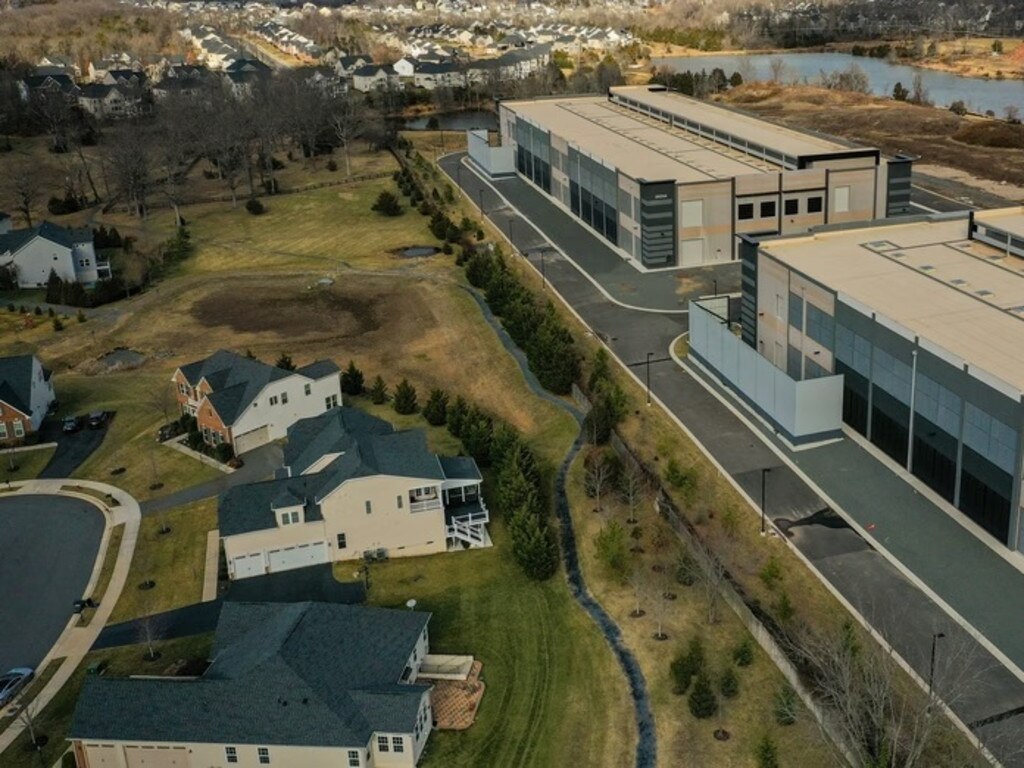

Data centres are getting pretty close to homes in the US. Picture: Getty Images
The data centre boom is slowly arriving in Australia and residents are rightly asking what it all means for the neighbourhoods where these developments spring up.
The same questions are being asked in the US.
But with America’s own data centre explosion being ahead of Australia’s, their lived experiences offer potential insight into what data centres could mean for the population Down Under.
The impact on home prices is a huge source of concern for many Aussies, and how data centres are impacting the real estate industry in the US is now something being heavily scrutinised.
The situation in the US
Data centres are increasingly popping up next to American homes, and they’re changing neighbourhoods in the process.
The number of large data centres over 50 megawatts has increased sevenfold from 2018, and now U.S. communities host over 350 of them. Not surprisingly, the share of home sales near them has doubled, now accounting for 1.5 per cent of all sales, new Realtor.com® research shows.
Data centres have emerged as the hot-button issue of 2026. Many cities and states have paused data centre developments or incentives amid growing public controversy over their heavy power consumption, noise, and environmental pollution. And more lawsuits are pitting the hesitant neighbours against each other.
By the end of this year, almost 2 per cent of home sales will be near a big data centre. Not because there is more sales activity around data centres, but because there are more data centres in more U.S. communities than ever.

Picture and data courtesy of Realtor.com
And while data centres are pushing into increasingly rural areas and lower-income regions, their impact on home values remains unclear.
In a statement to Realtor.com, the Data Center Coalition, which represents many major developers and users in the industry, said companies operate how they are authorised to do so.
They also follow local ordinances and rules, said Nicole Riley, director of Virginia Government Affairs for the group. They provided 5.5 million jobs, $204 billion (AUD $288 billion) in taxes, and $1.7 trillion (AUD $2.41 trillion) in gross domestic product.
“Data centres are committed to being responsible actors in the localities where they operate,” Riley said. “The data centre industry takes compliance and accountability seriously and works closely with the many local, state, regional, and federal bodies responsible for permitting and project approvals, environmental regulation, and oversight.”
New neighbours
Data centres are also moving out to more rural areas. Pulling housing data from Aterio, Realtor.com looked at the communities where these new centres are coming.
But overall, the nation’s data centre output is exploding. In 2015, 50-megawatt-plus centres operated in 21 states drawing a combined 9,600 MWs. As of last year, they’re in 26 states and drawing 43,000 MWs. At least 200 more large data centres are under construction now.
The typical large data centres that opened in 2017 were about 23 miles from the nearest city centre. Those that open this year will be about 27 miles from major metro centres, and those planned to open next year will be 34 miles away.
That means more large centres in less housing-dense places. Those 2017 openings were in areas with about 116 housing units per square mile. That’s down to 32 homes per square mile this year.
Picture and data courtesy of Realtor.com
It also means more data centres in lower-income communities. The median income in ZIP codes hosting new data centres was 25 per cent above the national median income in 2023. This year, it will be just below the national median, and will further decline next year.
There are consequences for such a shift. Data centres in rural areas can expect thinner tax bases, smaller housing markets, and less experience with big infrastructure.
Still, several Fed papers suggest they’ve boosted sluggish regional economies.
Brian Kassalen, an lawyer who leads Baker Tilly’s construction practice, noted they’ve brought wage growth. But data centres have also siphoned skilled labour away from the residential construction market.
While a data centre can demand a different kind of electrician compared to a house, the building boom encourages upskilling that pulls from the homebuilding labour force.
“Hyperscale projects are absorbing labour in an already short labour pool,” Kassalen said. “That could translate to higher labour costs and more expensive new builds.”
Data centre impact on home prices
The oft-cited fear that data centres could lower nearby home values remains tricky to prove. But the Realtor.com economic research team concluded that — so far — home prices near data centres move in line with those that don’t have them.
After analysing 43 ZIP codes, some with new centres and some without, Realtor.com found no statistically significant difference.
There are some caveats. Realtor.com could only track data centres in two years after they opened. In that time, the economic boost from the construction jobs hasn’t worn off. And some long-term impacts, like electricity prices and noise, could take longer to bear out.
And the data looks only at states that publicly disclose home sale prices. Texas, one of the nation’s most prolific data centre developers, isn’t in that group.
The other big caveat: The data centres that are coming are much larger than those from before. Some of the major data centres are coming to more rural areas that aren’t experienced in dealing with developments of this type. And new strains on water supply could create additional problems.
The data centre communities Realtor.com studied have lower residential property tax rates, but those lower tax rates predate the actual data centre. The property tax rate eased slightly in the studied areas after the centre opened but then rose again later. Why this is the case is difficult to discern.
Picture and data courtesy of Realtor.com
Growing attention from elected officials
For politicians, one key to the coming midterms is calming residents’ anxiety about data centre development.
In Virginia, Gov. Abigail Spanberger pushed for data centre developers in the state to be responsible for their own infrastructure costs.
Texas Gov. Greg Abbott called for a pause in data centre development so the state could conduct an audit of the projects in development. He called for them to offset water and power impacts. Meta, OpenAI, and QTS are among those that have already signed on to comply.
“We welcome Governor Abbott’s leadership and look forward to working with him to establish clear guardrails for the industry and help ensure all providers operate with a commitment to transparency, accountability and responsible growth,” QTS co-CEOs Tag Greason and David Robey said in a statement.
For data centre developers and technology companies, the mission has been to present a willingness to respond. The data centre boom is connected to broader anxieties about the advent of artificial intelligence and its other market impacts.
Meta CEO Mark Zuckerberg acknowledged the linked anxieties in a 6,500-word open letter he called “The Future is for Everyone: The Path to a Positive AI Future.”
He likened the data centre development boom to the development of the railroads, broadband, and other innovations that turned communities into “centres of research, business, and industry, with population and economic growth that follow.
“We believe AI infrastructure can play a similar role if it is built with strong Community Compacts that build durable assets and reasons for the next generation to build and grow their lives there,” Zuckerberg said.