
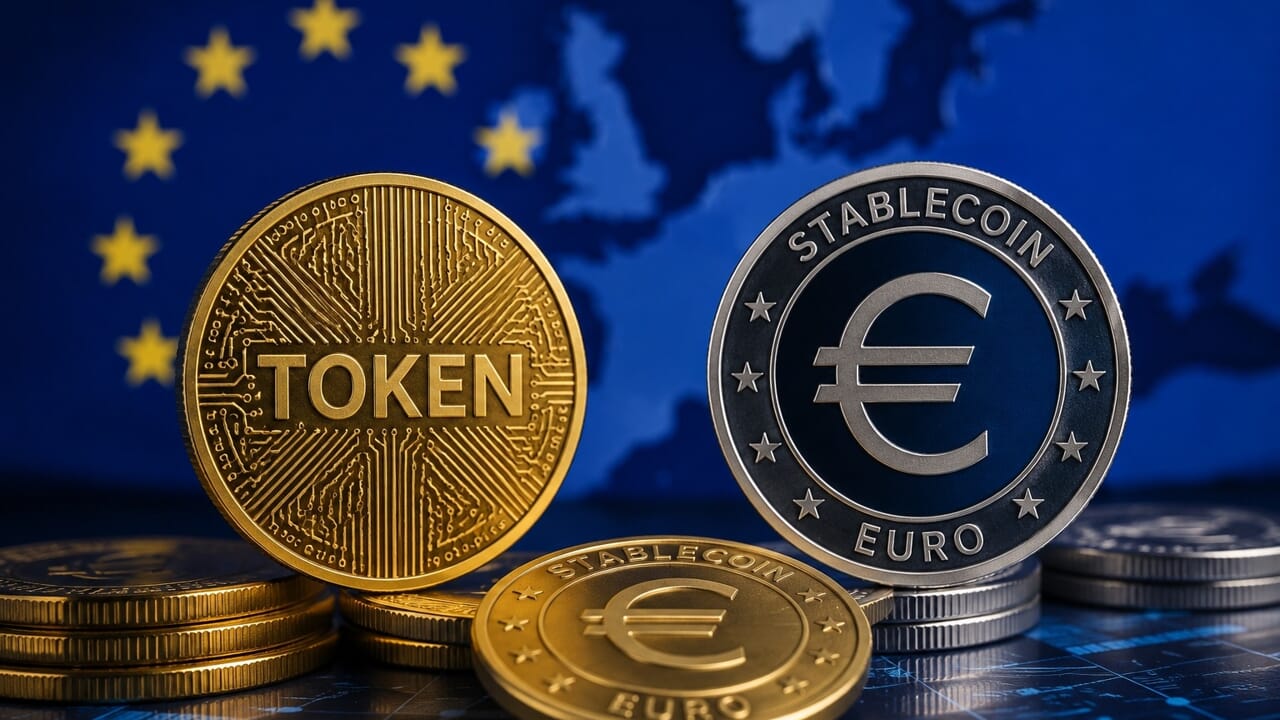
Keeping investment, technological development and payment innovation in Europe while strengthening the competitiveness of financial markets and reducing dependence on foreign infrastructure.
This is the goal the European Union should pursue, according to a resolution adopted by the European Parliament during its latest plenary session. Although the text is non-legislative, it sets out the direction the European Commission and member states should follow in developing digital finance. Among the priorities identified in the resolution on “digital assets – challenges and opportunities for competitiveness and the integrity of the EU financial system” are the wider use of tokenised financial instruments, support for euro-denominated stablecoins, the development of the digital euro and stronger oversight of the risks linked to crypto-assets.
Keeping the market in Europe
According to MEPs, the EU has already secured a competitive advantage by becoming one of the first major jurisdictions to introduce a dedicated regulatory framework for crypto-assets through the Markets in Crypto-Assets Regulation (MiCA). However, that advantage could quickly erode if businesses, investment and technological development move elsewhere.
For this reason, Parliament calls for “a predictable and innovation-friendly regulatory environment”, describing it as essential “to ensure that investment and technological development remain within the EU” while strengthening the competitiveness of financial markets and euro-denominated payment systems.
MEPs also argue that the Commission should prevent the single market from becoming fragmented by diverging national rules and instead promote a harmonised framework that makes it easier to develop new digital financial services.
Finance goes digital
One of the key pillars of the strategy is tokenisation, the process of converting traditional financial instruments such as shares and bonds into digital assets. Rather than being managed through conventional systems, these assets are recorded on a shared digital ledger, making transactions faster, more transparent and harder to tamper with.
The Markets in Crypto-Assets Regulation, better known as MiCA, which became fully applicable in December 2024, divides stablecoins into two categories: asset-referenced tokens, whose value is linked to a basket of currencies or other assets, and e-money tokens, which are pegged to a single official currency such as the euro.
For the latter, MiCA imposes a clear restriction that Parliament explicitly recalls: issuers are prohibited from “granting, directly or indirectly, interest in relation to e-money tokens”. As a result, holding a stablecoin does not generate returns as a bank deposit would. In addition, holders are not protected by deposit guarantee schemes because stablecoins do not have direct access to central bank facilities.
Parliament also stresses that digitising a financial instrument does not change its legal nature. A tokenised security must provide the same rights as a traditional one, preventing regulatory arbitrage and ensuring investor protection.
According to the resolution, tokenisation could make capital markets more efficient, lower operating costs, increase transparency and facilitate cross-border investment. For example, a bond issued in digital form could be transferred and settled almost instantly between investors in different countries, significantly reducing both costs and processing times.
Euro-denominated stablecoins
Another major focus is stablecoins, a category of crypto-assets designed to maintain a stable value by being linked to a currency such as the euro or the US dollar, or to other assets, thereby avoiding the sharp price swings typically associated with many cryptocurrencies.
The resolution expresses concern over the rapid growth of US dollar-denominated stablecoins, warning that their dominance could “weaken the EU’s monetary sovereignty, increase risks to financial stability, impair the transmission of monetary policy and deepen external dependencies in payments”.
Parliament therefore encourages the development of euro-denominated e-money tokens, which are already provided for under MiCA. The objective is to support faster and cheaper cross-border payments, strengthen the international role of the single currency and enhance the competitiveness of Europe’s financial industry. At the same time, MEPs call for common rules on liquidity management and crisis response in order to reduce systemic risks.
The digital euro and European infrastructure
The resolution also supports the European Central Bank’s work on the digital euro, both for everyday retail payments and for wholesale financial transactions.
In particular, Parliament backs the Pontes and Appia pilot projects, which aim to make money transfers and the completion of financial transactions faster and more secure through new digital infrastructures based on central bank money. It also calls on the European Commission and the European Central Bank to ensure that future digital euro solutions are compatible with these new infrastructures and “complement cash”.
MEPs also express concern about Europe’s heavy reliance on technology infrastructure providers based outside the continent and call for close monitoring of the evolving US approach to digital assets.
Risks that cannot be ignored
Alongside the opportunities, the resolution identifies a number of risks that the Commission should continue to monitor closely. The first concerns the use of crypto-assets to circumvent anti-money laundering and counter-terrorist financing rules. Parliament calls for “stronger supervisory, enforcement and compliance tools” to address these risks, including stricter customer identification procedures. The second concerns unbacked crypto-assets, which remain inherently more volatile and risky than other categories.
The third, and perhaps more strategic, issue is Europe’s dependence on non-EU providers of distributed ledger infrastructure. MEPs “regret the EU’s reliance on third-country service providers” and urge the Commission to closely monitor the US administration’s approach to digital assets, given its potential impact on Europe’s competitiveness in this sector.
The resolution therefore calls for more effective supervisory powers, stricter customer identification procedures and greater use of digital technologies to detect and block illicit transactions.