
Bangladesh illustrates this distinction with unusual clarity. Its ready-made garment (RMG) industry has created millions of jobs, generated substantial foreign exchange, and established a major manufacturing base. These achievements deserve full recognition. Yet garments still account for roughly 82 per cent of Bangladesh’s exports. What the country has achieved is substantial but narrowly concentrated industrialisation rather than the broad-based transformation seen in more diversified emerging economies.
Export Success Without Industrial Transformation: Industrialisation normally creates forward and backward linkages that spread through the economy. A globally competitive garment industry could have become the first rung of a longer industrial ladder, encouraging expansion into textiles, synthetic fibres, chemicals, machinery, electronics, engineering services, logistics, research, design, branding, and other higher-value activities. These are the sectors that typically deepen technological capability and broaden the industrial base.
Instead, garments remain overwhelmingly dominant. Bangladesh lacked the coordinated industrial policies, long-term finance, engineering capabilities, and technological infrastructure needed to support more capital-intensive and technologically demanding sectors. Without these complementary foundations, the garment sector’s success could not propagate widely across the industrial landscape.
Export statistics can therefore be misleading when interpreted without considering underlying industrial structure. Under the World Bank’s standard classification, manufactured goods accounted for about 94 per cent of Bangladesh’s merchandise exports in the latest available observation. Comparable recent figures are considerably lower for Indonesia and India. Yet Bangladesh clearly does not possess a deeper or more diversified industrial economy than either country. Its unusually high manufactured-export share reflects garment dominance and the relatively small role of primary commodities in its export basket.
What Indonesia and India Reveal: Indonesia demonstrates why such comparisons require caution. Its economy is more than three times the size of Bangladesh’s and includes substantial industrial, agricultural, mineral, energy, and resource-based production. Its exports span fuels, minerals, metals, palm oil, manufactured goods, and numerous other products. A lower manufactured share of exports can coexist with a larger and more diversified productive economy.
Another revealing indicator is the importance of exports relative to gross domestic product (GDP). In 2024, exports of goods and services represented approximately 10.5 per cent of Bangladesh’s GDP, compared with about 21.2 per cent for India and 22.2 per cent for Indonesia. Bangladesh is therefore not exceptionally export-oriented when exports are measured against the size of the total economy. Its vulnerability arises instead from concentration: a large proportion of a comparatively modest export sector depends on one industry.
India followed a different and more complex route. Beginning under Jawaharlal Nehru, it invested heavily in steel, engineering, scientific education, research institutions, public-sector enterprises, and technological capability. Its large domestic market provided firms with substantial demand and allowed industrial learning behind protective barriers. These policies helped create scientific and engineering capacities that Bangladesh never developed to the same extent.
India’s experience, however, should not be interpreted as an endorsement of unrestricted inward-looking industrialisation. Its regulatory structure eventually evolved into the License Raj, under which government permission was required to establish factories, expand capacity, introduce products, and import machinery. The dismantling of many of these restrictions, followed by trade liberalisation, greater foreign investment, technological inflows, and deeper participation in international markets, accelerated industrial development. India’s transformation was therefore neither purely export-oriented nor purely home-market-oriented. It combined domestic capability building with increasing exposure to foreign technology and competition.
Technology, Markets, and Industrial Catch-Up: Successful late industrialisation also depends on technological catch-up. Countries beginning well behind the technological frontier do not have to reinvent every machine, production process, managerial technique, or scientific advance already developed elsewhere. Japan, South Korea, Brazil, India, and Mexico, despite following different development strategies, benefited from technologies, machinery, engineering knowledge, production techniques, and managerial practices originating in advanced industrial economies.
Technology licensing, imported capital equipment, foreign direct investment, joint ventures, multinational enterprises, reverse engineering, education, and domestic adaptation provided channels through which technological knowledge crossed national borders. These mechanisms allowed emerging economies to accelerate productivity growth by adopting and adapting existing technologies rather than inventing them from scratch.
This experience is broadly consistent with the macroeconomic convergence hypothesis rooted in Robert Solow’s neoclassical growth model and later technological catch-up literature. Economies beginning below the technological frontier possess the potential to grow faster because adopting existing technologies can be less costly and less time-consuming than developing them independently. But convergence is not automatic. Countries require an educated workforce, engineering capability, research institutions, infrastructure, investment, entrepreneurship, effective institutions, and sufficient absorptive capacity to translate imported technologies into sustained productivity growth.
Bangladesh’s trajectory suggests that its absorptive capacity—especially in engineering, research, and firm-level learning—remains limited. These constraints reduce the speed at which imported technologies can be transformed into broad-based productivity gains.
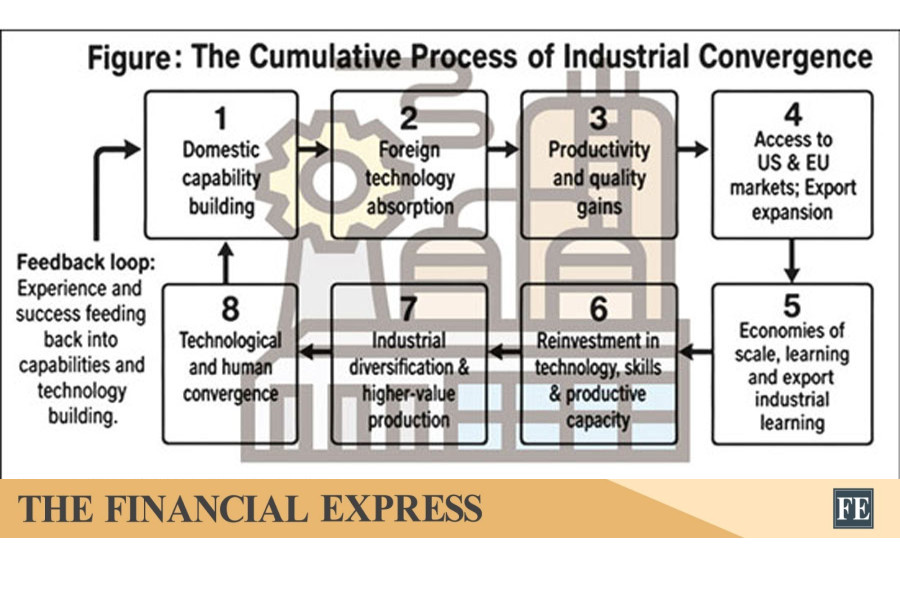
Technology transfer was only one side of the process. The other was access to the enormous consumer markets of the United States (US) and Western Europe. Advanced economies served simultaneously as sources of technology and destinations for manufactured products. Foreign technology raised productivity and quality, while access to large high-income markets allowed firms to produce at scales their domestic markets alone might not have supported.
Japan and South Korea provide especially strong examples. They absorbed foreign technologies, developed increasingly sophisticated domestic industrial capabilities, and used American and European markets to expand production. Export demand generated economies of scale, foreign exchange, capital accumulation, manufacturing experience, and pressure to meet international standards. These gains then supported further investment in technology, skills, research, and higher-value industries.
Mexico followed another path, but its industrial transformation also became increasingly connected to the vast US market, foreign investment, multinational production networks, and imported technologies. Brazil and India relied more heavily on their large domestic markets during important stages of industrialisation, but they too benefited from foreign technology and greater participation in international trade and investment.
The broader lesson is that technological absorption and access to large markets reinforce each other. Foreign technology raises productivity; higher productivity improves export competitiveness; expanding exports generate foreign exchange, economies of scale, investment, and industrial learning; and these gains finance further technological upgrading. Successful convergence requires transforming foreign technology and foreign-market access into progressively deeper domestic productive capabilities.
Why Bangladesh’s Success Did Not Spread: Bangladesh’s garment industry successfully combined imported machinery and production technologies, abundant labour, entrepreneurial initiative, and access to American and European markets to become one of the world’s leading apparel exporters. In that sense, Bangladesh participated successfully in the same international production and market integration that helped earlier industrialising countries accelerate development.
The difficulty lies in what did not follow. Export earnings, commercial connections, manufacturing experience, technological knowledge, and entrepreneurial capabilities generated by garments did not spread sufficiently into machinery, advanced textiles, man-made fibres, chemicals, electronics, engineering, research, product development, design, branding, and other higher-value activities. Bangladesh entered the global production system successfully but remained concentrated in a relatively narrow portion of it.
The Domestic Market Still Matters: This brings the domestic market back into the picture. The home market should not be viewed simply as a residual market to be served after export opportunities have been exhausted. Rising household incomes generate demand for locally produced goods, while expanding domestic demand allows firms to accumulate capital, train workers, establish supplier networks, improve technology, experiment with products, and develop capabilities before confronting international competition.
For countries with sufficiently large populations, the domestic market can provide the initial scale needed for industrial learning; foreign markets can subsequently multiply that scale.
Nor should domestic markets be protected indefinitely. Excessive protection can create inefficient firms dependent on political privilege rather than technological improvement. A more promising model is domestic-capability-led and export-disciplined industrialization: domestic demand provides an incubator for entrepreneurship, diversification, and technological learning; imported technologies accelerate productivity gains; and international markets provide scale, foreign exchange, and competitive discipline.
For Bangladesh, the challenge is not to retreat from exports or diminish the extraordinary contribution of garments. It is to use the capital, capabilities, technological experience, and international networks accumulated through garments as stepping-stones toward a broader industrial structure. Bangladesh has realistic opportunities in technical textiles, light engineering, and chemical intermediates—sectors that build naturally on existing capabilities while offering greater technological depth.
The success of one export industry should become the beginning of industrial transformation, not its destination.
Export-oriented industrialisation remains a powerful pathway from poverty toward prosperity, but its success needs to be judged by what develops behind the export figures: technological depth, diversification, productive capability, and employment. For Bangladesh, the next stage is not simply to export more, but to combine domestic demand, foreign technology, and international markets to build a diversified and technologically progressive industrial economy capable of continuously moving toward higher-value production.
Dr Abdullah A Dewan, former physicist and nuclear engineer at Bangladesh Atomic Energy Commission, is professor emeritus of economics at Eastern Michigan University.
[email protected]