
Closed-End vs. Open-End Investments: An Overview
Closed-end funds usually issue a fixed number of shares, although some closed-end structures offer shares continuously or periodically. Open-ended funds don’t have a limit on the number of issued shares. The primary differences between the two lie in how they’re organized and how investors buy and sell them.
Both are professionally managed funds that pool the resources of many investors. They commonly provide diversification by investing in a collection of equities or other financial assets rather than in a single stock.
Key Takeaways
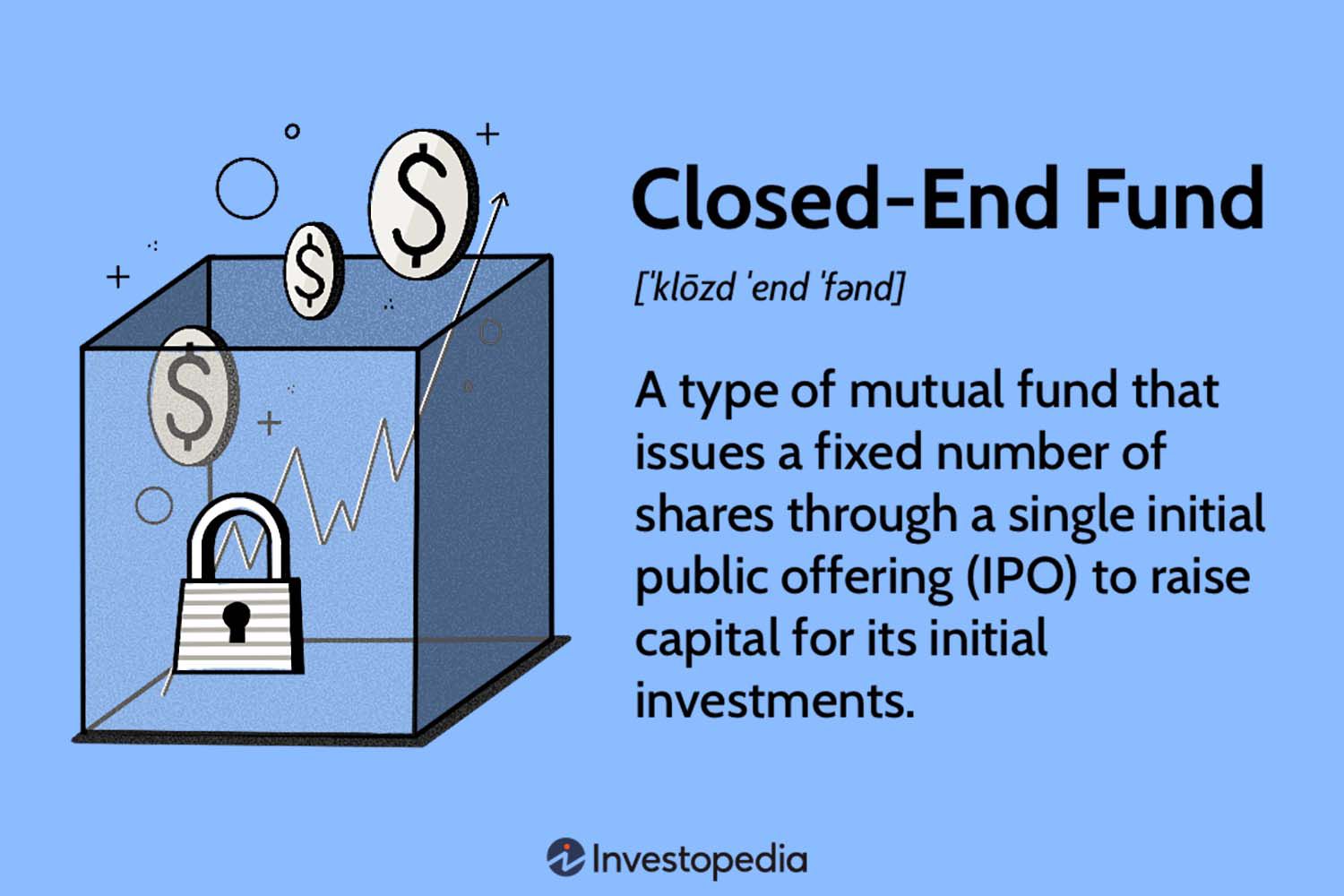
- A closed-end fund generally offers a fixed number of shares through an initial public offering.
- Open-end funds don’t have a fixed number of shares.
- Open-end funds are offered through fund companies that sell shares directly to investors.
- There are significant differences in the structure, pricing, and sales of closed-end funds and open-end funds.
Closed-End Investments
A closed-end investment is overseen by an investment or fund manager. Publicly traded closed-end funds often offer a fixed number of shares and raise their initial capital through an initial public offering (IPO). Shares are listed on an exchange after the public offering, and investors can purchase them through a brokerage firm on the secondary market.
Closed-end funds can be traded throughout the day when the market is open. They can take on additional capital after their initial launch, including through secondary or rights offerings, and they may own unlisted securities in the U.S. There are also interval funds, a type of closed-end fund that typically doesn’t trade in the secondary marketplace.
Shares of publicly traded closed-end funds trade at market prices that can differ from the fund’s net asset value (NAV). Investors can purchase or sell these shares at their market price during the trading day. Market demand drives the price level for closed-end funds, so their shares commonly trade at either a premium or a discount to NAV.
Closed-end funds are more likely than open-end funds to include alternative investments in their portfolios. These can include futures, derivatives, or foreign currency. Some closed-end funds, such as municipal bond funds, try to minimize risk by investing in local and state government debt.
Distributions from closed-end funds come from several possible areas. They can come from dividends, realized capital gains, or interest from fixed-income assets held in the funds. Regulated investment companies generally distribute taxable income and gains to shareholders, although not every distribution creates a current tax liability. Many shareholders who receive reportable distributions get an IRS Form 1099-DIV showing the breakdown.
Open-End Investments
You wouldn’t be entirely wrong if you heard the term open-end fund and immediately thought of a mutual fund. A mutual fund is one type of open-end fund, and many ETFs are also legally organized as open-end investment companies. Some hedge funds use open-ended structures, although most U.S. hedge funds are private, unregistered funds. Investors may buy mutual fund shares from the fund or through a financial intermediary, while retail investors generally buy and sell ETF shares on an exchange. Outside of the United States, open-end funds can take the form of SICAVs in Europe and OEICs or unit trusts in the U.K.
Investors can submit traditional mutual fund orders during the business day, and the price is based on the next net asset value (NAV) calculation. There’s no limit to how many shares an open-end fund can offer, and new shares are issued continuously to meet demand.
The net asset value (NAV) is usually determined at the end of the trading day. NAV is a measure of the fund’s total assets minus its total liabilities; per-share NAV divides that amount by the number of outstanding shares. NAV changes with the portfolio’s value, but total return is the more appropriate measure of fund performance. Open-end ETFs trade throughout the day at market prices.
Some open-end funds charge investors a fee that occurs when shares are purchased or when they’re sold. A front-end load is a fee or commission that’s charged when an investor initially purchases shares in the fund. This is a one-time charge and isn’t incurred as an operating expense.
The back-end load is a fee charged to investors when they sell shares in mutual funds. The fee amount depends on the value of the shares being sold and is usually charged as a percentage. Other open-end funds won’t charge investors a sales load fee at all, but may still charge other redemption, exchange, and operating fees. These are known as no-load funds.
Important
Mutual funds commonly distribute income and capital gains to shareholders. Investors holding them generally owe tax on distributions and realized gains, but not every distribution is currently taxable. Funds can also owe tax on retained or undistributed gains, and different rules may apply to retirement accounts, exempt-interest distributions, and nondividend distributions.
How Will I Use This in Real Life?
Let’s say a closed-end fund’s shares are being traded on the New York Stock Exchange. It has more than $335 million in assets under management and 21.3 million shares outstanding. It’s trading at a discount of -2.96% and it has a current monthly distribution per share of $0.0882. The fund has 161 holdings and a market price of $11.82. You’d have to buy 10,000 shares for $118,200 to achieve a gross cash distribution of $882, although that distribution shouldn’t automatically be characterized as income because it may include return of capital.
Now consider an open-ended fund with just under $42 billion in assets under management. This fund tracks the S&P 500 Index and has a net expense ratio of 0.01%. It holds the stocks of 504 companies and is open to new investors who can purchase shares through a broker. Gains are made by increases in a share’s market price. The fund is coming off a one-year return of 29.85%, a five-year return of 15.04%, and a 10-year return of 12.94%.
Which option is right for you? It depends on how much of a return you’re looking for and when you want to achieve it.
Is an ETF Open- or Closed-End?
Most ETFs are organized as open-end investment companies, and their number of outstanding shares can change through the creation and redemption process. However, some ETFs are organized as unit investment trusts rather than open-end investment companies. Traditional publicly traded closed-end funds generally sell a fixed number of shares in an initial public offering, although they can issue additional shares later.
What’s the Difference Between Open-End and Closed-End REITs?
The open-end and closed-end labels don’t reliably describe a REIT’s lifespan. Some non-listed REITs are structured as evergreen funds with no fixed termination date. REIT investors may seek dividend income, capital appreciation, or both.
What’s the Difference Between Open-End and Closed-End Management Companies?
Open and closed-end funds are legal companies that are registered to offer shares. These companies can offer shares as part of an IPO (closed-end) or continuously offer shares on the market (open-end).
The Bottom Line
An open-end mutual fund doesn’t have a fixed number of shares and generally offers shares continuously at net asset value (NAV), plus any applicable fees. A traditional publicly traded closed-end fund generally raises its initial capital through a public offering. Its shares then trade on the market and often sell at a premium or discount to NAV.