
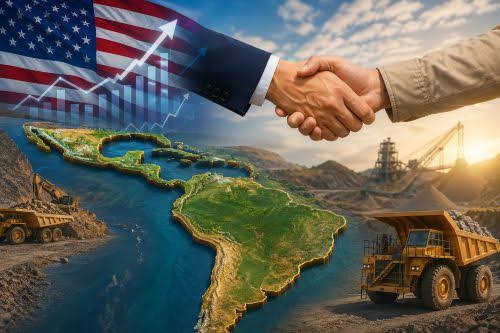
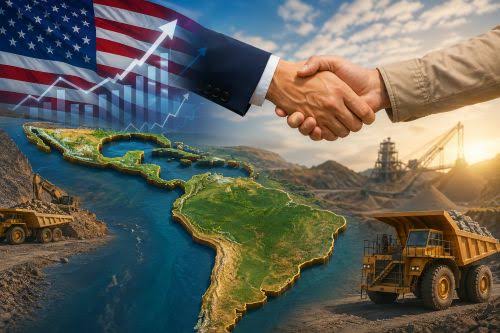
The United States has been accelerating its influence in Latin America through a series of initiatives that have advanced in recent days, with impacts both on important sectors of the economy and on the region’s politics.
Since the beginning of Donald Trump’s current administration, in January 2025, the U.S. government has emphasized its intention to bring Latin America back into the United States’ sphere of influence.
In recent decades, China has occupied a significant space in the region, with strong trade and heavy investments, while at the same time the United States turned its attention to issues in other parts of the world, such as the Middle East.
Latin America is now an increasingly important stage for the geopolitical rivalry between the two global powers, the United States and China, and this has been affecting both the business environment and the political environment in the region in various ways.
The businesses
In the economic sectors, U.S. initiatives in the region are gaining traction.
This week, international trading companies Glencore and Mercuria were selected by the United States government as founding partners in the launch of the initiative called VaultCo, which is likely to favor direct investment in critical mineral projects in Latin America.
Announced at the beginning of the year, the Vault project is an initiative of up to US$12 billion created by the United States government to build stocks of critical minerals and rare earths, with the aim of protecting the national industry against supply disruptions and reducing dependence on China, through investments and financing in the critical minerals chain.
Glencore has now received a commitment of US$500 million from the Export-Import Bank of the United States (EXIM), the same amount committed to Mercuria.
The dispute between the United States and China for influence has been a catalyst for business.
“I don’t think there has ever been a moment like this for mining, especially for critical minerals and for mining more broadly, which covers not only extraction but also processing. The current wave initially began with the demands of the energy transition, especially for copper, lithium, cobalt, and other minerals. But it has now expanded to other critical minerals that are important for defense, electric vehicles, and other applications. The level of activity we are seeing at this moment is extremely high. I’ve never seen anything like it,” said Augusto Ruiloba, a partner at the international law firm A&O Shearman, to BNamericas, emphasizing that part of the strong appetite of international investors for the critical minerals chain in Latin America has been driven by the participation of multilateral institutions backed by governments.
As part of this trend, in the rare earths segment, the United States Secretary of State, Marco Rubio, recently visited Colombia, Ecuador and Peru, amid Washington’s efforts to strengthen ties with right-wing governments in the region, and highlighted the United States’ interest in the critical minerals chain throughout the region.
In Colombia, where Rubio met with the newly elected president, Abelardo de la Espriella, the governments of the two countries signed an agreement focused on cooperation to ensure the supply, mining, and processing of critical minerals and rare earths.
But U.S. interest in the region is not focused solely on mining.
In Argentina, U.S. support tends to generate impacts on various projects.
The Andes–Atlantic Corridor, launched by the United States and Argentina, will modernize the rail, pipeline, port, energy and digital infrastructure that connects Argentina’s mineral-rich northwest and the Vaca Muerta shale basin to Atlantic ports, with support of up to US$7 billion in US financing.
The resources will come from the Export-Import Bank, or EXIM, which provides financing until 2027.
On another front, during the United Nations General Assembly, President Trump met with Venezuela’s interim president, Delcy Rodríguez, amid the strong interest of the United States in the Venezuelan oil and gas sector.
“During the talks, the strengthening of bilateral relations and the development of a joint work agenda in strategic areas, such as energy, mining, security, and other issues of mutual interest were assessed”, said the government of Venezuela in a statement.
Another sector in the U.S. spotlight is technology.
“The United States is in the midst of a technological race with China, and Latin America is of interest to the United States in two respects. One is the issue of having access to technological infrastructure, such as in the area of data centers and energy sources. The other aspect is the issue of social networks and the regulations regarding them, which involve topics related to the influence of power in the region and the control of narratives,” Mário Sérgio Lima, an analyst at Medley Global Advisors, told BNamericas.
Lima mentioned the case of the American billionaire Peter Thiel, cofounder of PayPal and Palantir and close to the Trump administration, who recently moved to Argentina and became closer to the government of President Javier Milei, amid the interests of technology entrepreneurs in the region.
Politics
The growing US influence has also been seen in the political arena, where the Trump administration has celebrated recent victories by right-wing politicians in Latin America.
But this influence has also generated tensions.
Despite the advance of right-wing parties, the two largest countries in the region, Brazil and Mexico, are governed by left-wing politicians, and the United States has a conflictive relationship with both.
In Brazil, the issue has gained prominence as the October elections approach, with recent polls indicating a tight race between the current president and left-wing candidate, Luiz Inácio Lula da Silva, and the right-wing candidate, Flávio Bolsonaro.
Recently, a group of 30 representatives and a senator from the United States sent an open letter to Secretary of State Rubio criticizing the attempts by the United States to interfere in the election in Brazil.
The Trump administration and the Lula government have maintained a tense relationship in recent months, with Brazil pointing to attempts by the United States to interfere in the Brazilian political process, among other means, through the imposition of tariffs on Brazilian products.
In addition, the Trump administration has sought to undermine the image of the Brazilian government in the security area, after designating Brazilian criminal groups such as the PCC and the Comando Vermelho as terrorist organizations.
Historically, voters associate public security problems with the allegedly weak fight against these organizations by left-wing politicians, who tend to emphasize human rights aspects, while right-wing political forces advocate a tougher stance on security issues.
During the current presidential campaign in Brazil, Lula has used the signs of interference to criticize attempts by the United States to intervene, while Flávio Bolsonaro has sought to support U.S. policy, claiming that it can benefit the fight against criminal organizations.
Recently, a coalition of Latin American countries currently governed by right-wing politicians joined Washington and also declared criminal organizations from Brazil to be terrorist groups.
Turnaround?
It is also through politics that this entire scenario can be turned around.
In November, the United States will have the so-called midterm elections, which will determine the new composition of the U.S. Congress, and recent polls show chances of the Democratic Party winning a majority in Congress, to the detriment of Trump’s Republican Party.
“The midterm elections will have a direct impact on American influence in Latin America. That is because, if the Democrats manage to secure a majority in Congress, we tend to see a lot of challenges to various United States plans in the region, such as, for example, what the current government has been doing to interfere in security issues in the region and also to various oil agreements that are being concluded in Venezuela without much transparency”, said Lima.
(The original version of this content was written in Portuguese.)