
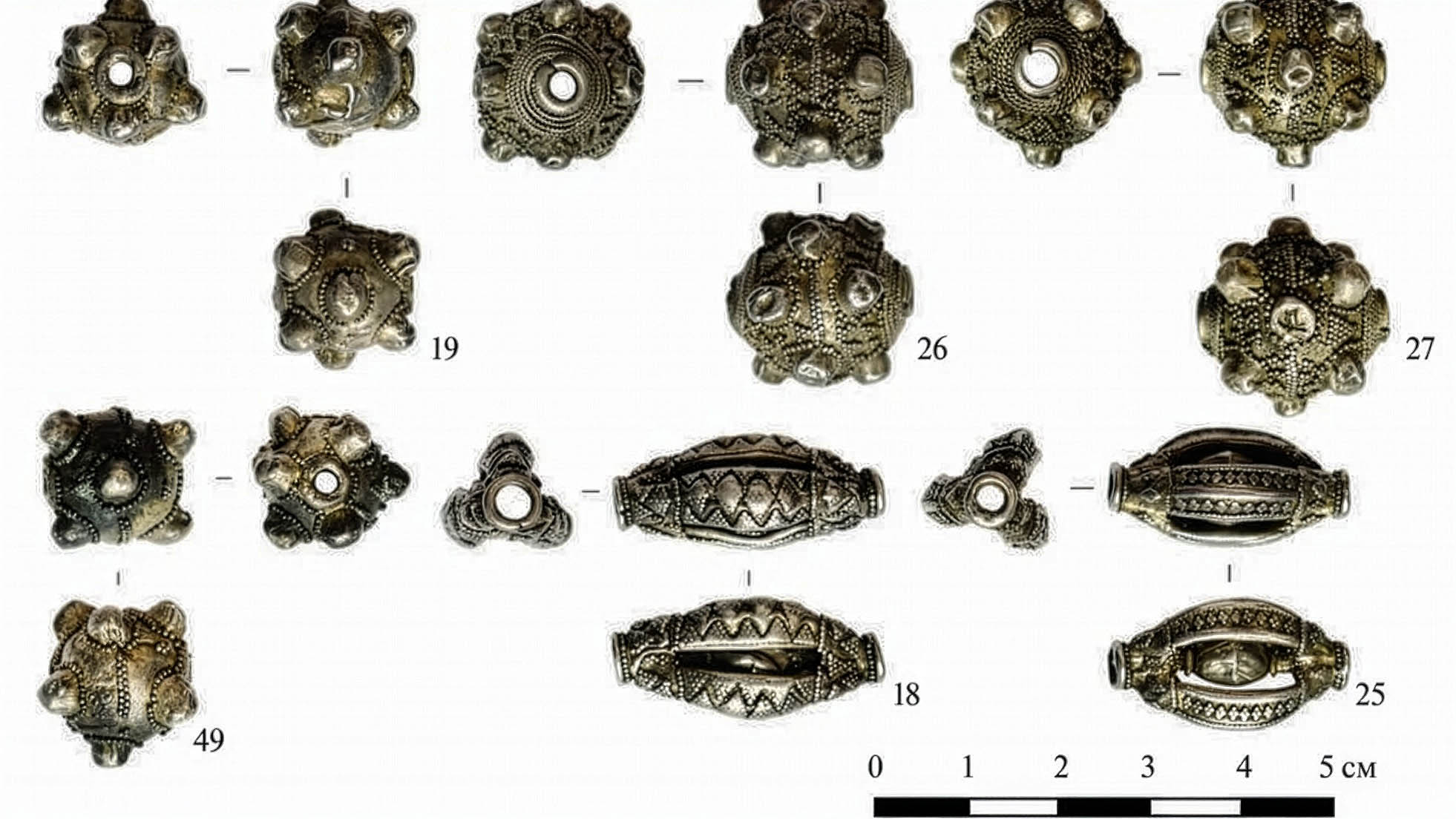
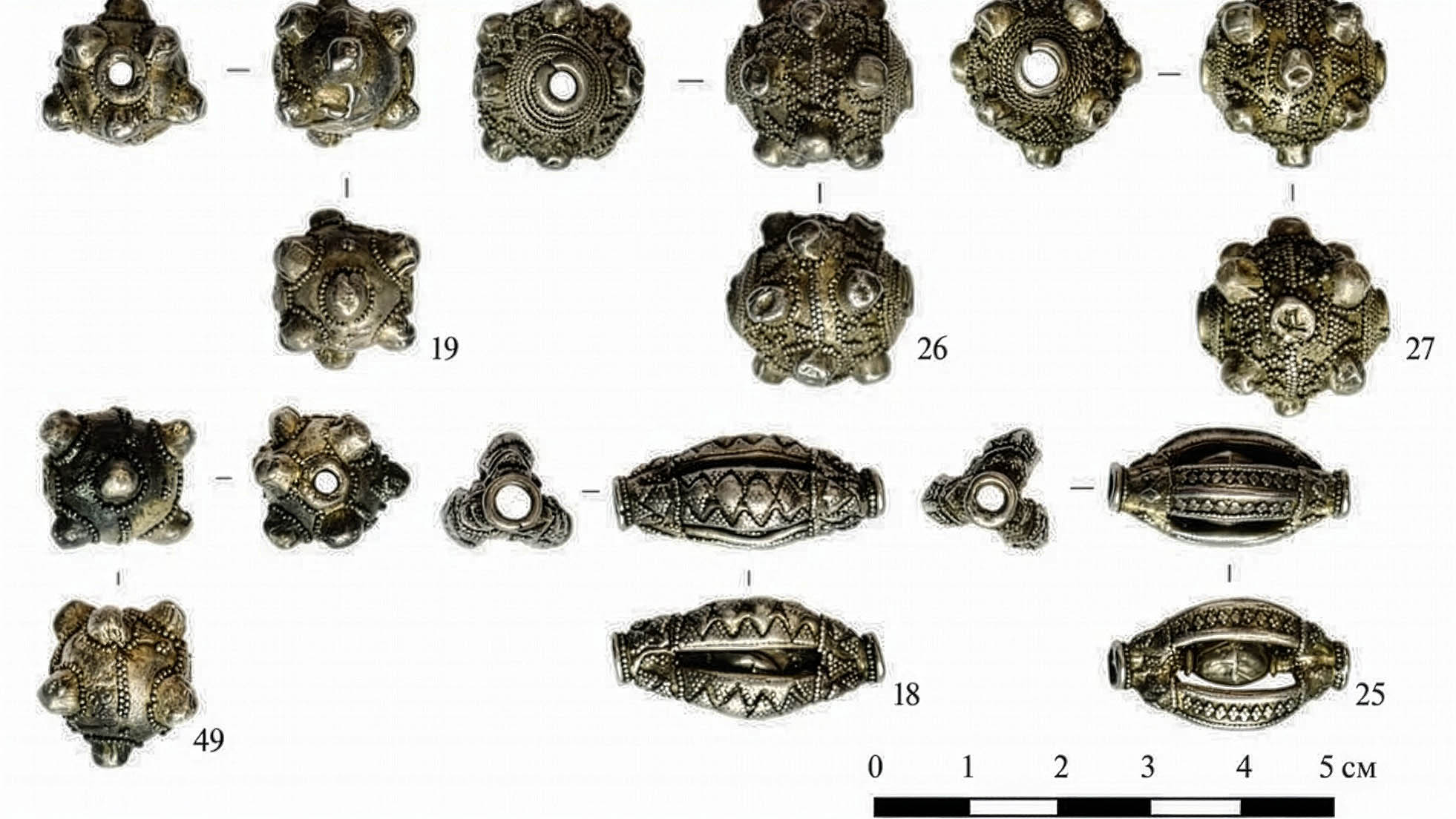
Researchers have identified that a buried 10th-century silver necklace in Veliky Novgorod, one of the oldest cities in northwestern Russia, contains beads traced to workshops across Scandinavia, central Europe, and early Rus.
That reach reframes the city as a tightly connected hub where status objects moved across vast regions and carried shared cultural meaning.
Clues inside one pit

Buried in a clay pit on Novgorod’s Sofia Side, a historic district, the cache held nearly 1,900 objects from one concealed act.
By analyzing 40 beads, Irina Zaytseva of the Institute of Archaeology of the Russian Academy of Sciences (IA RAS) matched them to European finds.
Different bead types tied the hoard to Scandinavian, Slavic, and broader European traditions rather than to a single local workshop.
Instead of one local style, the jewelry suggests an elite wardrobe assembled through contacts, gifts, trade, and recycled silver.
Silver from many mints
Most of the hoard was coin silver, with more than 1,800 pieces struck in the Middle East and Central Asia.
Among those coins, dirhams – silver coins used across Islamic trade – made up the largest group and reached Novgorod through long commercial chains.
Coins and ornaments sat together in one deposit, showing how easily silver could move between money and display.
A Byzantine silver coin, a German piece, and Volga Bulgarian imitations help date the burial to the late 970s.
Jewelry that held value
Wear marks told a second story, because some beads were rubbed smooth while others stayed sharply defined.
Many silver beads were heavily worn, which points to long use before the hoard ever entered the ground.
Several ornaments also showed repairs, suggesting their owners kept prized pieces in use rather than discarding damaged silver.
That pattern makes the cache feel less like freshly assembled wealth and more like valuables kept within a household.
Craft seen inside
To see how the beads were built, researchers used tomography, scans that reveal interiors in thin slices.
Those scans clarified manufacturing methods, soldering points, and metal composition, which stayed remarkably pure across the ornaments.
The team also identified the types of wire used in the decoration, adding detail to how the beads were assembled.
That level of control makes the jewelry look less improvised and more like output from practiced, well-developed workshops.
Fashion across frontiers
Parallels in Gnezdovo near Smolensk in western Russia, on Sweden’s Gotland, and in Roskilde, Denmark, place the ornaments in a broad northern style.
Pendants and beads also used filigree, thin silver wire soldered into patterns, seen in older hoards from near Novgorod.
“Despite the uniqueness of each item in the new hoard, all of them have analogies in hoard complexes of this period discovered in Eastern Europe and Scandinavia,” said Zaytseva.
That spread shows local elites could follow a shared look without giving up regional pieces and regional meanings.
Early Christian symbols
One silver cross in the hoard links the cache to some of the earliest Christian objects known in early eastern Slavic lands.
Its flared arms and triple discs match Scandinavian-type crosses that spread in northern Europe during the later 10th century.
Because Novgorod’s better-dated examples usually come later, this piece hints that Christian symbols reached local elites before official conversion.
That does not prove who wore it, but it narrows the distance between trade networks and early religious change.
Status through jewelry
Within one dress set, the ornaments also mix Scandinavian and East Slavic traditions rather than separating them into collections.
A temple ring used granulation, tiny silver beads fused onto metal, in a style that later became common in East Slavic dress.
That combination fits the wider picture of a city where imported forms met local taste and local power.
Jewelry here was not just decoration, because it signaled rank, connections, and belonging in an emerging political world.
What remains unknown
The hoard also leaves one crucial thing unresolved, because archaeology recovers objects more easily than motive or fear.
Coins, pendants, and beads survived in place, yet the human decision behind the burial remains out of reach.
That limit matters because the cache preserves wealth, status, and belief, but not the personal emergency behind them.
Unanswered questions like that keep the find open, turning a finished collection into a still-moving historical problem.
Importance of rescue digs
Found during rescue excavations ahead of construction, the hoard did not emerge from a search aimed at treasure.
That setting preserved the pit, its layers, and the relationship between coins and ornaments, which random digging often destroys.
Only three comparable hoards from this period had been found in Novgorod before, which helps explain the excitement.
Seen that way, the cache matters not just for beauty, but because archaeologists caught it with its story intact.
What the hoard shows
The hoard shows that one buried set of ornaments could tie Novgorod to bullion routes, craft traditions, religious symbols, and fashion across Europe.
Further study may refine where each piece was made, but the buried set already makes Novgorod’s early history feel larger and more connected.
The study is published in Russian Archaeology.
Image Credit: Institute of Archaeology of the Russian Academy of Sciences
—–
Like what you read? Subscribe to our newsletter for engaging articles, exclusive content, and the latest updates.
Check us out on EarthSnap, a free app brought to you by Eric Ralls and Earth.com.
—–