
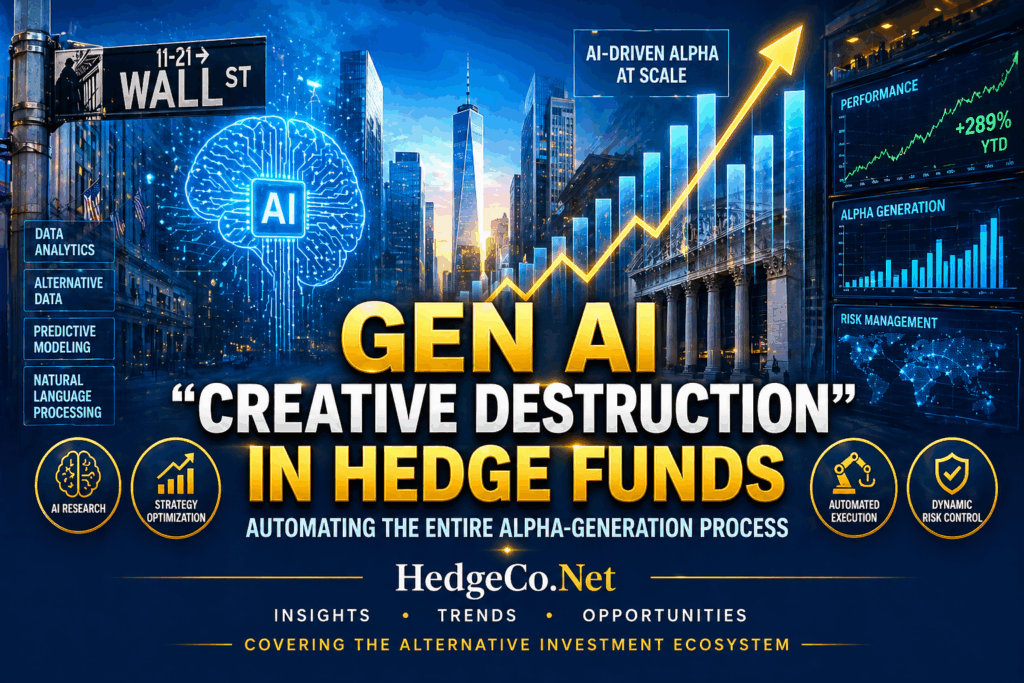
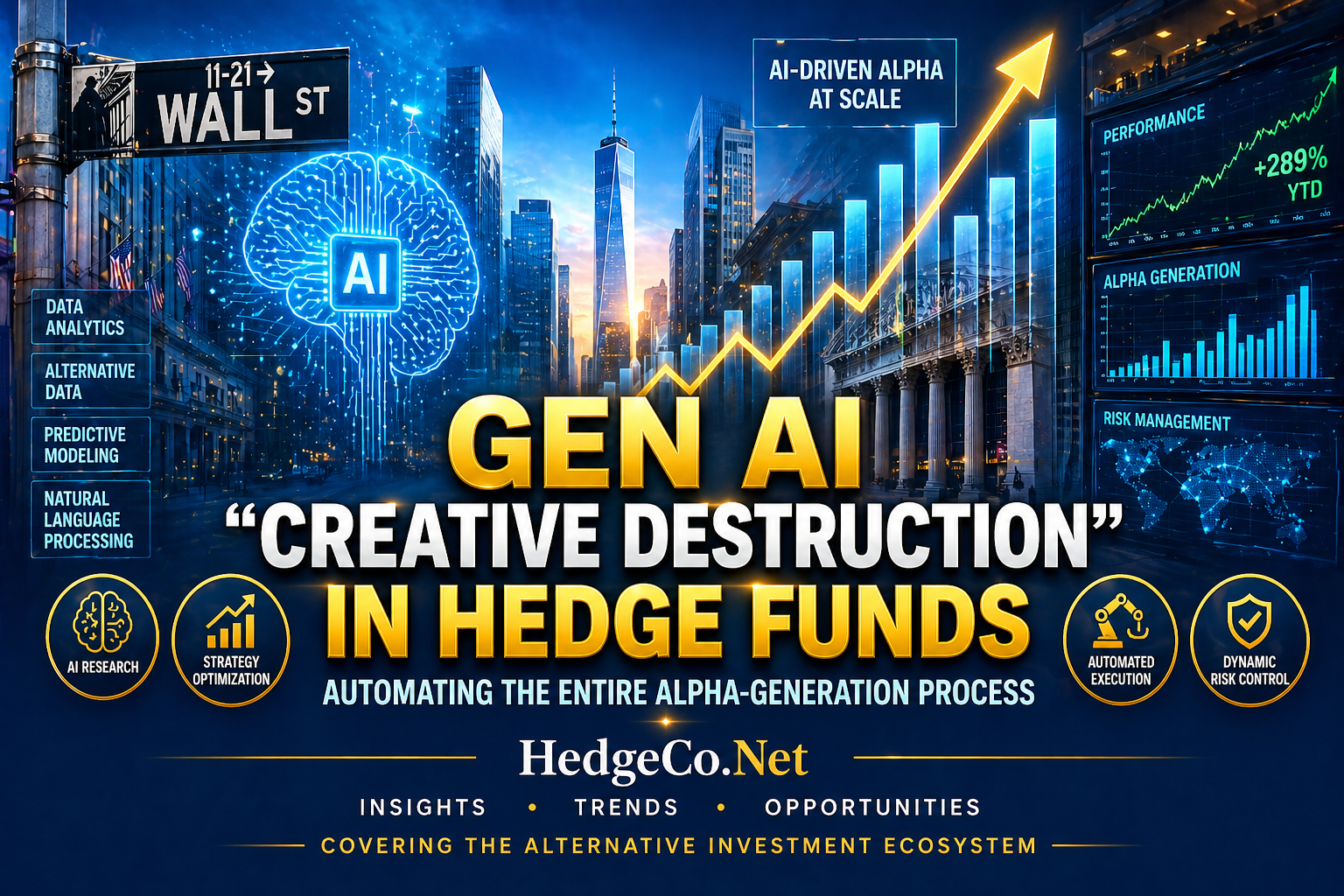
(HedgeCo.Net) A new paradigm is emerging across the hedge fund industry—one that goes far beyond simply allocating capital to artificial intelligence themes. According to Morgan Stanley’s 2026 outlook, the industry is entering a phase of “creative destruction,” where generative AI (Gen AI) is not just influencing investment decisions, but fundamentally reshaping how alpha is generated, executed, and scaled.
This shift represents one of the most consequential technological inflections in modern finance. For decades, hedge funds have competed on human insight, discretionary judgment, and incremental technological advantages. Today, that model is being challenged by systems capable of processing vast datasets, generating investment theses, executing trades, and continuously learning from outcomes—all with minimal human intervention.
The result is a profound transformation of the hedge fund value chain.
From Investing in AI to Becoming AI-Driven
The first wave of AI adoption in hedge funds was relatively straightforward: invest in companies building or benefiting from artificial intelligence. This included semiconductor firms, cloud providers, and software companies enabling machine learning applications.
But the second wave—now underway—is far more disruptive.
Hedge funds are increasingly turning inward, applying AI not just as an investment theme, but as a core operational capability. Gen AI models are being deployed across the entire investment lifecycle:
- Idea Generation: Identifying opportunities through pattern recognition and data synthesis
- Research Automation: Summarizing earnings calls, parsing filings, and extracting insights from unstructured data
- Portfolio Construction: Optimizing allocations based on real-time risk and return metrics
- Trade Execution: Automating order placement and adjusting strategies dynamically
- Risk Management: Monitoring exposures and stress-testing portfolios continuously
This end-to-end integration of AI has the potential to compress timelines, reduce costs, and enhance decision-making at a scale previously unimaginable.
The Concept of “Creative Destruction”
The term “creative destruction,” originally coined by economist Joseph Schumpeter, refers to the process by which innovation disrupts and replaces existing systems. In the context of hedge funds, Gen AI is acting as the catalyst for such disruption.
Traditional investment roles—analysts, traders, even portfolio managers—are being redefined. Tasks that once required teams of highly paid professionals can now be performed by algorithms in a fraction of the time.
This does not mean human expertise is becoming obsolete. Rather, it is being augmented—and in some cases, displaced—by machines.
Firms that fail to adapt risk being left behind.
The Automation of Alpha
At the heart of this transformation is the concept of “automated alpha.”
Historically, alpha generation has been a labor-intensive process, relying on deep fundamental research, market intuition, and experience. Gen AI introduces a new approach—one that leverages data, computation, and continuous learning.
Modern AI systems can:
- Analyze millions of data points simultaneously
- Identify correlations and anomalies invisible to human analysts
- Generate hypotheses and test them in real time
- Adapt strategies based on evolving market conditions
In effect, alpha becomes a function of computational power and data quality.
This shift has profound implications for the industry. It lowers the barriers to entry for technologically sophisticated firms while raising the bar for everyone else.
The Data Arms Race
If AI is the engine, data is the fuel.
Hedge funds are engaged in an increasingly intense competition to acquire, process, and utilize data. This includes not just traditional financial data, but also alternative datasets such as satellite imagery, social media sentiment, supply chain information, and web traffic.
Gen AI models thrive on large, diverse datasets. The more data a firm can access, the more effective its models can become.
This dynamic is creating a “data arms race,” where scale and access are critical advantages. Large multi-manager platforms and well-capitalized firms are particularly well-positioned, as they can invest heavily in data acquisition and infrastructure.
Smaller firms, by contrast, may struggle to compete.
Multi-Manager Platforms and AI Integration
The rise of AI is particularly significant for multi-manager platforms.
Firms like Citadel, Millennium Management, and Point72 Asset Management have long relied on technology to manage risk and allocate capital across dozens of portfolio managers.
Gen AI takes this model to the next level.
By integrating AI into their platforms, these firms can:
- Enhance risk management through real-time analytics
- Optimize capital allocation across strategies
- Identify underperforming teams more quickly
- Provide PMs with advanced research tools
The result is a more efficient, data-driven ecosystem—one that amplifies the strengths of the multi-manager model.
The Changing Role of the Portfolio Manager
As AI takes on more responsibilities, the role of the portfolio manager is evolving.
Rather than focusing on granular analysis, PMs are increasingly acting as orchestrators—overseeing AI-driven processes, validating outputs, and making high-level strategic decisions.
This shift requires a different skill set:
- Technical Literacy: Understanding how AI models work and how to interpret their outputs
- Data Interpretation: Distinguishing signal from noise in complex datasets
- Strategic Thinking: Setting the direction for AI-driven strategies
- Risk Oversight: Ensuring that automated systems operate within defined parameters
In this new paradigm, the most successful PMs will be those who can effectively collaborate with machines.
Cost Structures and Margins
One of the most immediate impacts of AI adoption is on cost structures.
Hedge funds have traditionally been labor-intensive businesses, with significant expenses related to compensation, research, and operations. AI offers the potential to reduce these costs by automating many functions.
However, these savings are offset by new investments:
- High-performance computing infrastructure
- Data acquisition and storage
- AI model development and maintenance
- Cybersecurity and compliance
The net effect is a shift in cost composition rather than a simple reduction. Firms that can scale their AI capabilities effectively are likely to see improved margins over time.
Risks and Limitations
Despite its promise, Gen AI is not a panacea.
Several risks must be carefully managed:
Model Risk: AI systems can produce erroneous or biased outputs, particularly if trained on flawed data.
Overfitting: Models may perform well in backtests but fail in live markets.
Black Box Nature: The complexity of AI models can make it difficult to understand how decisions are made.
Cybersecurity: Increased reliance on technology creates new vulnerabilities.
Regulatory Scrutiny: Regulators are beginning to examine the use of AI in financial markets more closely.
Addressing these risks requires robust governance frameworks, transparency, and ongoing oversight.
The Competitive Landscape
The adoption of Gen AI is reshaping competitive dynamics within the hedge fund industry.
Large, well-capitalized firms are leading the charge, leveraging their resources to build advanced AI capabilities. Technology-focused funds and quantitative firms are also well-positioned, given their existing expertise.
Traditional discretionary managers face a more challenging transition. While many are incorporating AI into their processes, the cultural and operational shift can be significant.
The result is a widening gap between “AI-native” firms and those still adapting.
Beyond Hedge Funds: Industry-Wide Implications
The impact of Gen AI extends beyond hedge funds to the broader financial ecosystem.
Asset managers, banks, and private equity firms are all exploring ways to integrate AI into their operations. From credit underwriting to deal sourcing, the applications are vast.
In this sense, the “creative destruction” identified by Morgan Stanley is not confined to a single segment—it is a systemic transformation.
The Future of AI in Investing
Looking ahead, several trends are likely to shape the evolution of AI in hedge funds:
- Increased Autonomy: AI systems will take on more decision-making responsibilities
- Integration Across Functions: AI will become embedded in every aspect of the investment process
- Collaboration Between Humans and Machines: Hybrid models will dominate
- Regulatory Frameworks: Clearer guidelines will emerge around AI usage
- Continued Innovation: Advances in machine learning and computing will drive further capabilities
The pace of change is unlikely to slow.
Conclusion
The emergence of Gen AI as a core driver of hedge fund strategy marks a turning point for the industry. What began as a thematic investment trend has evolved into a fundamental rethinking of how alpha is generated.
As Morgan Stanley’s 2026 outlook suggests, this is a period of “creative destruction”—one in which old models are being dismantled and new ones are taking their place.
For hedge funds, the message is clear: adapt to the AI-driven future or risk obsolescence.
In the years ahead, the firms that successfully integrate Gen AI into their operations will not just compete—they will redefine the boundaries of what is possible in investment management.