
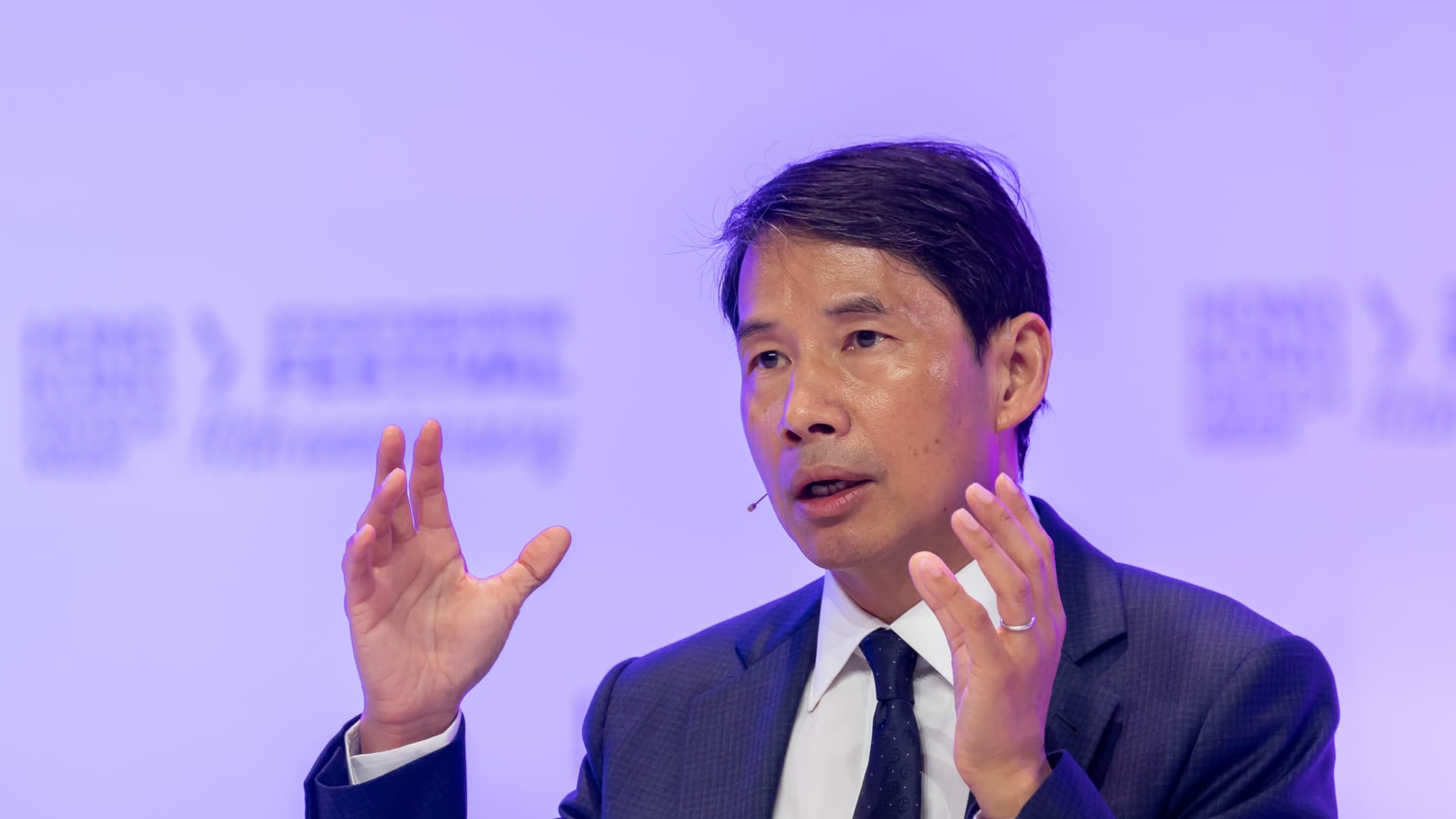
Fred Hu, chairman and chief executive officer of Primavera Capital Group, during the Hong Kong Fintech Week in Hong Kong, China, on Monday, Nov. 3, 2025.
Paul Yeung | Bloomberg | Getty Images
China’s biggest weakness in its rivalry with the United States isn’t AI, semiconductors or tariffs. It’s finance, according to one of the financiers who helped open China’s markets to Wall Street.
Fred Hu, the former Goldman Sachs executive who helped engineer the firm’s landmark investment in Industrial and Commercial Bank of China before founding Primavera Capital, says Beijing’s financial system has become the country’s “short plank” as Washington and Beijing increasingly sever investment ties.
Hu’s private equity firm has backed several of the China’s tech and consumer conglomerates, including Alibaba, ByteDance, Yum China and ride-hailing firm Didi Chuxing.
Hu also served as Henry Paulson’s principal adviser on China during the former U.S. Treasury secretary’s tenure as Goldman Sachs CEO and was a trusted adviser to reform-minded officials under then-Premier Zhu Rongji.
As U.S.-China competition extends beyond technology to the capital that fuels it, Washington has restricted American investment in Chinese companies developing sensitive technologies, while Beijing has sought to limit U.S. funding for some of its most promising startups. Hu argues that financial decoupling may come at a cost.
Chinese regulators have planned to restrict private tech firms from accepting U.S. capital without government approval, after Beijing ordered to reverse Meta Platform’s high-profile acquisition of startup Manus. Washington also bars its pension funds and college endowments from investing into Chinese firms developing sensitive technologies. Listings by Chinese firms in the U.S. have also become politically fraught in both countries.
American private equity funds have largely sailed through the sweeping rivalry unscathed, but Chinese peers have been squeezed from both ends, said Hu, whose firm manages about $20 billion in assets.
Compared with the deep capital pool in the U.S., “finance is still China’s short plank,” he told CNBC in Singapore last week. “Blackstone can do without China. But China’s private equity funds still rely heavily on the U.S. in fund raising,” he said.

The U.S. stock market is worth roughly $75 trillion, against $22-odd trillion for China and Hong Kong combined, with thousands of pension funds available for private funds like Hu’s to tap into.
Chinese state funds are usually small and scattered across local governments, with Beijing keeping a firm grip on the country’s massive pool of household savings that could otherwise fill the gap left by the retreating U.S. capital.
“With U.S. investors deterred by regulatory risk from Washington, China’s startup ecosystem has lost a major source of capital. Chinese PE and VC shops can only fill a small fraction of the gap left behind,” said Kyle Chan, a fellow at Brookings Institution, a Washington-based think tank.
He anticipates that U.S. restrictions on American capital flows to China will tighten further.
Capital vs. control
Beijing, for its part, has never aspired to Wall Street’s model.
“Capital is an absolutely critical resource that Beijing does not want to relinquish control over,” said Chan. Chinese policymakers see the U.S. economy as being steered by private finance — at odds with the party-state’s intention to set overall policy direction itself, Chan added.
China’s financial system has been central to Beijing’s tech and industrial ambitions, marshaling vast sums into strategic sectors, such as electric vehicles, artificial intelligence, and renewable energy.
Private equity and venture capital activity has remained well below its 2021 peak, partly because public capital crowded out private investors, according to Rhodium Group. Government-led funds contributed 81% of new capital last year, up from 65% in 2019, it estimates. “Rather than retreating, Beijing is intensifying its control over the allocation of resources, both public and private,” the research firm said.
Over the long run, Rhodium warns, this approach is likely to compound wasteful spending and inefficiency in the economy, even as it advances industrial goals in the short term.
Ultimately, Beijing is most constrained by its own fear of ceding control over capital resources.
Kyle Chan
Fellow at The Brookings Institution
Untapped trillions
China has the capital to incubate more homegrown tech companies and to help traditional industries transform, but few renminbi funds are built to be a meaningful player in dealmaking and corporate restructuring, Primavera’s Hu said.
The country’s national savings rate hovered near 43% of its GDP, more than double the U.S. rate of about 18%, accumulating 167 trillion yuan ($24.6 trillion) in household wealth as of end-2025.
“Households overwhelmingly favor property, bank deposits, and guaranteed products over venture investing,” said Han Shen Lin, China managing director at The Asia Group, a Washington-based advisory firm.
All that idle cash points to what Hu calls an “underdeveloped” financial system: Chinese households cannot freely invest abroad and have soured on property and stocks at home, while the country’s fund managers struggle to raise money in their own market.
China’s securities regulator this year tightened the screw on mainland investors channeling money into overseas stocks, as part of a broader push to keep capital outflows in official channels that give Beijing more visibility and control.
Chinese fund managers have increasingly courted Middle Eastern sovereign wealth to seek funding, but the Gulf’s money pool is far smaller than America’s – and shallower than China’s own wealth stash, Hu said.
“Ultimately, Beijing is most constrained by its own fear of ceding control over capital resources,” Chan echoed.
Another kind of diplomacy
Not a habitual critic of China, Hu describes himself as deeply patriotic and believes Chinese leadership remains committed to reform and opening. Primavera often convenes small gatherings to bring wary Western executives and institutional investors to visit robotic firms, battery makers, and electric-car plants in the country.
In 2010, when Hu’s name circulated for a senior position at China’s central bank, he chose Primavera instead. Asked about the decision — a subject he rarely addresses in public — Hu said, despite a passion for public policy, his life and education have built him to act as a bridge between China and the West, outside the system.
A Chinese flag at the People’s Bank of China (PBOC) headquarters in Beijing, China, on Wednesday, June 18, 2025.
Bloomberg | Getty Images
Hu remains optimistic about investing in China, even in its sluggish consumer sector — though the returns now demand more of fund managers. Solid brands and business models can still create value, he said, seeing gains in tightening distribution and controlling costs, rather than from waiting for an upturn.
Demand is recovering slowly, Hu said, pointing to two indicators for assessing the reviving confidence: whether this summer’s university graduates find jobs, and whether the property market has found a floor.
To get consumers spending, Hu said the government needs to act on three fronts: steady and transparent policy that gives the private sector certainty, a fuller social safety net, and a rebuilt consumer-credit market — thinned since regulators forced Ant to restructure its lending arms — so that spending no longer depends on savings alone.
Primavera’s money is moving into AI at several levels: large-language-model developers, physical AI, such as robotics and automation, and energy infrastructure, including wind and battery storage to keep data centers powered.
The firm is also betting on upgrading traditional industries, such as healthcare, education, and manufacturing, to create additional value with the technology.
