

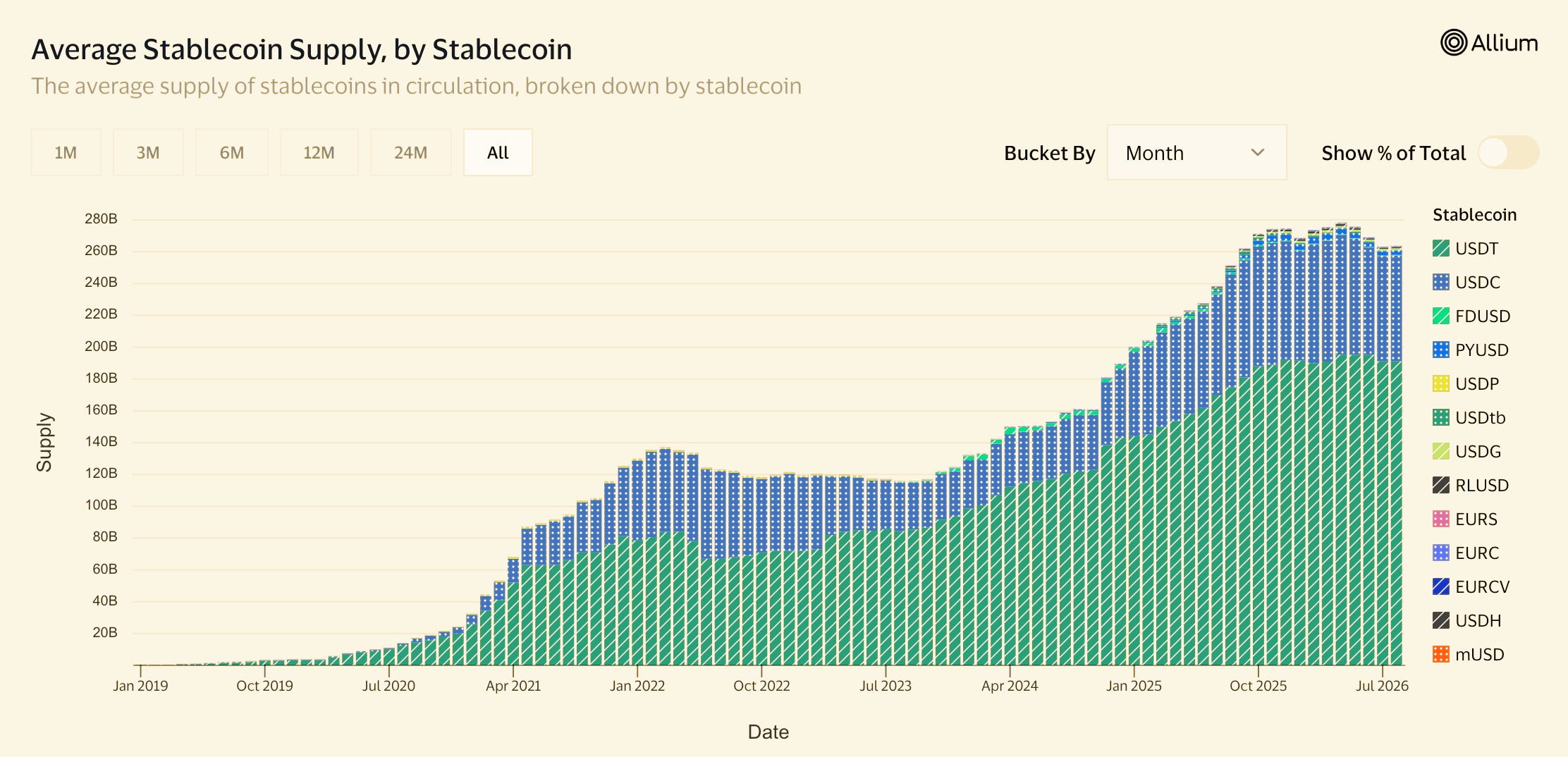
Stablecoins are moving from crypto-market infrastructure into payments, settlement, liquidity management and institutional finance, making their legal architecture increasingly consequential.
Major jurisdictions are converging around high-quality reserves, redemption rights and supervised issuers, yet they continue to differ on what holders actually own, how assets are treated in insolvency, who may distribute yield and how foreign issuers can access domestic markets.
These differences determine not only risk, but also whether stablecoins can function as institutional collateral, how strongly they compete with bank deposits and who captures the economics of reserve income. This paper compares the emerging frameworks across the US, EU, UK, Hong Kong, Singapore, Japan and UAE, connecting regulation and private law with monetary policy and market structure. The central question is whether regulatory convergence is actually making stablecoins legally and economically equivalent, or simply making increasingly different legal instruments look similar on the surface.

At insights4vc, we pay attention to teams building the infrastructure behind emerging market categories.
Umia is developing a new operating model for token-native ventures. The platform brings fundraising, legal formation, treasury management and governance into one integrated system, enabling projects to launch with clearer structures and more accountable decision-making from day one.
To learn more about Umia, contact office@insights4.vc
-
Stablecoin regulation is converging faster than stablecoin law. Across major jurisdictions, regulated fiat-backed stablecoins increasingly share an economic template: licensing, liquid reserves, redemption rights, asset protection and compliance. But the legal mechanism differs substantially. A holder may have a contractual redemption claim, statutory priority, a trust interest, e-money rights, or rights mediated through a custodian. The evidence supports the thesis that economic convergence is materially greater than legal convergence.
-
Owning the token does not necessarily mean owning the reserves. The commercially relevant legal stack is more complex: control of the on-chain asset, a claim against the issuer, possible rights in reserve assets, and, where custody is intermediated, a separate claim against the wallet, exchange or custodian. These layers determine recovery in insolvency and whether stablecoins can serve as robust institutional collateral.
-
The regulatory map is operationally fragmented. MiCA is effective in the EU; Hong Kong has an operative licensing regime and two licensed issuers; Japan’s regime is operative; and the UAE’s federal payment-token rules are in force. By contrast, the US GENIUS Act is enacted but not yet effective, the UK’s final FCA stablecoin rules do not operate until October 25, 2027, and Singapore’s 2023 SCS framework remains finalized policy rather than an operative SCS-specific statutory regime at the cutoff.
-
Yield is becoming a value-chain question. The meaningful question is no longer simply whether a stablecoin “pays interest”. Regulation can prohibit an issuer from paying holders while leaving room for economically distinct distributor incentives. Circle’s Q2 2026 results illustrate the stakes: $668 million of reserve income alongside $412 million of distribution, transaction and other costs. As reserve design standardizes, distribution can capture a growing share of the economics.
-
Stablecoin competition with banks depends on where the reserves go. Deposit-funded stablecoins backed by Treasury bills can withdraw funding from banks; reserves redeposited in banks largely transform retail deposits into concentrated wholesale balances; direct central-bank reserves could make the model more narrow-bank-like and potentially more disintermediating. US stablecoin legislation does not itself grant Federal Reserve account access.
-
The international monetary issue is overwhelmingly about dollars. BIS estimates that 99.4% of fiat-backed stablecoin value was US-dollar-pegged in 2026. Stablecoins therefore matter not only as payment technology but as a new distribution mechanism for offshore dollars, with implications for currency substitution and monetary sovereignty.
-
For institutional adoption, private law may become as important as prudential regulation. A regulated stablecoin is not automatically good collateral. Lenders also need certainty about property status, control, perfection, priority, custody and insolvency. UCC Article 12 is consequently financial infrastructure, not merely digital-asset legal housekeeping.
The deceptively simple answer is “a token”. Institutionally, that is insufficient.
A stablecoin can create several distinct legal relationships. First is the digital asset recorded on the ledger. Second is whatever contractual redemption right the issuer gives the holder. Third is any proprietary, beneficial or statutory interest that the holder has in backing assets. Fourth, when the token is held through an exchange or custodian, is the relationship between the customer and that intermediary.
These rights need not travel together.
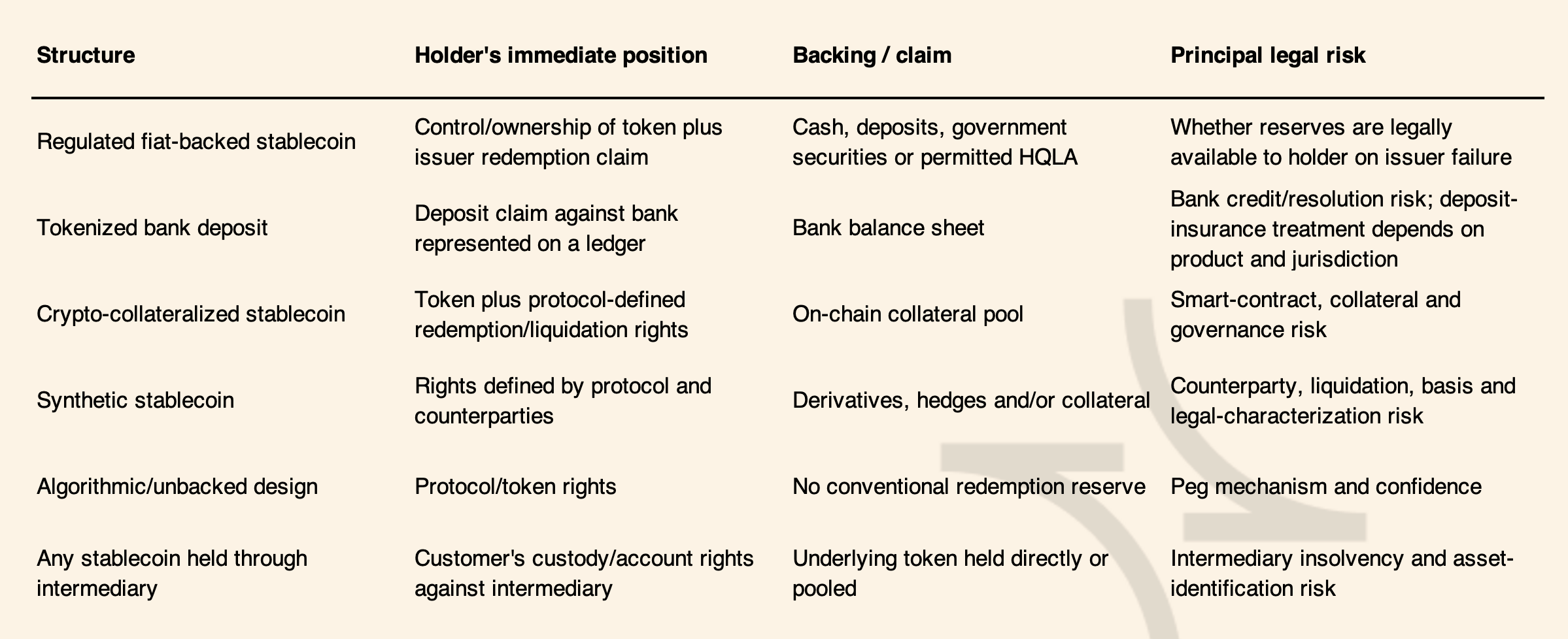
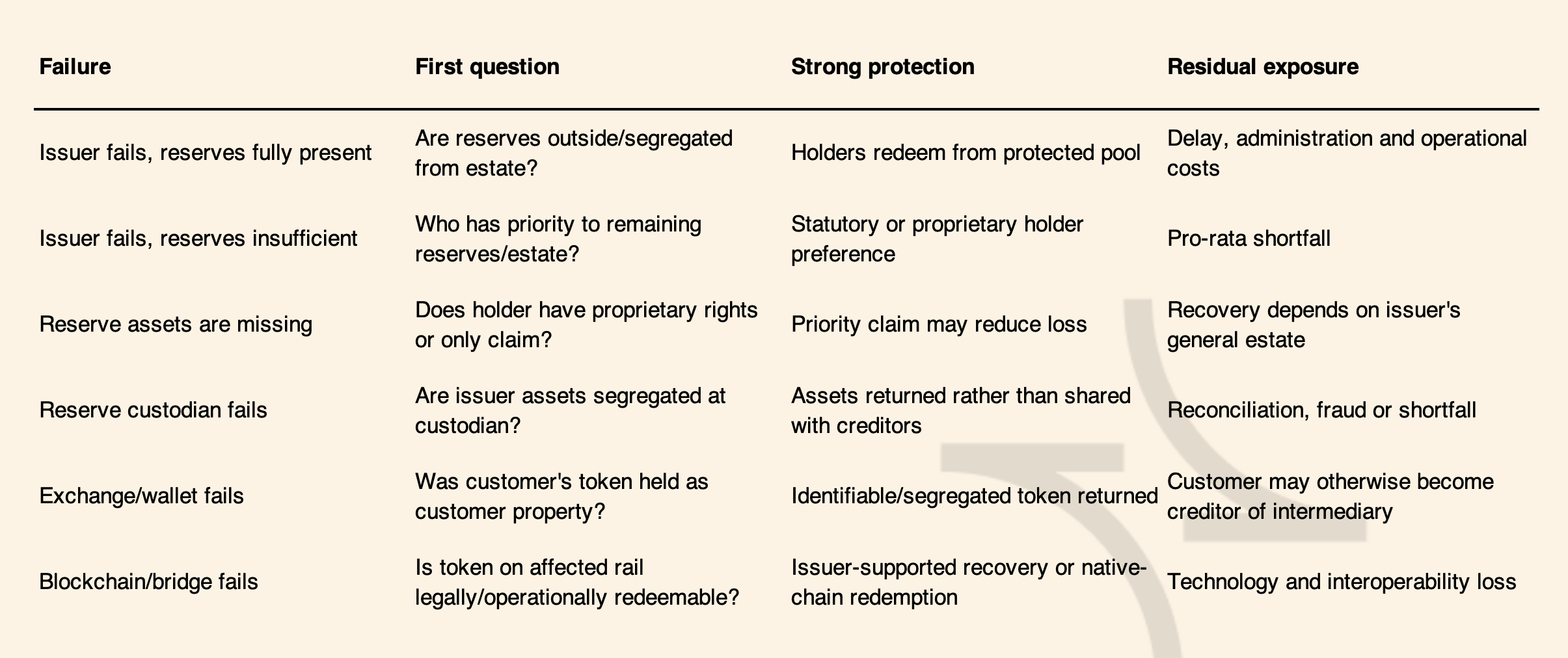
The key distinction is between a claim on the issuer and a proprietary interest in the reserves. A $1 redemption promise does not by itself make the holder owner of $1 of Treasury bills. Even full economic backing cannot answer who owns the assets when insolvency begins.
The future US GENIUS regime illustrates the distinction. The GENIUS Act creates statutory protections for payment stablecoin holders, including treatment of required reserves outside the issuer’s bankruptcy estate and priority mechanisms for holders. That is not the same thing as giving every holder a perfected security interest. Describing the regime simply as “secured-creditor priority” would therefore misstate the legal mechanism.
The UK’s future regime uses another architecture. The FCA’s final PS26/10 rules establish a statutory-trust approach for backing assets, but the rules do not become operative until October 25, 2027. Hong Kong requires segregation and legal protection of reserve assets under its supervisory regime. MiCA imposes its own reserve segregation and custody architecture for ARTs.
These can produce similar economic objectives while allocating property rights differently.
The institutional importance of property law becomes clearest when stablecoins are used as collateral.
The 2022 UCC amendments created Article 12 and the category of a controllable electronic record, or CER. “Control” performs a function analogous to possession for certain digital assets. A qualifying purchaser who acquires control for value, in good faith and without notice of competing property claims can obtain stronger protection against those claims. Amendments to Article 9 also allow security interests in CERs to be perfected by control, with important priority advantages over interests perfected only by filing.
For a lender, that changes the question from “Can we put USDC in the collateral agreement?” to “Can we obtain legally effective control, perfect our interest, preserve priority and enforce it after default?”
The Uniform Law Commission’s live enactment tracker shows adoption across a clear majority of UCC jurisdictions. New York’s amendments became generally effective on June 3, 2026 under S1840A. Ohio enacted amendments in July 2026, but its principal effective date falls after this research cutoff. Because headline adoption totals can differ depending on whether partial and substantially similar enactments are counted, the live ULC tracker is the more durable reference than a hard-coded state count.
This commercial-law infrastructure matters because prudential regulation cannot establish collateral priority by itself.
The same direction is visible internationally. The UNIDROIT Principles on Digital Assets and Private Law provide a framework for proprietary rights, transfers, custody and conflicts of law. They are model principles, not binding global law. In Britain, the Property (Digital Assets etc) Act 2025 removes the categorical obstacle that an electronic or digital thing must fit traditional property categories to be capable of personal-property rights. Neither development makes every stablecoin legally identical.
Consider a European investment fund holding USDC through a Singapore custodian and pledging that position to a US lender.
There is no single answer to “which law governs the USDC”.
The custody agreement may choose Singapore law. The credit agreement may select New York law. Rules governing perfection and priority can turn on the law applicable to the controllable electronic record or collateral arrangement. Singapore insolvency law becomes relevant if the custodian fails. The issuer’s governing law and US insolvency regime matter if the stablecoin issuer fails. EU regulatory rules can still constrain what the European fund or its service providers may do.
A contractual governing-law clause therefore cannot necessarily solve every proprietary question.
UNIDROIT’s digital-asset principles attempt to reduce this uncertainty through harmonized choice-of-law concepts. But until national implementation becomes substantially aligned, the economic cost remains real: additional legal opinions, collateral haircuts, custody restrictions, narrower eligible-collateral lists and greater capital allocated against uncertain enforceability.
For institutional markets, conflict of laws is therefore not an academic edge case. It can determine whether an apparently liquid digital dollar is usable as collateral at all.
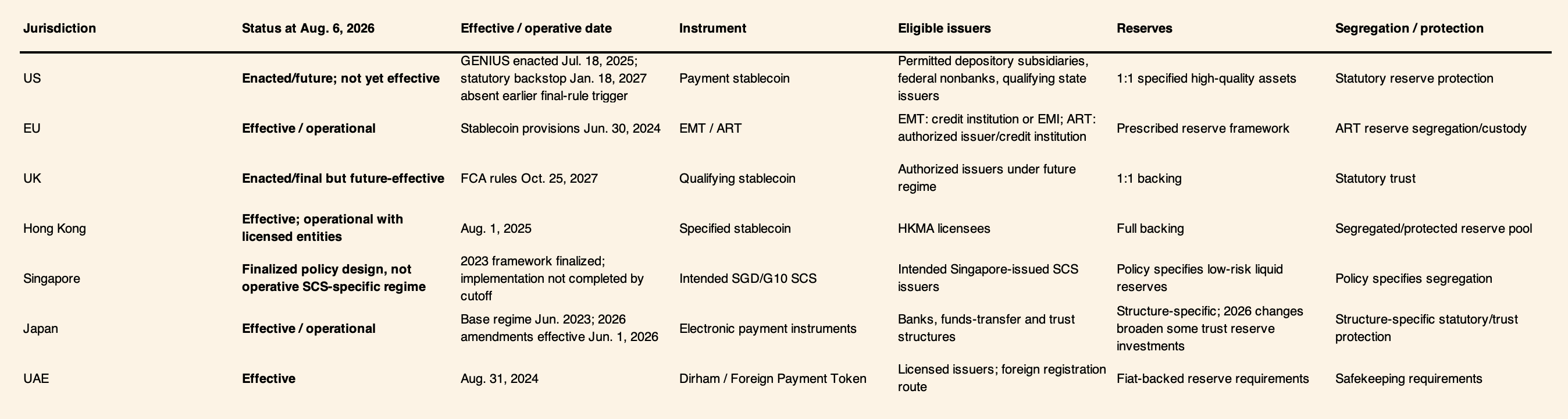
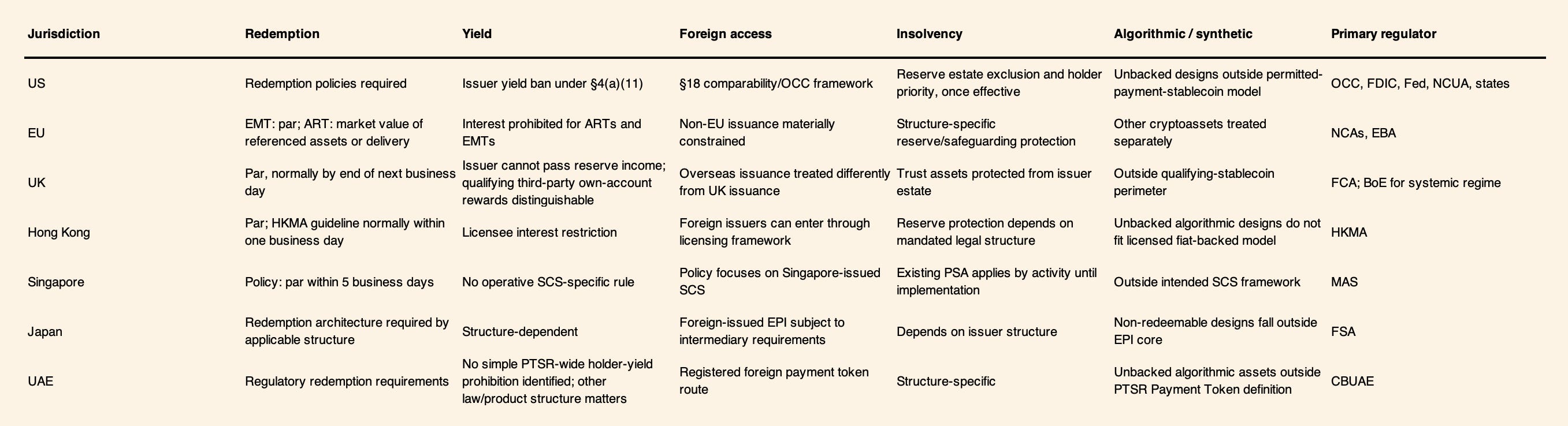
The matrix reveals three different kinds of convergence.
First, reserve risk is being constrained. The US GENIUS Act specifies a 1:1 portfolio of identified liquid assets, including short Treasury instruments and bank deposits. MiCA prescribes reserve and custody requirements. Hong Kong requires full backing. The future UK regime uses a 1:1 backing pool. This is genuine prudential convergence: regulation is pushing payment stablecoins toward something resembling privately operated narrow balance sheets rather than leveraged banks.
Second, redemption is becoming a defining regulatory feature, but not on identical terms. MiCA provides the clearest example of why details matter. An EMT holder has a claim on the issuer and, under Article 49, issuance and redemption occur at par. An ART holder’s Article 39 right instead references the market value of the assets referenced by the ART, or delivery of the referenced assets. Treating the two rights as interchangeable would turn economic similarity into legal error. ART reserve assets are also subject to segregation and a six-month independent audit under Article 36.
Third, the implementation clocks are radically different.
The GENIUS Act became law on July 18, 2025, but its substantive payment-stablecoin regime was not yet effective on August 6, 2026. Its commencement mechanism uses the earlier of the statutory 18-month timetable and a 120-day period following final implementing regulation. No final federal implementation had triggered the earlier path at the cutoff. The OCC, FDIC and NCUA had proposed implementation measures, while the Federal Reserve’s relevant rulemaking remained unfinished. The FDIC’s April 2026 proposal is particularly important evidence that implementation remained prospective.
When effective, §4(a)(11) prohibits a permitted issuer or foreign payment-stablecoin issuer from paying interest or yield solely for holding, using or retaining the stablecoin. It does not justify the blanket claim that every distributor reward is prohibited. The Act also does not convert stablecoins into insured deposits. A stablecoin holder is not transformed into an FDIC-insured depositor merely because an issuer holds part of its reserves as bank deposits.
The March 2026 SEC Commission interpretation, meanwhile, is already operative and concludes that the category of covered payment stablecoins described by the Commission is not a security. That conclusion is narrower than declaring every instrument labelled “stablecoin” outside securities law.
The CLARITY Act had progressed materially through Congress but was not enacted by August 6, 2026. It therefore belongs under proposed legislation, not law today.
MiCA’s stablecoin regime is operative. But an EMT’s status as electronic money creates an additional interface with payments legislation. The EBA’s June 2025 no-action letter did not abolish PSD2 authorization requirements. Its transitional enforcement approach expired on March 2, 2026; the EBA confirmed the end of that transition in February.
PSD3 and the proposed Payment Services Regulation had reached political agreement, but were not yet the operative replacement regime at the cutoff.
The UK’s legislation is enacted and the FCA’s rules are final, but the stablecoin rules become operative on October 25, 2027. The Bank of England’s June 2026 systemic stablecoin framework remains a draft consultation, including the proposed split between central-bank deposits and short government securities.
Hong Kong is already operational. Its regime took effect August 1, 2025, and the HKMA granted its first two licences, to Anchorpoint Financial and HSBC, on April 10, 2026. The HKMA register provides the durable source for licence status. The frequently cited one-business-day redemption standard comes from the supervisory guideline, not from treating those words as the statutory text itself.
Singapore is the opposite case. MAS finalized the design of its single-currency stablecoin framework in 2023, including high-quality reserves and redemption within five business days. Its consultation response contemplated adding a stablecoin issuance service to the Payment Services Act. As of August 6, 2026, that SCS-specific implementation had not become operative legislation. Existing Payment Services Act requirements continue to apply according to the relevant activity. MAS Notice PSN08 concerns disclosures and communications for payment service providers; it is not stablecoin-specific implementation of the 2023 framework.
The distinction is commercially consequential. A company cannot build its licensing or capital plan around a finalized policy document as though it were already operative law.

The Hanging of the Sigismund Bell
Jan Matejko, c. 1874
insights4vc provides independent research based primarily on publicly available information believed to be reliable at the time of publication. Figures may change because of market prices, token supply, reclassification and methodology updates. Legal structures, investor rights and regulatory treatment vary by product and jurisdiction.
This article does not constitute investment, legal, tax, accounting or financial advice, or an offer, solicitation or recommendation regarding any security, token, fund interest or other asset. insights4vc makes no representation regarding the completeness or accuracy of third-party data. Readers should conduct independent due diligence and consult appropriately qualified advisers before making investment or business decisions.