
On September 13, 2026, Nubank—the Brazilian neo-bank partly backed by Berkshire Hathaway—launched its Nu Global account, a move that instantly redefines what crypto banking means for the real economy. The account automatically converts customer deposits into USDC and EURC stablecoins and enables fee-free transfers across more than 35 countries, as TheStreet reported the same day. A bank with over 90 million customers has integrated stablecoin utility into a retail product—stablecoin banking just became mainstream.
Table of Contents
What just happened with Nubank and stablecoins?
Nubank’s Nu Global account lets customers hold, send, and receive value in fiat currencies that are instantly converted to dollar- and euro-backed stablecoins. Built with Circle, it uses USDC and EURC, two of the most liquid and transparently reserved stablecoins. TheStreet’s September 13 report confirms the service covers more than 35 countries without transfer fees, bypassing correspondent-banking rails that typically add days and double-digit costs.
Nu Global is a pooled account that sweeps customer balances into stablecoins behind the scenes. The user sees a dollar or euro balance; the underlying assets are on-chain tokens. Cross-border transfers become on-chain transfers, not wires. For businesses, this demonstrates a bank can offer a USDC business account without requiring customers to manage private keys or navigate exchanges. The fiat-to-stablecoin on-ramp is invisible, lowering the barrier for companies paying suppliers, contractors, or subsidiaries overseas.
Nubank has carried Berkshire Hathaway’s implicit approval since its 2021 investment. When a Buffett-linked institution adopts stablecoins as a core product, it signals that crypto banking is no longer a speculative side show. It also validates the approach of crypto-friendly neo-banks such as OneSafe, which already serves Web3 startups and DAOs with direct USDC custody and multi-currency fiat accounts.
Why does a major bank entering stablecoins matter for businesses?
Until now, most firms wanting to pay overseas partners in stablecoins had to maintain separate crypto wallets and juggle exchange accounts. Nubank’s model shows the on-ramp can be buried inside a standard bank account, making stablecoin adoption 2026 as simple as opening a checking account.
Companies are already using USDC to settle invoices, pay remote teams, and manage multi-country treasury—not for crypto exposure, but because it is faster and cheaper than legacy correspondent systems. Nubank crystallizes that shift, proving stablecoins can be deployed at scale within a regulated banking framework.
Traditional banks now face a competitor offering cross-border payment stablecoins with zero fees. A SWIFT transfer still costs $25–$65 and takes two to five business days; Nubank settles in minutes at no direct cost. We have already seen U.S. Bank complete a stablecoin pilot earlier this year, as OneSafe analyzed, and Revolut’s U.S. bank charter gives it the license to embed similar services.
What are stablecoins and how do they differ from other cryptocurrencies?
A stablecoin is a digital token designed to maintain a stable value relative to a reference asset, typically the U.S. dollar or euro. Unlike Bitcoin or Ethereum, stablecoins are built as a medium of exchange and store of value on blockchain rails. The Bank of England explains that these tokens combine fiat stability with the programmability and 24/7 settlement of crypto networks.
Holding a USDC business account does not expose you to the price swings of Bitcoin. USDC and EURC are backed by cash and short-duration U.S. Treasury securities, kept at 1:1 through mint-and-burn mechanisms overseen by regulated issuers. That is why businesses can use them for payroll, supplier payments, and treasury without waking up to a 10% loss. Nubank relies on this property, converting deposits into USDC and EURC precisely because they function as dollar and euro substitutes, not speculative instruments.
How do crypto banks and neobanks work for business banking?
A crypto-friendly neo-bank or crypto payment platform for startups natively supports both fiat and on-chain assets through a single interface. OneSafe, for example, provides corporate accounts that hold USD, EUR, and CAD alongside USDC, with instant conversion between them.
Legacy banks run on batch-processing systems that struggle with real-time blockchain reconciliation. When a company in Brazil pays a supplier in Colombia via Nu Global, the settlement is an on-chain USDC transfer—confirmation occurs in minutes, not days. A traditional bank would route the payment through correspondents, adding intermediary fees and FX markups. Neo-banks built on modern APIs can integrate Fireblocks-grade custody and on-chain settlement by design.
The practical driver is that global businesses increasingly hold working capital in both forms. A Web3 startup may pay developers in USDC but pay taxes in fiat. A DAO may collect revenue in stablecoins but convert to fiat for grant distributions. OneSafe serves this need with DAO banking, native stablecoin accounts, corporate cards, and automated workflows. The Federal Reserve’s December 17, 2025 analysis on stablecoins and deposit intermediation noted that holding both asset types in one place is becoming a competitive necessity.
How can global companies use stablecoin banking to reduce costs and complexity?

Stablecoin banking removes the SWIFT infrastructure from cross-border payments, along with its fees, delays, and floating FX margins.
Nubank’s Nu Global account eliminates wire fees entirely for transfers within its covered countries, charging nothing to send USDC or EURC across borders. For businesses outside that corridor, a dedicated fiat to stablecoin on-ramp like OneSafe offers USDC deposits and withdrawals free, with domestic ACH and wire transfers at published rates (0.15% for fiat deposits, $25 wire withdrawal, and 0.35%+$50 SWIFT when SWIFT is unavoidable). That compares with opaque bank FX markups often exceeding 3% and correspondent fees that can eat up $50 per leg.
A stablecoin banking account lets a business denominate balances in dollars or euros without opening local bank accounts abroad. OneSafe extends this to companies with multi-currency fiat accounts and the ability to pay vendors in USDC, EURC, or fiat from one dashboard. Funds settle in minutes, 24/7, and a CFO can reposition working capital without manual bank calls.
While Nubank brings stablecoin banking to retail, specialist neo-banks have served the business segment for years. OneSafe has processed over $800 million in transaction volume from more than 1,000 businesses across 30-plus countries, combining fiat accounts, corporate cards, and Fireblocks-secured USDC custody. Its DAO banking module gives decentralized organizations role-based permissions, bulk disbursements, and automated reconciliation. Nubank validates the market; it does not replace these providers.
Is putting business funds into a stablecoin account safe?
There is no binary answer. Stablecoin banking reduces price volatility but introduces reserve and regulatory risks that demand active management.
A stablecoin is only as stable as its reserves. USDC and EURC publish transparent attestations and hold short-duration Treasury securities alongside cash, supervised by Circle and regulated partners. That makes them far less fragile than algorithmic stablecoins that collapsed in previous cycles. However, the Bank Policy Institute notes a run on a large stablecoin is still possible if confidence in reserves erodes. For a business holding USDC, verify the issuer publishes monthly reserve attestations, is subject to U.S. money-transmitter regulation, and holds reserves that can be liquidated rapidly.
The legal status of stablecoin accounts varies by jurisdiction. Nubank launches into Brazil’s relatively progressive framework, but the U.S. still operates under a patchwork of state money-transmitter licenses and pending federal legislation. The Wall Street Journal reported that banks are actively considering launching their own stablecoins because the regulatory perimeter is shifting. A stablecoin balance may not be FDIC-insured. OneSafe is transparent: it is a financial technology company, not a bank; banking services are provided by partners, and digital asset custody is performed by Fireblocks.
At minimum, verify the platform stores assets with a qualified custodian, enforces mandatory MFA, and maintains SOC 2–audited data centers. OneSafe requires MFA at signup and secures cryptographic keys on Fireblocks.
What should a business look for in a crypto banking platform?
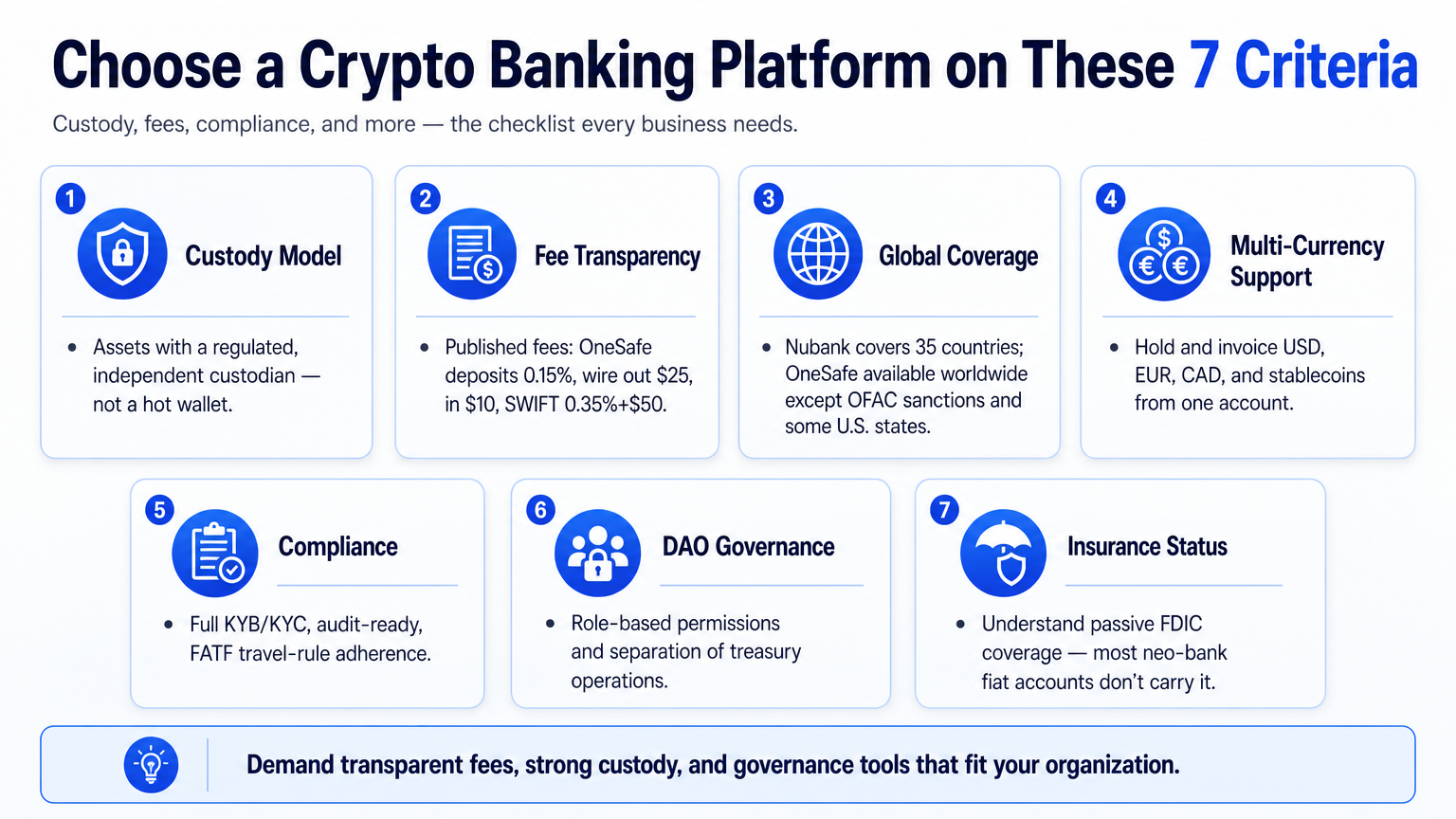
- Custody model: digital assets held by an independent, regulated custodian, not a proprietary hot wallet.
- Fiat on/off-ramp clarity: published fees. OneSafe lists fiat deposit/withdrawal at 0.15%, $25 wire out, $10 wire in, and 0.35%+$50 SWIFT.
- Jurisdictional coverage: Nubank covers 35 countries; OneSafe is available worldwide except OFAC-sanctioned jurisdictions and certain U.S. states.
- Multi-currency ledger: hold and invoice in USD, EUR, CAD, and stablecoins from one account.
- Compliance posture: full KYB/KYC, audit-ready reporting, FATF travel-rule adherence.
- DAO and multi-signer governance: role-based permissions and separation of treasury operations.
- Insurance status: understand whether passive FDIC insurance applies; most neo-bank fiat accounts do not carry it.
What regulatory changes could affect stablecoin banking this year?
Three forces are converging: a land grab by traditional banks, finalization of major-economy stablecoin frameworks, and pressure to let stablecoins pay yield.
Twenty-one banks are already known to be exploring stablecoin issuance or integration, and the U.S. Bank stablecoin pilot showed a federally chartered institution can settle on-chain compliantly. The question is whether banks embed stablecoins inside current accounts—as Nubank did—or offer separate wallet bolt-ons. The former will move global business banking stablecoins forward.
The U.S. Senate is debating a bill requiring stablecoin issuers to hold only high-quality liquid assets and submit to regular examinations. Europe’s MiCA framework imposes similar reserve requirements and redemption rights. Harmonized rules will reduce another Terra-style collapse and give businesses clearer legal footing, though they may narrow the field to a few highly regulated issuers.
A key open question is whether regulators will permit stablecoin holders to earn interest. The Bank Policy Institute has flagged the systemic risks of turning stablecoins into uninsured deposit substitutes. No major neo-bank currently offers interest on USDC balances; any provider doing so without clear regulatory backing should be approached with caution.
Meanwhile, DAOs and globally distributed startups are already voting with their wallets, managing contributor payments and grant disbursements in stablecoins. Platforms like OneSafe bridge into fiat when necessary. This persistent demand will force regulators to clarify rules rather than stifle innovation.
Key Takeaways
- Nubank’s September 13, 2026 launch of fee-free USDC/EURC accounts across 35+ countries turns crypto banking into a mainstream retail product and a direct challenge to legacy cross-border revenue.
- Stablecoin banking unlocks cheaper, faster cross-border payments by removing SWIFT dependency without introducing crypto volatility.
- Safety hinges on reserve quality, custody standards, and a clear understanding that stablecoin balances are not FDIC-insured.
- Demand transparent fees, institutional-grade custody (Fireblocks), mandatory MFA, multi-currency support, and DAO governance tools.
- U.S. and European rules are solidifying around high-quality reserves and redemption rights, making compliant stablecoin banking more predictable.
To see how a single platform can unify your fiat and stablecoin operations—with multi-currency accounts, corporate cards, and Fireblocks-secured custody—explore OneSafe’s business banking.