
The crypto industry is splitting in two. On one side sit bitcoin, exchange-traded funds (ETFs), derivatives and speculative financial markets. On the other are stablecoins and blockchain platforms, which are gradually becoming embedded in the mechanics of global payments. As that second world matures, a new contest is taking shape beneath the surface, not over ideology but over infrastructure — specifically, what kinds of blockchains should move the world’s money.
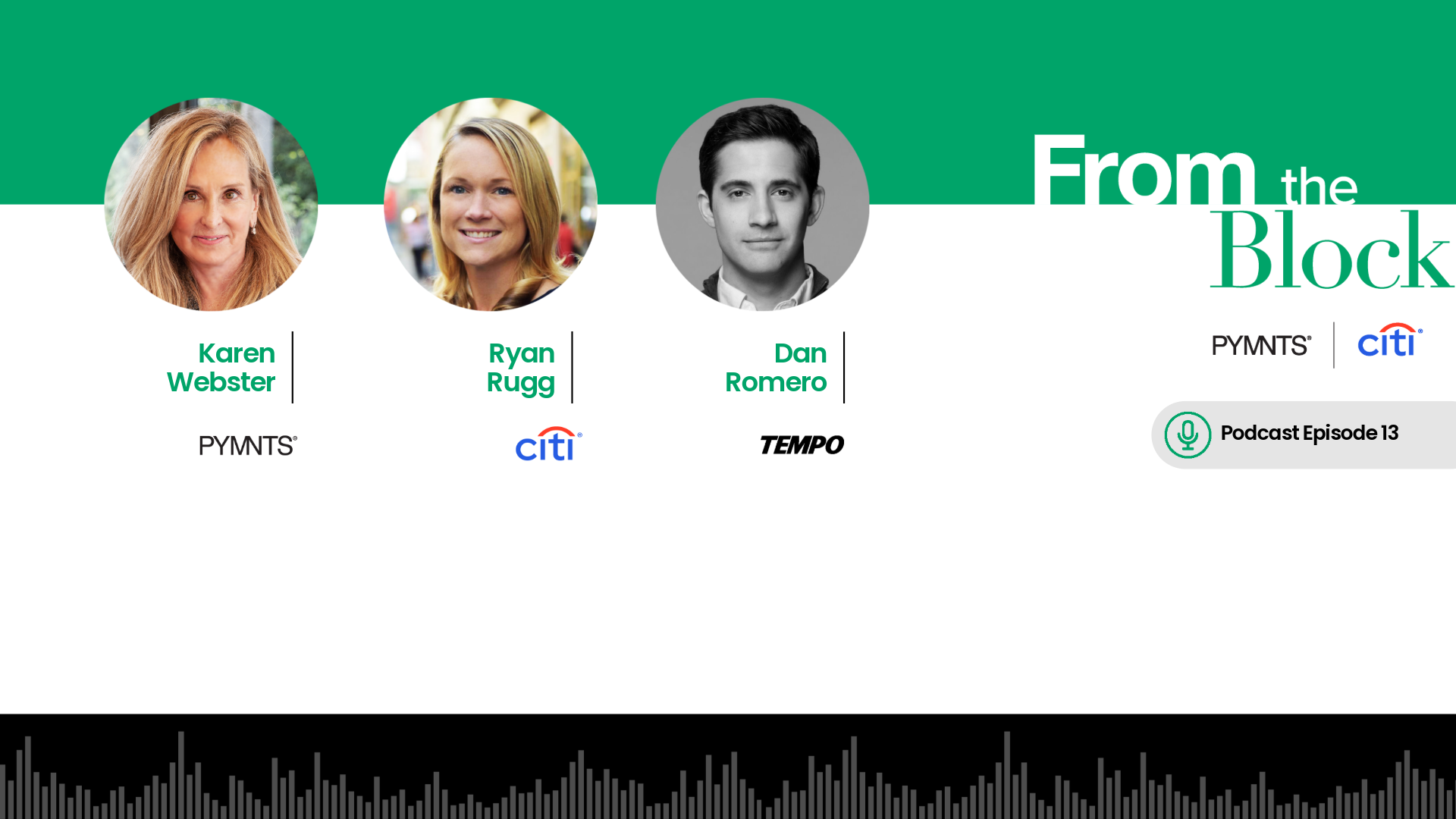
Joining PYMNTS CEO Karen Webster and Citi Global Head of Digital Assets, TTS, Ryan Rugg on the latest episode of “From the Block,” Tempo Go-To-Market Lead Dan Romero argued that cryptocurrency has evolved into what he called a “barbell economy” split between speculative markets and real-world payments rails. “I think cryptocurrency gets lumped as an overall monolith of a market,” he said. “But it’s actually very much a barbell at this point.”
The New Infrastructure Wars
As stablecoins gain legitimacy, a battle is emerging over which networks should power them. The first generation of major blockchains, including bitcoin, Ethereum and Solana, were built as general-purpose systems supporting everything from trading to gaming to token launches. Payments companies increasingly see that as a problem.
“If you talk to payments companies, they say, ‘Wait a second, I don’t want to be on the same server as the New York Stock Exchange,’” Romero said.
The concern is practical. A payments network cannot afford the congestion and volatility created by speculative trading competing for capacity; in crypto markets, intense trading has historically pushed transaction fees sharply higher and delayed settlements. Just as artificial intelligence (AI) workloads spawned specialized chips and cloud providers, blockchain infrastructure is now fragmenting into networks optimized for specific functions: payments, tokenization, compliance or enterprise settlement.
Advertisement: Scroll to Continue
That fragmentation raises its own question. “How many do we need?” Webster asked of the growing field of payments-focused chains. The future may belong not to one dominant blockchain but to many narrowly focused ones, among them Tempo, Romero’s own payments-focused chain backed by Stripe and Paradigm.
“The future of networks will be multi-asset, multi-currency, multi-border, always on,” Rugg said.
Crypto’s New Pitch: Don’t Call It Crypto
That shift reflects a broader change in how enterprises approach blockchain, not as ideology but as infrastructure. At Citi, Rugg works with multinationals seeking faster cross-border settlement, but she emphasized that they want complexity abstracted away. “Our clients don’t want wallets and keys and hosting nodes and all the complexities,” she said. “They want to streamline their operations, not add additional ones.”
“What they’re interested in is what benefit can you provide,” Romero added. “We’re talking about what problem are you solving, rather than leading with the technology.” That marks a profound cultural shift for an industry long obsessed with technology itself.
Regulation is accelerating the change. The passage of the GENIUS Act, which established federal rules for stablecoins in the U.S., has become a watershed inside the industry.
“When you have a federal law, it sets the playing field for what is OK versus not,” Romero said, noting that for the first time, crypto has had “a regulatory tailwind, not a headwind.” Stablecoins now account for at least 5% of the U.S.-to-Mexico remittance corridor, one of the world’s largest payment routes.
Institutions rarely adopt infrastructure that lives in legal gray zones, and stablecoins are increasingly being viewed as regulated financial rails rather than a speculative corner of the market. “There are still a lot of controls that have to be introduced,” Rugg cautioned, citing cybersecurity, illicit-finance monitoring, key management, fraud prevention and transaction sequencing. “It’s not apples for apples.”
Bitcoin Has Become Something Different
The survivors in digital assets, Romero argued, are the businesses focused on a far less ideological problem: moving money better. Many of crypto’s most ambitious consumer experiments, from decentralized social networks to mass-market apps, never gained traction. Romero himself spent years building Farcaster, a decentralized social protocol, before concluding that much of the sector’s consumer vision “didn’t work.”
“Most of what has happened in crypto over the last decade has not really impacted the real world,” he said, “with maybe the exception of bitcoin and ETFs.”
Even bitcoin has been transformed. A decade ago, it was pitched as an alternative payment system; today, executives increasingly describe it as a digital store of value closer to gold than cash.
“The shape of the asset class for bitcoin has changed significantly post-ETF,” Romero said, noting it has moved from a retail-heavy, early-adopter asset to a far more institutional one. “But remember,” Webster pushed back, “bitcoin started out as a payment method. That’s the double edge to bitcoin.”
That maturation is changing how institutions treat the sector. Despite large outflows from bitcoin ETFs earlier this year, prices stayed relatively stable, a sign of deeper participation and liquidity. “If you would’ve told me 10 years ago that billions of dollars could move in and out of bitcoin and prices would remain relatively stable, I probably wouldn’t have believed you,” Romero said.
If stablecoins ultimately become mainstream financial infrastructure, Webster asked, “What do we have to worry about breaking?” That question may define crypto’s next phase more than any token launch. The industry’s biggest challenge is no longer proving blockchain can move money. It is proving the system can operate safely, reliably and invisibly at institutional scale.