
Meta description: Stablecoin payments surged as crypto card spending tripled to $1.04 billion in July 2026, with USDC at 50% of volume. Here’s what it means for finance teams.
Stablecoin payments hit a new benchmark in July 2026: crypto card spending tripled year-over-year to $1.04 billion, driven by dollar-backed stablecoins and everyday purchases like groceries. USDC accounted for 50% of volume and USDT for 20.3%; dollar-backed stablecoins drove 70% of more than 10 million tracked transactions. (PYMNTS.com, reporting Paymentscan data, August 23, 2026; news peg published August 24, 2026.) For finance leads and Web3 founders, that is no longer a niche crypto story.
Table of Contents
What Just Happened: Stablecoin Card Spending Triples in a Year
The July 2026 data shows consumers buying groceries and other everyday goods with stablecoin-backed cards. The composition matters more than the headline number: dollar-backed stablecoins drove 70% of more than 10 million tracked transactions. USDC accounted for half of all stablecoin card volume; Tether’s USDT made up 20.3%, compared with about 48% and 7% respectively a year earlier.
Thomas Gregory, a vice president quoted in the PYMNTS report, framed the shift this way: “The real measure of crypto’s progress is not simply how many people own digital assets, but how useful those assets become in everyday life.” That is the signal: stablecoin payments are transitioning from exchange-only settlement into ordinary, card-based spending.
Dollar-backed stablecoins let users hold digital dollars and spend them without first moving funds through a bank. The shift from trading rails to payment rails is the deeper structural change: when half of tracked card volume is USDC, businesses can reasonably treat stablecoin-denominated balances as working capital, not speculative exposure.
Why It Matters Now for Founders and Finance Leads
The July 2026 figure changes the evaluation question. It is no longer “should we accept crypto?” but “can we run operational spend through dollar-backed stablecoins without adding treasury risk?” Three implications stand out:
- Cross-border payments become a working-capital decision, not a crypto decision. A business holding USDC can pay a contractor or supplier through card rails even when the recipient does not accept crypto directly.
- USDC payments are becoming the default stablecoin leg. With half of tracked volume in USDC, treasury teams can evaluate one fiat-backed asset instead of managing a basket.
- Stablecoin adoption is being pulled by consumer behavior. Employees and contractors who already spend stablecoins personally will expect business platforms to support the same flows.
The risk is treating this as a reason to move all treasury operations to crypto. The better response is to identify specific payment flows — international vendor payments, contractor payroll, cross-border card spend — where stablecoin payments reduce cost or settlement delay, and leave the rest unchanged.
The Background: How Stablecoin Payments Are Reshaping Business Transactions
From Cross-Border Transfers to Everyday Spending
Fiat-backed stablecoins were initially used to move value quickly across borders without correspondent-bank cost and delay. The IMF has noted that stablecoins can improve payments and financial inclusion; McKinsey describes tokenized cash as enabling next-generation payment flows that settle faster and with fewer intermediaries.
Card programs now extend that utility to point-of-sale and vendor spending. Mastercard crypto card programs let cardholders spend digital assets wherever card rails are accepted. That infrastructure is what turns a stablecoin balance into usable operating cash.
The Role of Multi-Currency and Crypto‑Native Banking
Traditional banks often separate fiat treasury from crypto asset custody, forcing global businesses to run two ledgers. Crypto-native neobanks — financial technology companies, not banks — collapse that split into one interface for fiat accounts, stablecoin balances, cards, and wires. A useful primer is What Is a Neobank? A Guide for Businesses & Crypto.
How does a stablecoin corporate card work for a global business?
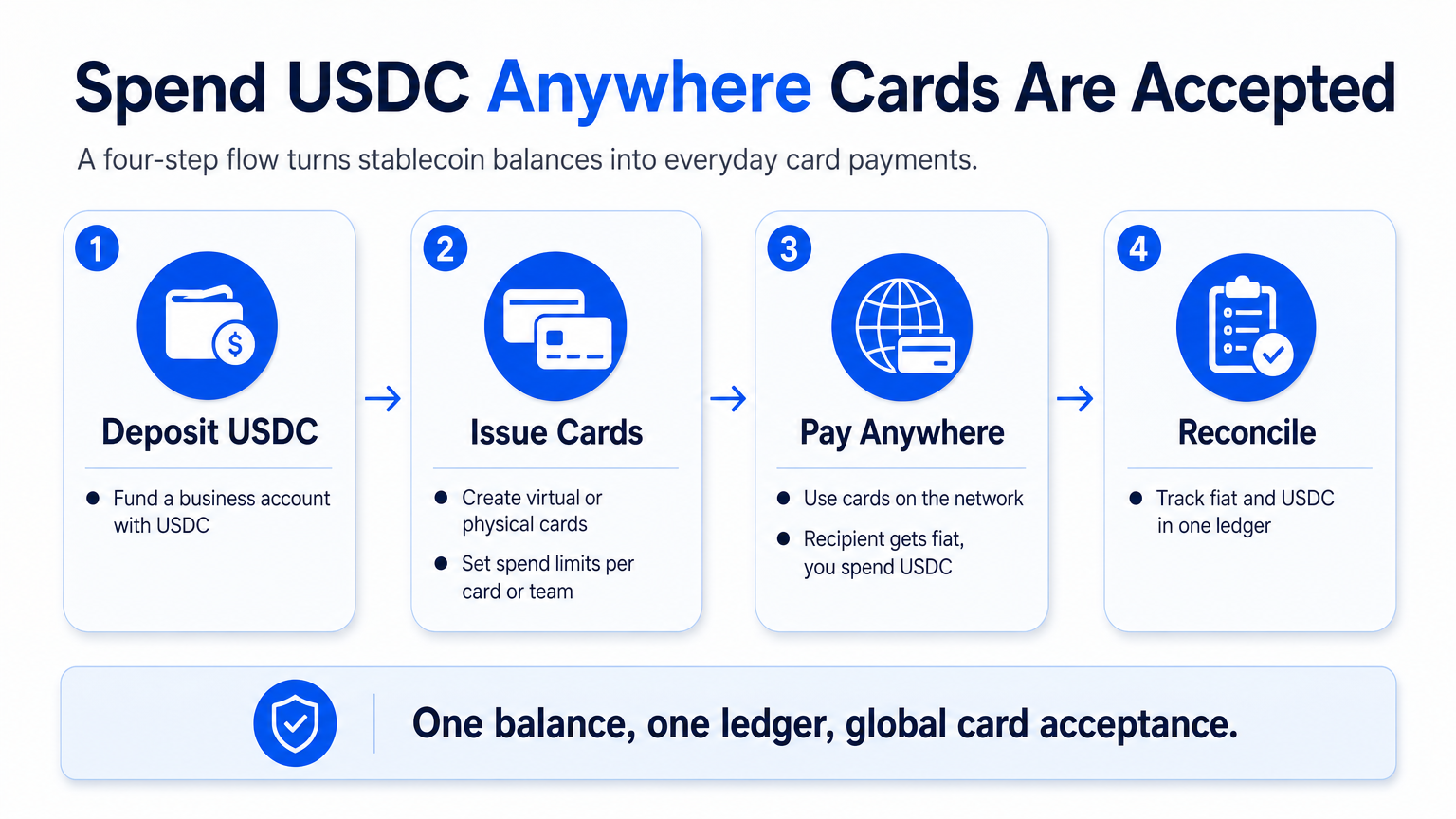
A stablecoin corporate card typically works like a prepaid business card with a crypto-native funding source. The business holds a USDC balance on a platform. When a card transaction occurs, the platform converts the required stablecoin to fiat at authorization or settlement, then settles through the card network. The practical flow:
- Deposit USDC into a business account.
- Issue virtual or physical corporate cards against that balance, with spend limits per card or team.
- Pay vendors or employees through the card network, even where the recipient only accepts fiat.
- Reconcile fiat and USDC activity in one ledger.
The card network supplies acceptance; the platform supplies custody, conversion, and reporting.
Concrete Implications: What the $1.04 Billion Figure Means for Your Business
Reevaluating Your Corporate Card Strategy
For businesses that already use corporate cards for international spend, the $1.04 billion figure makes concrete what was previously theoretical: stablecoin-funded cards have measurable, retail-scale utility. The case is strongest when the business already receives crypto revenue or holds USDC for payroll and vendor settlement. But card strategy should follow treasury reality. If a business does not already hold stablecoins, converting fiat into USDC solely to fund card spend may add a conversion step without a clear benefit. Start with the question: where do our funds already sit?
Hidden Costs and Trade-Offs to Watch For
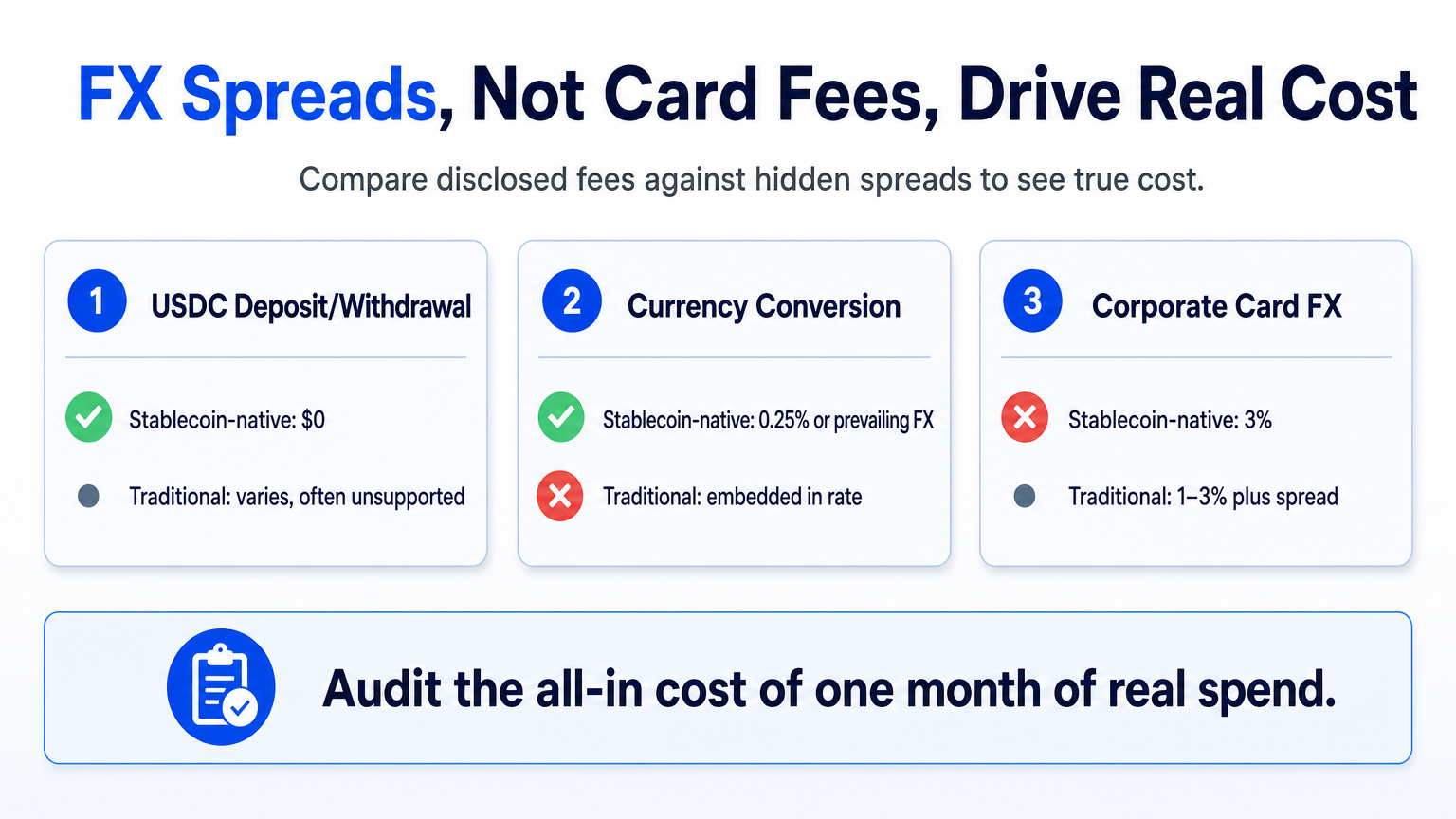
The headline “free USDC deposits” can obscure the real cost of stablecoin card spending. FX fees, not card issuance, are often the real cost. Audit the full chain: deposit fee, conversion spread, card FX markup, wire withdrawal fee, and any subscription charge. The table below shows one example of a stablecoin-native platform’s disclosed pricing; many traditional issuers embed these costs in the FX rate or account terms.
| Cost category | Example stablecoin-native platform fee | Traditional corporate card benchmark |
|---|---|---|
| USDC deposit/withdrawal | $0 | Varies; often unsupported without conversion |
| Fiat deposit/withdrawal | 0.15% | Varies |
| Wire deposit | $10 | Varies |
| Wire withdrawal | $25 | Varies |
| SWIFT transaction | 0.35% + $50 | Varies |
| Currency conversion | 0.25% or prevailing FX | Varies; often embedded in rate |
| Corporate card foreign exchange | 3% | Varies; many issuers charge 1–3% plus spread |
The trade-off is not “crypto versus free.” It is whether the platform’s disclosed conversion and card FX fees are lower than the hidden spread a traditional card or bank already charges. For international businesses, the biggest hidden costs tend to be conversion before card spend, corporate card FX markup, and wire/SWIFT fees for off-ramping. The practical rule: audit the all-in cost of one month of real spend, not the advertised rate.
What are the real costs and hidden fees compared to traditional cards?
Traditional corporate card pricing is issuer-specific. Some cards advertise no annual fee but charge a wide FX spread; some offer rewards that offset FX costs. Direct comparison requires pulling a real line-item statement for the same cross-border spend pattern. The table above makes known costs visible. A platform that publishes a 3% corporate card FX fee may look more expensive than a card that advertises “no FX fee” — until the settlement rate is compared with the mid-market rate. The hidden cost is usually the spread.
Recommended Actions: How to Get Started with Stablecoin Payments Today
Steps for Integrating Stablecoin Payments
For a startup or DAO that wants to test stablecoin payments without putting core treasury at risk, keep the sequence narrow and reversible:
- Map two or three real payment flows. Identify a recurring cross-border vendor payment, contractor payroll run, or team expense stream that already incurs FX or wire fees.
- Separate custody from card program decisions. Confirm where USDC is held and how conversion occurs before funds are loaded.
- Start with a capped float. Load only the amount needed for 30 days of test payments.
- Test with non-critical payments first. Use a single virtual card and one vendor before rolling out team-wide cards.
- Audit after the first settlement cycle. Compare the platform’s all-in cost against the previous method using the actual settlement amount.
For a deeper walkthrough, see Stablecoin Payments for Startups: A Complete Guide.
What steps should a business take to adopt stablecoin payments without unnecessary risk?
The lowest-risk adoption path is incremental: use a corporate card with spend limits, keep a separate ledger for stablecoin and fiat activity, and review custody arrangements before scaling. The business should not move depository cash into stablecoins solely to chase card rewards or lower headline fees. It should move funds only where the payment flow demonstrably improves. The broader risk of global accounts includes compliance exposure, counterparty concentration, and operational failure; see What Are the Risks of a Global Account?.
How can a platform like OneSafe help a startup manage stablecoin payments?
OneSafe is a financial technology company, not a bank; banking services are provided by its partners. Its relevant capabilities include fiat and crypto transactions in one interface, corporate cards with spend limits, multiple virtual cards at no extra cost, multi-currency accounts in USD, Euro, and CAD, and free USDC deposits and withdrawals. For a startup or DAO, that means a USDC balance can pay a vendor through a card or a wire without a separate off-ramp. OneSafe reports processing over $800 million in transaction volume from more than 1,000 businesses across 30-plus countries, with onboarding typically completed within a week using business formation papers and a government-issued photo ID. The platform offers a free account; premium starts at $29 per month.
Security and Compliance Considerations
Safety depends on three layers: custody, access control, and compliance.
- Custody means where private keys or digital assets are held. Fireblocks describes stablecoin payments in the context of institutional-grade custody. A platform using Fireblocks is structurally different from one that leaves assets on an exchange hot wallet.
- Access control includes mandatory multi-factor authentication and role-based permissions.
- Compliance includes know-your-business checks, transaction monitoring, and sanctions-jurisdiction restrictions.
Compliance controls do not guarantee the stablecoin’s underlying value or protect against all loss. Stablecoins are not FDIC-insured bank deposits; custody is not insurance. Treat stablecoin card balances as limited, monitored operating float. For how these rails fit into platform operations, see Understanding Payments in Neo-Banking.
What to Watch Next: Regulations, New Use Cases, and Market Shifts
The key question is whether the July 2026 retail spending mix holds beyond a single month. Three open issues matter most:
- Regulation. U.S. stablecoin legislation remains the largest known variable. Final implementation rules — not just framework agreement — will determine whether banks and neobanks face the same compliance burden.
- Use-case expansion. If USDC card volume stays above 50%, expect payroll, vendor settlement, and cross-border treasury products to market themselves as stablecoin-native rather than crypto-adjacent.
- Network economics. Card networks and issuers may adjust interchange, FX, and redemption policies as stablecoin-funded cards scale, reshaping the cost comparison quickly.
Web3 teams building treasury infrastructure around these rails can review Banking for Web3 App: A Comprehensive Guide.
Key Takeaways
- Crypto card spending reached $1.04 billion in July 2026, tripling year-over-year, with USDC at 50% of tracked stablecoin volume and USDT at 20.3%.
- Stablecoin payments are moving from exchange settlement into everyday card spend, making them more relevant to corporate treasury decisions.
- The real cost of stablecoin card programs is usually the FX spread and conversion chain, not card issuance or account fees.
- Security depends on custody, KYC/KYB, and MFA; custody is not a guarantee against loss, and stablecoins are not FDIC-insured deposits.
- Businesses should adopt stablecoin payments through a capped, audited pilot — not by moving core treasury balances all at once.
If you are evaluating a business account that can move between fiat and stablecoin payments without a legacy bank’s overhead, sign up for a OneSafe business account to test fiat and USDC flows in one place.