
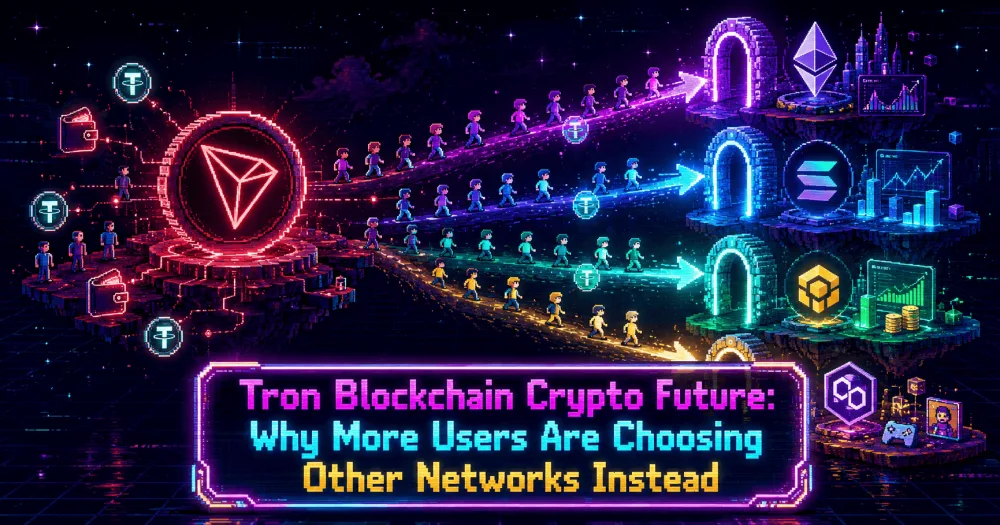
Tron blockchain remains one of the busiest crypto networks in the world, but its future is becoming harder to read. TRON still processes millions of transactions per day and holds roughly $90 billion in stablecoins, mostly USDT▲$0.9991. Yet users looking for decentralized trading, memecoins, consumer apps, and institutional products are increasingly choosing Solana, Ethereum, Base, BNB▲$572.56 Chain, and newer networks instead.
This is not yet a collapse story. But the Tron blockchain is gaining payment activity while losing market share in many of the sectors shaping crypto’s next phase. Here’s why this is happening and whether Tron can regain its prominent position.
Contents
Tron Blockchain Usage Is Still Growing
Claims that users are abandoning TRON entirely are not supported by current network data. TRON averaged about 3.5 million daily active accounts in Q2 2026, while daily transactions frequently exceeded 12 million. The network also carried close to $90 billion in USDT and increased its share of sub-$1,000 USDT transfers.
That makes the Tron blockchain one of crypto’s most important retail payment rails. It is especially useful in markets where users depend on stablecoins for remittances, exchange transfers, dollar savings, payroll, and cross-border commerce.
However, active-address numbers do not reveal everything. One person can control multiple addresses, automated transfers can inflate activity, and a stablecoin payment does not necessarily create demand for TRON-based DeFi or applications. High transaction volume proves that the network is useful. It does not prove that its wider ecosystem is expanding at the same pace.
Why Users Still Choose The Tron Blockchain
TRON’s strongest advantage is familiarity. USDT users know that TRC-20 transfers are widely supported by centralized exchanges, wallets, merchants, and peer-to-peer marketplaces. The network is fast, available around the clock, and usually cheaper than moving tokens on Ethereum’s main network.
The Tron blockchain also has a mature resource system based on Bandwidth and Energy. Users can burn TRX▲$0.3220 to cover costs or stake TRX to obtain network resources. Power users and businesses can rent or delegate Energy, reducing the cost of repeated transfers.
This structure works well for high-frequency stablecoin activity. Once an exchange, payment company, or OTC operator has built its systems around TRC-20 USDT, switching networks creates technical and operational friction. TRON therefore benefits from a strong network effect even when competing chains offer lower headline fees.
Read more: TRON Price Prediction 2026: Can TRX Reach $0.5? TRX Price Forecast & Market Analysis
Why Other Networks Are Winning New Crypto Users
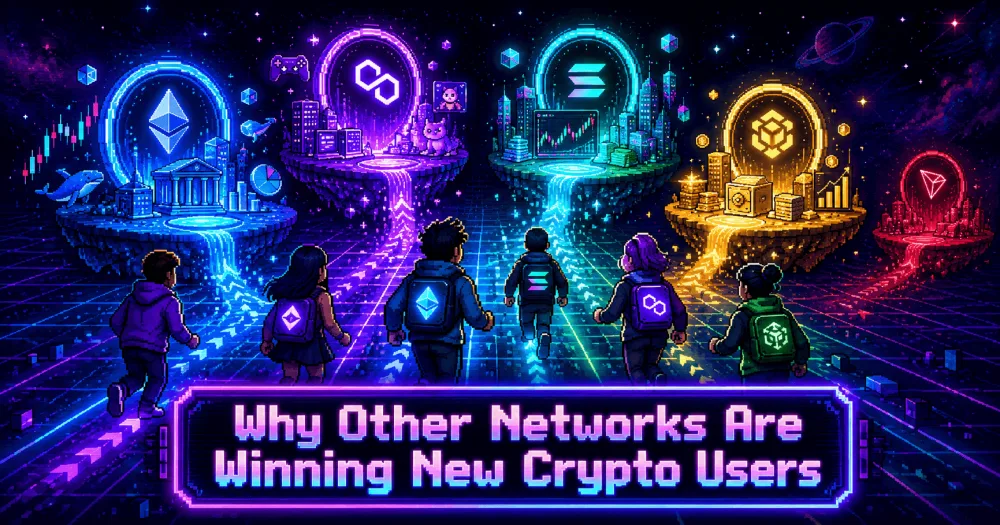
TRON remains powerful in payments, but competitors are attracting users who want more than basic stablecoin transfers. The main problem is not that the Tron blockchain has stopped working. It is that other ecosystems are producing more reasons to stay.
DeFi Traders Find More Liquidity Elsewhere
TRON holds billions of dollars in DeFi, but its activity is concentrated in a small number of protocols, especially JustLend and SUN. This makes the ecosystem easier to navigate, but it also limits competition and product diversity.
Daily decentralized exchange volume on TRON is often only a fraction of the volume seen on Solana, Ethereum, Base, or BNB Chain. Those networks offer deeper markets, more lending venues, liquid staking products, perpetual exchanges, prediction markets, restaking systems, and automated trading tools.
A user who only needs to send USDT may choose the Tron blockchain. A user who wants to trade, borrow, hedge, farm yield, or move between multiple applications has stronger reasons to choose another chain.
Solana Offers A Broader Retail Economy
Solana has become one of TRON’s most important competitors because it combines low fees with a large consumer-facing ecosystem. It supports stablecoins, memecoin trading, payments, DePIN, NFTs, mobile apps, decentralized exchanges, and increasingly sophisticated financial products.
Solana’s stablecoin supply remains far below TRON’s, but its liquidity is distributed across more use cases. USDC▲$0.9999 is deeply integrated into exchanges and applications, while wallets such as Phantom make it easy for users to move between trading, staking, collectibles, and payments.
The Tron blockchain remains simpler for many USDT transfers. Solana is more attractive when the transfer is only the first step in a longer on-chain journey.
Related: Top 3 Justin Sun Controversies: Scandals, Feuds, and Their Impact on Crypto Markets
Base Benefits From Coinbase Distribution
Base has a major advantage TRON cannot easily reproduce: direct access to Coinbase’s users, products, compliance infrastructure, and developer relationships. Its stablecoin supply is much smaller than TRON’s, but its decentralized exchange activity and application revenue are disproportionately high.
Developers can build with Ethereum-compatible tools while reaching users through Coinbase Wallet and integrated exchange services. This makes Base attractive for social applications, payments, token launches, lending, and consumer products.
For newcomers who enter crypto through Coinbase, using Base may feel more natural than setting up a separate Tron blockchain wallet and learning how Energy and Bandwidth work.
BNB Chain Competes For The Same Mass Market
BNB Chain is another direct competitor because it targets many of the same cost-sensitive users. It has broad exchange support, low transaction fees, millions of active addresses, and a larger variety of decentralized applications.
BNB Chain also combines stablecoins with active DEX trading, launchpads, gaming, lending, and token speculation. Users can transfer USDT cheaply and then access a wider on-chain market without leaving the network.
TRON’s payment specialization remains valuable, but BNB Chain offers a more complete mass-market ecosystem.
TRON’s USDT Dependence: Both Moat And Risk
Stablecoins account for the overwhelming majority of value held on TRON, and USDT represents almost all of that supply. This concentration is the foundation of the network’s success. It is also its biggest strategic vulnerability.
The Tron blockchain depends heavily on Tether continuing to issue USDT on the network, exchanges continuing to support TRC-20 deposits and withdrawals, and users continuing to prefer TRON over cheaper or more integrated alternatives.
A regulatory change, technical problem, issuer decision, or major shift toward USDC could weaken that advantage. Solana, Base, Ethereum, Stellar, and other networks support a more diverse mix of stablecoins and institutional issuers.
TRON does not need USDT to disappear for this concentration to become a problem. It only needs stablecoin growth to happen faster elsewhere.
The User Experience Is Cheap But Not Always Simple
TRON is often described as a low-fee network, but costs can be confusing. Simple transfers consume Bandwidth, while smart-contract transactions require Energy. When users lack sufficient resources, TRX is burned to pay the fee. Dynamic Energy pricing can also make contract costs vary.
Experienced users can reduce expenses through staking or Energy rental. Beginners may find the system less intuitive than paying a small, predictable gas fee on another network.
The Tron blockchain user experience is optimized for people who already understand TRC-20 transfers. It is less competitive when wallets and applications on rival networks hide gas management, sponsor transactions, support passkeys, or integrate directly with major exchanges.
Related: Best 5 Altcoins to Buy Before August 2026 — These Could Lead the Next Crypto Rally
Centralization Concerns Still Affect The Tron Blockchain
TRON uses delegated proof of stake, with 27 Super Representatives responsible for producing blocks. This design supports speed and efficiency, but critics argue that a small validator set creates governance and decentralization concerns.
For ordinary stablecoin users, this may not affect daily transfers. For developers, institutions, and users moving large amounts of capital into permissionless finance, governance structure matters. Ethereum’s larger validator base and the expanding institutional ecosystems around Ethereum, Solana, and specialized networks may appear more resilient or politically neutral.
TRON’s close association with Justin Sun also remains a branding risk. A network can function reliably while still struggling to convince some users that its governance is sufficiently independent from its founder and core organizations.
Can The Tron Blockchain Expand Beyond Payments?
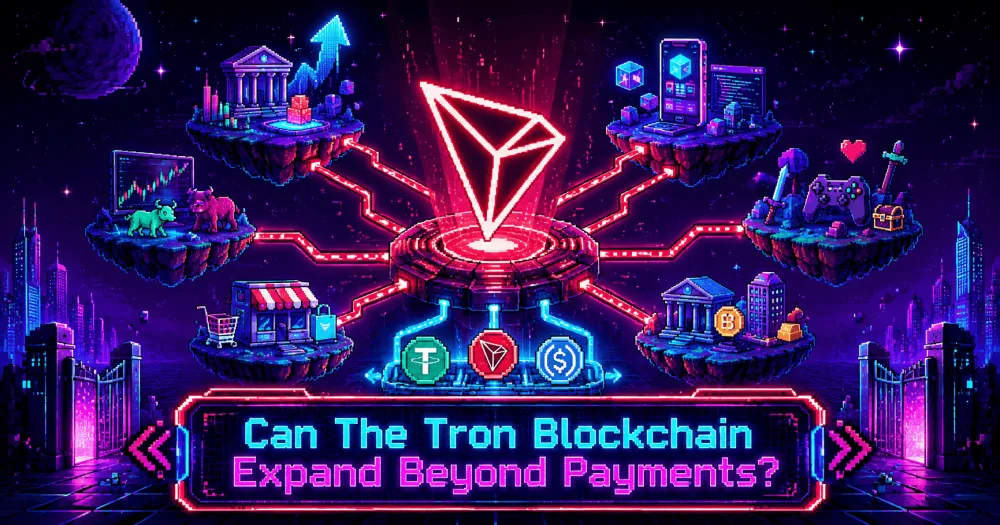
TRON does not need to beat every competing chain. Its realistic goal is to defend its stablecoin settlement leadership while building additional services around that traffic.
The network could strengthen its position by improving wallet design, simplifying Energy management, attracting independent developers, supporting more stablecoin issuers, and expanding cross-chain liquidity. Better institutional custody, compliance tools, tokenized assets, and merchant integrations could turn payment users into long-term ecosystem participants.
The Tron blockchain also needs more successful applications that are not directly connected to TRX, USDT, JustLend, or SUN. A broader developer base would reduce concentration and give users reasons to hold assets on TRON rather than treating it as a temporary transfer route.
Tron Blockchain Future Outlook
The Tron blockchain future is neither obvious decline nor guaranteed dominance. TRON remains one of the strongest networks for moving digital dollars, and its scale gives it a durable advantage. Millions of users are not leaving simply because newer chains are fashionable.
The problem is that crypto is becoming more specialized. Users choose Solana for liquid retail markets, Base for Coinbase-linked applications, Ethereum for institutional assets and deep DeFi, and BNB Chain for broad low-cost access. TRON wins when the task is sending USDT. It is less likely to win when the user wants an entire on-chain financial or consumer ecosystem.
That distinction will define the Tron blockchain over the next several years. If stablecoin transfers remain its main growth engine, TRON can stay large and profitable while gradually losing cultural and developer relevance. If it converts payment activity into diverse applications, it could remain a central part of crypto infrastructure.
Final Verdict
The Tron blockchain is not experiencing a straightforward user exodus. Its payment activity, active accounts, and stablecoin supply remain exceptionally strong. However, more users are choosing other networks for DeFi, trading, token launches, consumer apps, and institutional products.
TRON’s specialization is both its advantage and its limitation. It has built one of the world’s most successful stablecoin settlement networks, but competitors are building broader economies around their users. The future of TRON depends on whether it can become more than the place people use to send USDT.
FAQ
Is The Tron Blockchain Losing Users?
Not overall. TRON continues to record millions of active accounts and more than 10 million transactions on many days. The weaker trend is in ecosystem breadth: users often choose other networks for trading, DeFi, applications, and new token activity.
Why Is USDT So Popular On TRON?
TRC-20 USDT is supported by many exchanges, wallets, merchants, and peer-to-peer platforms. Transfers are fast, widely recognized, and often inexpensive, particularly for users who stake or rent Energy.
Which Networks Compete Most Directly With TRON?
Solana, BNB Chain, Base, Ethereum, Stellar, and several Ethereum Layer 2 networks compete with TRON in stablecoin transfers, payments, DeFi, and consumer applications.
Is The Tron Blockchain Centralized?
TRON uses 27 elected Super Representatives to produce blocks. This structure improves performance but is more concentrated than networks with much larger validator sets, which creates ongoing decentralization concerns.
What Could Improve The Future Of TRON?
TRON would benefit from simpler fees, more independent developers, a wider stablecoin mix, deeper decentralized markets, better wallets, stronger cross-chain access, and applications that convert payment users into active ecosystem participants.