
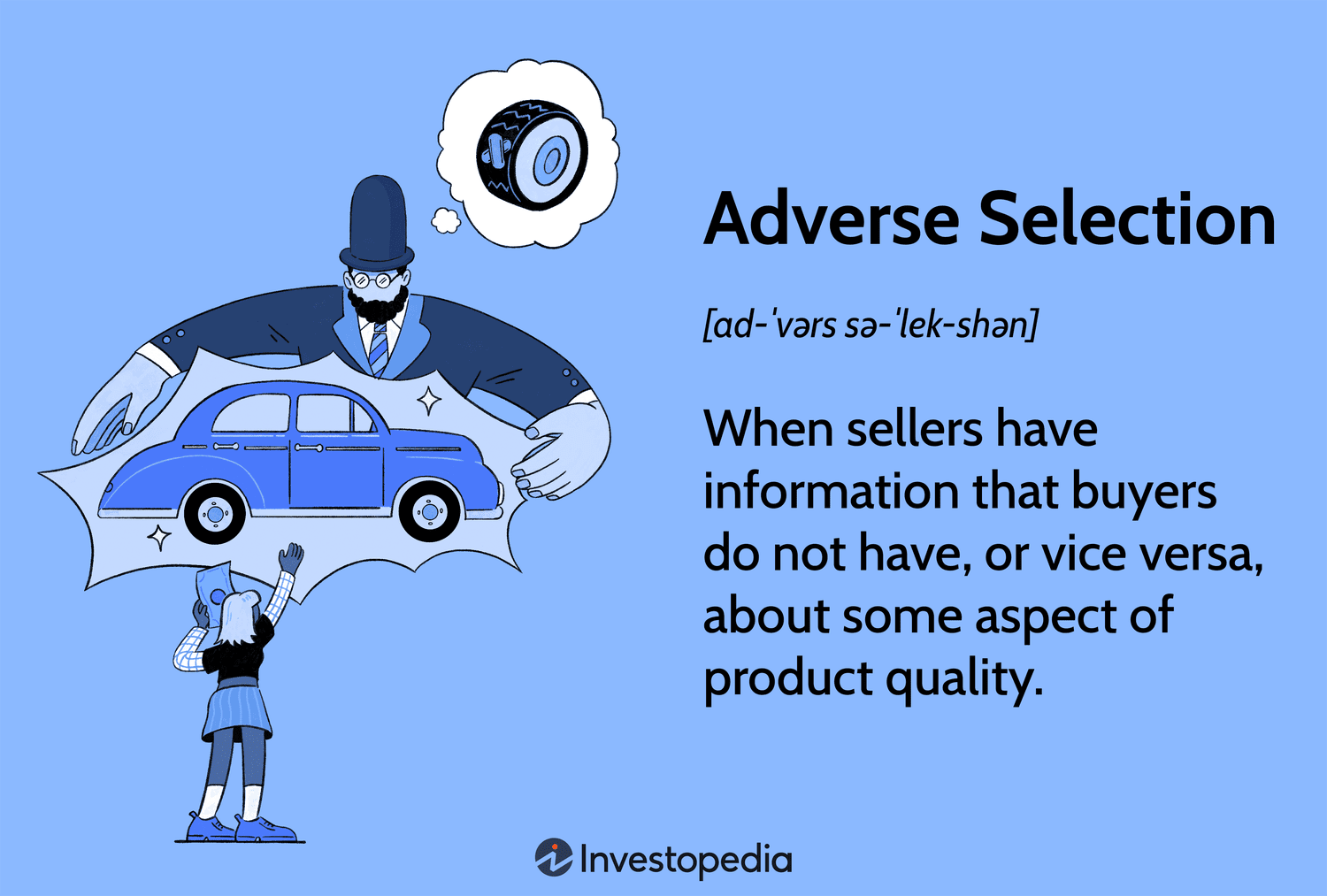
What Is Adverse Selection?
Adverse selection occurs when one party in a transaction has more information than the other, leading to market inefficiencies. Typically seen in insurance, the concept describes how high-risk individuals often obtain more coverage due to their insiders’ knowledge, leaving companies to manage financial risks. This article unpacks the dynamics of adverse selection, its impact on markets, especially in insurance and secondhand car sales, and how businesses can mitigate its effects through solutions like increased transparency and regulatory measures.
Key Takeaways
- Adverse selection occurs when there is asymmetric information between buyers and sellers, often leading to decisions that favor the more informed party.
- Insurance markets are particularly vulnerable to adverse selection, as individuals with higher risks are more likely to seek extensive coverage without disclosing their risk factors.
- To combat adverse selection, companies may raise premiums or limit coverage for high-risk individuals based on detailed evaluation and underwriting processes.
- The lemons problem is a classic example of adverse selection, highlighting how uncertain product quality due to asymmetrical information can lead to market failure.
- Adverse selection differs from moral hazard in that it occurs before a transaction, while moral hazard arises after an agreement is made, both involving information imbalances.
Get personalized, AI-powered answers built on 27+ years of trusted expertise.
Investopedia / Jiaqi Zhou
How Adverse Selection Influences Financial Decisions
Adverse selection happens when one party knows more than the other, often leading to risky or less profitable decisions.
In the case of insurance, avoiding adverse selection requires identifying groups of people more at risk than the general population and charging them more money. For example, life insurance companies go through underwriting when evaluating whether to give an applicant a policy and what premium to charge.
Underwriters typically evaluate an applicant’s height, weight, current health, medical history, family history, occupation, hobbies, driving record, and lifestyle risks such as smoking. All these issues impact an applicant’s health and the company’s potential for paying a claim. The insurance company then determines whether to give the applicant a policy and what premium to charge for taking on that risk.
Adverse Selection: Risks and Market Impact
Sellers might know more than buyers, giving them an advantage. For example, a company may issue shares knowing they’re overvalued, causing buyers to lose money. Similarly, a used car seller might hide defects to charge more.
The general consequence of adverse selection is that it increases costs since consumers lack information held by sellers or producers, creating an asymmetry in the market. This can also lower consumption as buyers may be wary of the quality of the products that are offered for sale. Or, it may exclude certain consumers that do not have access to or cannot afford to obtain information that could lead them to make better buying decisions.
Consumers can suffer health risks from poor information. Bad products or wrong claims may harm them physically, and avoiding vital medicines might lead them to see safe products as risks.
How Adverse Selection Affects the Insurance Industry
Because of adverse selection, insurers find that high-risk people are more willing to take out and pay greater premiums for policies. If the company charges an average premium for insurance but only high-risk consumers enroll, then the company takes a financial loss by paying out more in benefits or claims.
Insurance companies raise premiums for high-risk policyholders to cover benefits. For example, life insurance costs more for race car drivers, car insurance costs more in crime-prone areas, and health insurance is pricier for smokers. Meanwhile, lower-risk customers might skip insurance due to high costs.
A prime example of adverse selection in regard to life or health insurance coverage is a smoker who successfully manages to obtain insurance coverage as a nonsmoker. Smoking is a key identified risk factor for life insurance or health insurance, so a smoker must pay higher premiums to obtain the same coverage level as a nonsmoker. By concealing their behavioral choice to smoke, an applicant is leading the insurance company to make decisions on coverage or premium costs that are adverse to the insurance company’s management of financial risk.
Another example of adverse selection in the case of auto insurance would be a situation where the applicant obtains insurance coverage based on providing a residence address in an area with a very low crime rate when the applicant actually lives in an area with a very high crime rate. Obviously, the risk of the applicant’s vehicle being stolen, vandalized, or otherwise damaged when regularly parked in a high-crime area is substantially greater than if the vehicle was regularly parked in a low-crime area.
Fast Fact
Adverse selection might occur on a smaller scale if an applicant states that the vehicle is parked in a garage every night when it is actually parked on a busy street.
Strategies to Mitigate Adverse Selection
Sellers and buyers can reduce adverse selection by sharing more information to minimize imbalances. For consumers, the internet has greatly increased access while reducing costs. Crowd-sourced information in the form of user reviews along with more formal reviews by bloggers or specialist websites are often free and warn potential buyers about otherwise obscure issues around quality.
Warranties and guarantees offered by sellers can also help, allowing consumers to use a product risk-free for a certain period to see if it has flaws or quality issues and to return them without consequence if any arise. Laws and regulations can also help, such as Lemon Laws in the used car industry. Federal regulatory authorities such as the Food and Drug Administration (FDA) also help ensure that products are safe and effective for consumers.
Insurers reduce adverse selection by requesting medical information from applicants in the form of requiring paramedical examinations, querying doctors’ offices for medical records, and looking at one’s family history. This gives the insurance company more information that an applicant may fail to disclose on their own.
Distinguishing Between Moral Hazard and Adverse Selection
Moral hazard is the risk that one party has not entered into a contract in good faith or has previously provided false details about its assets, liabilities, or credit capacity.
Like adverse selection, moral hazard occurs when there is asymmetric information between two parties. However, adverse selection occurs when there’s a lack of symmetric information prior to a deal between a buyer and a seller, and moral hazard occurs after a deal is struck.
For instance, in the investment banking sector, it may become known that government regulatory bodies will bail out failing banks; as a result, bank employees may take on excessive amounts of risk to score lucrative bonuses knowing that if their risky bets do not pan out, the bank will be saved anyhow.
The Lemons Problem and Adverse Selection
The lemons problem refers to issues that arise regarding the value of an investment or product due to asymmetric information possessed by the buyer and the seller.
The lemons problem was put forward in a research paper, “The Market for ‘Lemons’: Quality Uncertainty and the Market Mechanism,” written in the late 1960s by George A. Akerlof, an economist and professor at the University of California, Berkeley. The tag phrase identifying the problem came from the example of used cars Akerlof used to illustrate the concept of asymmetric information, as defective used cars are commonly referred to as lemons. The takeaway is that due to adverse selection, the only used cars left on the market will ultimately be lemons.
The lemons problem exists in the marketplace for both consumer and business products, and also in the arena of investing, related to the disparity in the perceived value of an investment between buyers and sellers. The lemons problem is also prevalent in financial sector areas, including insurance and credit markets. For example, in the realm of corporate finance, a lender has asymmetrical and less-than-ideal information regarding the actual creditworthiness of a borrower.
Why Is It Called Adverse Selection?
“Adverse” means unfavorable or harmful. Adverse selection is therefore when certain groups are at higher-risk because they lack full information of unfavorable terms. In fact, they are often selected to enter into a transaction precisely because they are at such a disadvantage.
How Does Adverse Selection Impact Markets?
Adverse selection arises from information asymmetries. In economic theory, markets are assumed to be efficient and that everybody has full and “perfect” information. When some have more information than others, they can take advantage of those less-informed, often to their detriment. This creates market inefficiencies that can increase prices or prevent transactions from occurring.
What Is an Example of Adverse Selection in Trading and Investing?
In stock markets, there are some natural information asymmetries. For example, companies that issue shares know more about their internal finances and earnings before the general public does. This can lead to cases of insider trading, where those in-the-know profit from stock trades before public announcements are made, which is an illegal practice.
Another asymmetry involves the inventories of market makers and some institutional traders. While large holders of a company’s stock are made public, this information is only disseminated on a quarterly basis. This means that these players in the market may have a particular “axe to grind“—for example, a strong desire or need to buy or sell—that is not known by the investing public.
The Bottom Line
Adverse selection arises from asymmetric information, where one party, often sellers, holds more information than others, thus leading to market inefficiencies. This phenomenon is especially evident in insurance markets, where applicants may conceal critical information that highlights their higher risk, thereby causing financial strain on insurers. Effective strategies to counter adverse selection include gathering more information and implementing robust evaluation measures to level the informative playing field between buyers and sellers and promote a fair and transparent transaction environment.