
Preamble
Core Conflict: A historic constitutional and economic showdown occurred in Ghana’s Fourth Republic between the Executive branch and Parliament over the Human Sexual Rights and Ghanaian Family Values Bill.
The Institutional Rift: The standoff pitted the sovereign legislative authority of the Speaker of Parliament against the Executive’s responsibility to manage a fragile national economy.
The Hidden Driver: While public debate focused heavily on cultural morality and pending Supreme Court injunctions, an internal Ministry of Finance memo revealed that a feared $3.8 billion economic collapse was the true driving force behind the presidency’s refusal to sign.
The Analytical Focus: This critical review examines the specific constitutional powers invoked by both branches of government, the precise financial warnings issued behind closed doors, and the ultimate expiration of the legislation.
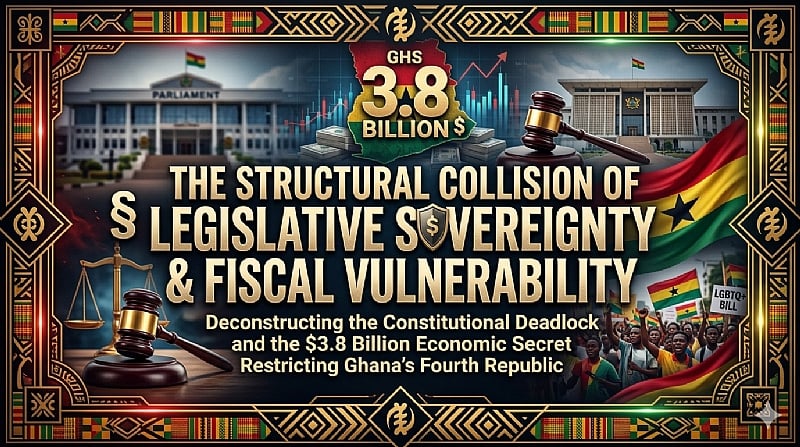
The Structural Collision of Legislative Sovereignty and Fiscal Vulnerability: Deconstructing the Constitutional Deadlock and the $3.8 Billion Economic Secret Restricting Ghana’s Fourth Republic
An Analytical Review: Macroeconomic Vulnerability and the Constitutional Gridlock Over Ghana’s Anti-LGBTQ+ Bill
The legislative odyssey of the Human Sexual Rights and Family Values Bill represents one of the most volatile constitutional and economic standoffs in Ghana’s Fourth Republic. While domestic public discourse primarily focused on socioreligious morality, the institutional reality was defined by a severe structural conflict between the sovereign legislative powers of Parliament and the executive management of a fragile economy.
An objective, critical analysis of this impasse reveals how Ghana’s legal framework and its macroeconomic dependencies collided, exposing the deep vulnerabilities of state governance.
I. The Constitutional Battleground: Article 106 vs. Executive Prerogative
The standoff brought into sharp focus the overlapping and sometimes contradictory boundaries of power between the Speaker of Parliament, representing the legislature, and the President, heading the executive.
The Legislative Mandate and the Speaker’s Defense
Under Article 106 of the 1992 Constitution, Parliament holds the sole power to make laws through bills passed by the House and presented to the President for assent. When the 8th Parliament passed the bill, Speaker Alban Bagbin maintained that the legislature had fulfilled its sovereign constitutional mandate.
The subsequent directive from the Office of the President—signed by Executive Secretary Nana Bediatuo Asante, ordering the Clerk of Parliament to “cease and desist” from transmitting the bill—was interpreted by the legislature as a direct assault on its independence. Speaker Bagbin fiercely rebuked the executive, declaring the directive “clearly contemptuous of Parliament”. He argued that an appointee of the President could not legally obstruct the administrative functions of a separate, co-equal branch of government.
In a retaliatory exercise of oversight power, the Speaker suspended the vetting and approval of newly appointed ministers, triggering a brief but significant institutional shutdown.
The Executive Strategy: Judicial Deferral
The Executive defended its refusal to receive the bill by citing pending interlocutory injunctions before the Supreme Court, notably filed by broadcaster Richard Dela Sky and academic Dr. Amanda Odoi. The presidency argued that performing an executive action on a contested bill would prejudice the judiciary’s role as the final arbiter of constitutional interpretation. Critics, however, viewed this as a tactical deployment of legal procedure to avoid the political fallout of a direct presidential veto.
II. The $3.8 Billion Leverage: Specific Revelations from the Finance Ministry
While constitutional mechanics provided the public rationale for the deadlock, a leaked internal assessment from the Ministry of Finance exposed the overriding macroeconomic anxieties driving the executive’s resistance.
In a highly critical briefing memo, the Ministry of Finance explicitly warned President Akufo-Addo of catastrophic financial repercussions if the bill were enacted. The memo detailed that Ghana stood to lose a staggering $3.8 billion in total World Bank financing over a five-to-six-year period.
The document outlined immediate threats to the national budget, stating:
“The loss of these financial resources will create a massive financing gap in the 2024 budget, which the government will struggle to fill through alternative sources.”
Furthermore, the ministry noted that a vital $600 million in budget support loans ($300 million awaiting imminent disbursement and an additional $300 million under negotiation) would be immediately jeopardized:
“A non-disbursement of the World Bank budget support will negatively impact our foreign exchange reserves and the stability of the local currency, the Cedi.”
At the time, Ghana was highly vulnerable, navigating a fragile recovery supported by a $3 billion IMF Extended Credit Facility following a historic sovereign debt default. The Finance Ministry explicitly warned that international backlash could derail ongoing, highly sensitive debt-restructuring negotiations with external creditors, plunging the country back into hyperinflation and economic instability.
III. Resolution, Lapse, and Institutional Limitations
The structural deadlock was ultimately dissolved not by political compromise, but by judicial dismissal and the expiration of the legislative calendar.
On December 18, 2024, the Supreme Court unanimously dismissed the lawsuits. The seven-member panel ruled that the challenges were premature, noting that because a text remains a bill until it receives presidential assent, the court lacked jurisdiction to rule on speculative statutory outcomes.
Despite the removal of this legal shield, President Akufo-Addo maintained his strategy of executive inaction until his term expired in January 2025. Under Ghanaian law, any bill that fails to receive presidential assent before the dissolution of a parliamentary term officially lapses. The 2024 Bill effectively died through automated pocket veto, forcing lawmakers to reintroduce a revised framework—the Human Sexual Rights and Family Values Bill—to restart the legislative process under the subsequent administration [8].
IV. Conclusion: The Reality of Restricted Sovereignty
This historic confrontation exposes a critical vulnerability in Ghana’s democratic governance: domestic legislative sovereignty is heavily constrained by international financial dependence.
While Parliament successfully asserted its constitutional authority to draft and pass legislation reflecting domestic cultural values, the Executive was forced to act as the manager of macroeconomic survival. The standoff proves that as long as Ghana relies heavily on external capital and Western-dominated financial institutions to support its national budget and currency, its legislative output will remain subject to an implicit external veto.
Conclusion
- The Institutional Precedent: The crisis demonstrated that the 1992 Constitution allows a president to deploy a legal “pocket veto” simply by avoiding a bill until the parliamentary term expires.
- The Limits of Sovereignty: This standoff exposed the stark reality that Ghana’s domestic legislative freedom remains heavily bound to Western donor capital.
- The Executive Compromise: By prioritizing macroeconomic survival over local popular demand, the Executive protected the Cedi and the IMF bailout at the cost of legislative finality.
- The Unresolved Core: As the newly revised 2025/2026 version of the bill returns to the Executive desk under a new administration, the foundational tension between national cultural autonomy and foreign economic reliance remains completely unchanged.
✍️ Retired Senior Citizen
For and on behalf of all Senior Citizens of the Republic of Ghana 🇬🇭
Teshie-Nungua
[email protected]