
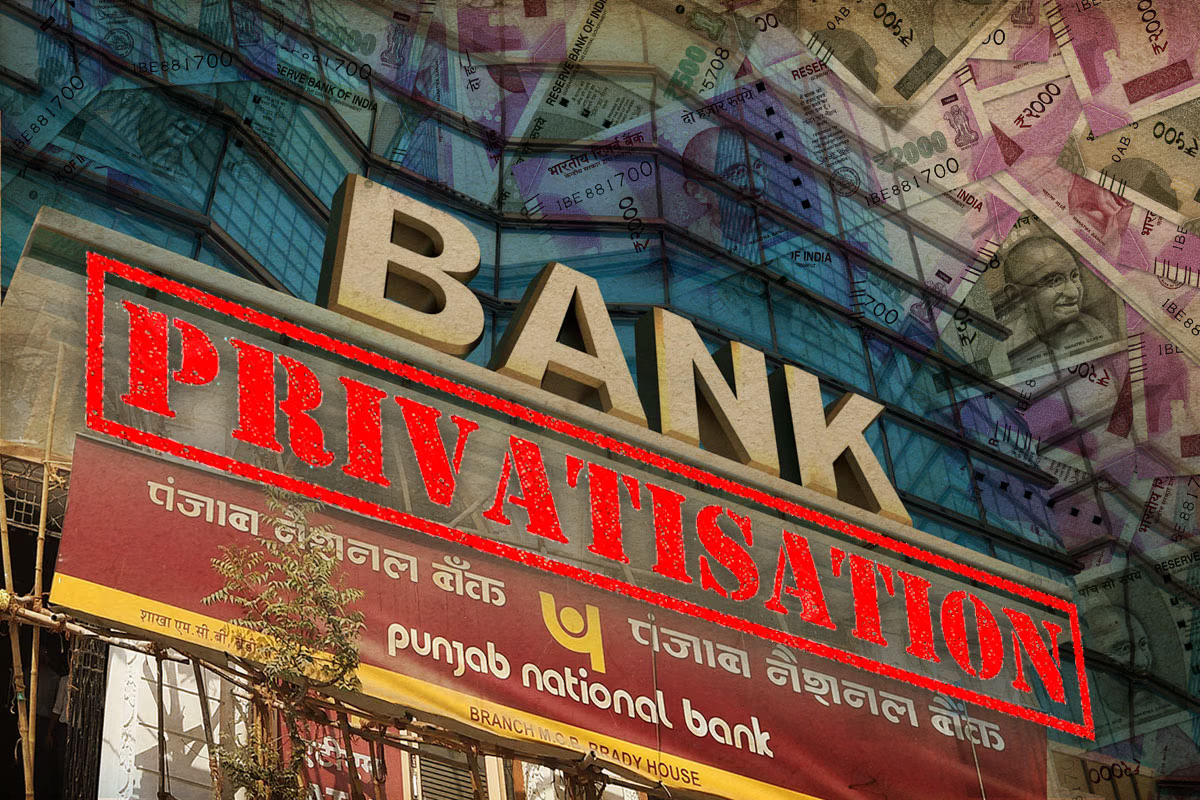
Every now and then we hear the cry that banks should be nationalised. The taking over of banks by the State is urged on various grounds, namely, that it is necessary in order “to mobilise resources” for the economic development of the country, “to prevent the concentration of economic power”, “to check malpractices in the working of banks” and to put a stop to profiteering” by banks. All these arguments will be found to be untenable on a dispassionate scrutiny of the issues involved.
The primary function of banks is to mobilise resources for economic development and that is exactly what the banks in our country have been doing. They have been working to attract deposits from those who have funds to spare on [a] long or short term basis. They have been making loans for industrial as well as agricultural expansion in accordance with numerous legislative requirements.
During recent years, they have opened numerous branches in order to extend credit facilities to people even in remote areas, even though the banking business in several branches has proved unremunerative. They have invested more than Rs 600 crore in Government securities. They have been broadening their capital base and increasing their reserves in accordance with statutory requirements. The enormous increase in their deposits during recent years bears testimony to the confidence which the public have in their working.
By undertaking the foreign exchange business, our banks render considerable help in promoting exports. An occasional appearance of a black sheep in the sphere of banking, as in any other sphere, does not detract from the value of the service which the banks as a whole are rendering to the country. What is regrettable is that though the Reserve Bank is invested with extensive powers to prevent malpractices, in one or two cases it failed to exercise them to protect the interests of the depositors as well as shareholders.
Ninety-five per cent of bank advances in India are secured loans. The corresponding figures for the USA, is only thirty per cent. This amply bears out the fact that our banks pursue a very conservative and safe policy while using the depositors’ money for making loans. Various legislative measures have been taken to prevent possible malpractices by banks. The Deposit Insurance Scheme ensures security to depositors. Under the Scheme, the premium payable is 1/20 of 1 per cent. At present, the annual premium on the total deposits with the banks amounts to a little over one crore of rupees.
If the Government desires to increase banking facilities, nothing prevents it from expanding the number and activities of its own banking and credit institutions and competing with banks in the private sector in terms of equality and fair play.
There is no force in the argument that the banks are making huge profits. The dividends which the shareholders receive on their investments work out to about six to eight per cent taxable, on the basis of ruling quotations. In most cases, dividends are considerably less on the basis of actual investment by the shareholders. Assuming some banks have made somewhat higher profits during recent years, it is the Government which has been the greatest beneficiary. Not only does it take 50 per cent of the profits by way of the corporation tax, but it takes a considerable slice as income-tax on dividends in the hands of the shareholders. Indeed, the Government itself makes much higher profits in a few of the Public Sector concerns where it enjoys a virtual monopoly, though its over-all performance in the working of the numerous public sector concerns is highly disappointing.
The banking industry in our country is subject to numerous controls, some of which are not only irksome but are uncalled for in the interest of the development of banking along right lines. However, the sphere in which banks can work on their own initiative is very valuable from the point of view of the society. The relationship between a bank and its client is one of great mutual confidence. It should be as intimate as between a physician and his patients. If the banks were to be nationalised this relationship would become truncated if not totally destroyed. A banker is required to make quick decisions after bearing in mind various factors in his relationship with his client. He has to assume a reasonable degree of responsibility in making the decisions. The employee of a state-managed bank is naturally reluctant to shoulder this responsibility. He is anxious to fortify himself with authority and approval from his superiors. The process of obtaining such approval is time-consuming and defeats the purpose for which the institution of banking exists.
It would be pertinent to quote in this context Mr C Subramaniam, Union Minister for Steel and Heavy Industries. Mr Subramaniam recently said that the Government had thought that members of the I.C.S., who had been excellent public administrators, would manage public corporations too, but very few of them had proved successful. The Minister observed that, “In Government departments decisions are taken on the basis of precedents, no matter how long it takes to find out the precedent. In industry and business, it is absolutely necessary to take quick decisions. Hesitancy and delay in taking decisions is the greatest harm to industry and business.”
An unimaginative compliance with regulations for extending credit is not the best way of transacting banking business. Government servants in the role of bankers would import red-tapism into banking. Needless to say these inseparable adjuncts of civil service are fatal to sound banking practices. Further, it has to be noted that civil servants have not made themselves conspicuous for courtesy or consideration to the members of the public. To give one instance, whereas some banks have made arrangements for the cashing of the current account cheques within five minutes of their presentation, we need not be surprised that because of red-tape procedures under bank nationalisation a holder of a cheque may have to wait for fifty minutes or more before his cheque is cashed.
If banks were to be nationalised, politicians would start interfering with bank officials and put on them undue pressure. The Government would get huge patronage in respect of making appointments on the staff as also extending credit to various interests. An element of nepotism and favouritism may be introduced in the sphere of banking which should be free from these vices. Unscrupulous elements may use the enormous power of granting or denying credit to stifle political opposition. This might deal one more blow to the working of democracy in our country.
Nationalisation of banks would not be to the interest of the bank employees. Against the combined role of the State and the employer, the employees will not be able to get their legitimate dues. Complaints have been made that labour legislation is often ignored in Public Sector concerns, giving rise to much discontent amongst labour. Friction between management and labour is responsible for lowered productivity. A number of Public Sector concerns are notorious for indiscipline of the employees and high degree of absenteeism. The country suffers as a result of all this.
Idle capacity in men as well as machines in Public Sector concerns has been criticised by the Estimates Committee of the Lok Sabha. The latest Audit Report (commercial) placed on the table of the Lok Sabha by the Finance Minister has referred on the irregularities in the accounting and auditing systems of Government companies. For instance, Hindustan Shipyard and Indian Rare Earths diverted their audit staff for the preparation of final accounts, thereby, as rightly pointed out by the Audit Report, “defeating the very object of internal audit.” This kind of irregularity in keeping accounts in case of nationalised banks would undermine the credit structure in the country, resulting in the loss of public confidence and consequent economic disruption.
Our banks are sometimes blamed for not holding the price line. The banks, their employees and the public generally are themselves victims of governmental measures and policies which push up prices. To hold the banks responsible for the failure to hold the price line is unjustified.
Far from nationalising banks, the time has come to institute a thorough probe into the working of the Public Sector concerns and to hand over to private management all State concerns which are working inefficiently.
Without a free market economy there will be an end to all fundamental rights. There can be no true democracy without the recognition and enforcement of fundamental rights. Fundamental rights must necessarily include the right of the people to practise any legitimate trade, profession or calling. Accordingly, people should be free to carry on banking subject to reasonable regulation. State monopoly of banking will deal a serious blow to our mixed economy and pave the way for a totalitarian regime. Advocates of totalitarianism are fully conscious of this development, which explains their enthusiasm for bank nationalisation. The people and the Government must, therefore, remain vigilant against the machinations of the enemies of democracy and basic freedoms.
This essay is part of a series from the Indian Liberals archive, a project of the Centre for Civil Society. It is taken from the economic supplement of The Indian Libertarian and titled ‘Bank Nationalisation Will Endanger Our Democracy And Economic Growth’, published on 15 December 1963. The original version can be accessed here.