
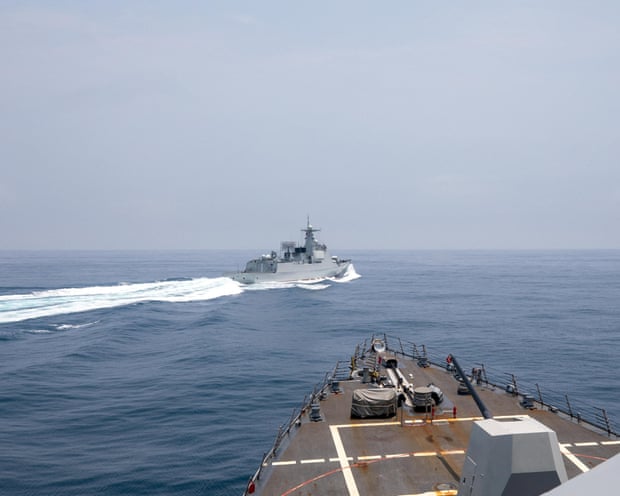
A Chinese missile destroyer has conducted live-fire drills in Japan’s economic waters, marking a significant escalation in regional tensions.
In a notable escalation in military activities, a Chinese missile destroyer conducted live-fire drills within Japan’s exclusive economic zone (EEZ) on Sunday. This incident, which occurred approximately 180 kilometres from Okinotori, Japan’s southernmost island, marks the first time Japan has acknowledged that a foreign navy vessel has fired live rounds in its EEZ.
The drill included the use of machine guns with live ammunition. Prior to this exercise, three Chinese warships, accompanied by a Russian frigate, were observed sailing in the Pacific between Okinawa’s main island and Miyako island. They were later detected around 330 kilometres south-west of Okinotori in the early hours of Sunday.
Following the drill, the Chinese missile destroyer issued warnings to maritime traffic about its military activities. Minoru Kihara, Japan’s chief government spokesperson, noted at a Tuesday briefing that Tokyo considers this exercise a sign of increasing cooperation between the Chinese and Russian militaries.
Japan’s government expressed its concerns to Beijing, stating that the drill “could have endangered the navigation of nearby ships.” Kihara emphasised that Japan would continue monitoring Chinese and Russian vessels in its coastal waters closely.
The tensions are further heightened by China’s stance on Okinotori. The Chinese government contests its status as an island, asserting that it is a reef, which implies that the surrounding waters should not fall under Japan’s jurisdiction. Previous instances of Chinese military presence in the area include a Chinese aircraft carrier and a research ship entering Japan’s EEZ in 2025.
The backdrop of these military maneuvers includes deepening rifts between Japan and both China and Russia, particularly following Japan’s criticism of China’s actions regarding Taiwan in November 2025. Japanese Prime Minister Fumio Kishida has previously remarked that any assault on Taiwan, which is self-governing but claimed by China, could trigger a military response from Japan.
In a related incident, a Chinese vessel approached the Second Thomas Shoal in the South China Sea, which is under Philippine control but claimed by China. Philippine Navy sources indicated that a sailor suffered significant injuries due to alleged aggression from the Chinese crew. China refuted these claims, proposing that its personnel had issued warnings and that the Philippine crew had initiated the confrontation.
Furthermore, the Philippines successfully challenged China’s broad claims of sovereignty over the South China Sea in a 2016 ruling by the Permanent Court of Arbitration, a decision that China continues to reject. The foreign ministers of the Philippines and China are expected to discuss these issues at an upcoming meeting of the Association of Southeast Asian Nations (ASEAN) in Manila.
Simultaneously, United States Secretary of State Marco Rubio condemned China’s recent actions. He stated that such provocations undermine regional stability and contradict China’s commitment to resolving disputes peacefully. In an article published before the ASEAN summit, he reiterated the US’s dedication to maintaining freedom of navigation in Southeast Asia, emphasising that control over these waters by a single power could threaten the sovereignty and economic future of both the US and ASEAN nations.
Discussions about whether Rubio will meet with Chinese Foreign Minister Wang Yi in Manila remain unconfirmed. China is currently engaged in territorial disputes with multiple nations in the South China Sea, as well as with Japan, India, and Bhutan.