
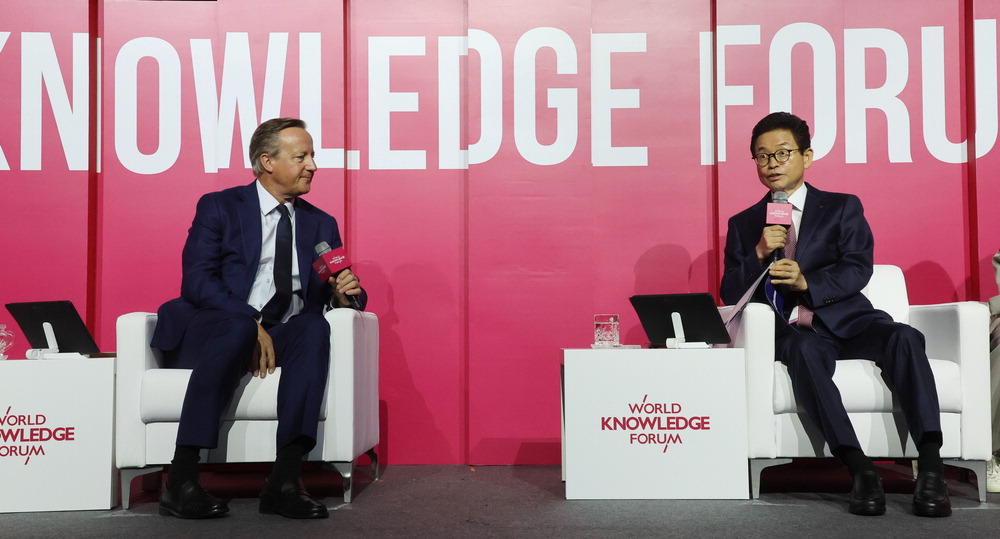

“Economic globalization is retreating, but the globalization of dictatorial and oppressive authoritarianism is spreading fiercely. And then there is populist politics. These are the causes of the world’s geopolitical crises.”
Former British Prime Minister David Cameron offered this assessment of global affairs in a keynote speech on “A New Order of Coexistence in the AI Era” at the opening ceremony of the 27th World Knowledge Forum, held at Jangchung Arena in Jung-gu, Seoul, on the 8th. Cameron said, “When former United States President George W. Bush referred to the ‘axis of evil’ during the 2003 invasion of Iraq, such an axis did not actually exist. But now it does.” He added, “North Korean troops are fighting in Ukraine under Russian leadership, supported by Iranian-made drones incorporating Chinese technology.” He also pointed out, “The various conflicts taking place around the world have encouraged isolationism in the West and destabilized the politics of major countries, making it more difficult to do the right thing.” He continued, “Populism has even reached the point of destroying alliances that had been taken for granted for years.”
◆ Social Media Shakes the Social Order
Cameron identified the failure of politics in major countries to function properly, along with stagnant economic growth, as key causes of the problems facing the world. He also noted that social networking services are having a harmful impact by shaking social order and values. “In the past, people read similar newspapers and listened to mediators who helped them determine what was true,” he said. “Now, people have their own news and their own truth, leaving them exposed to malicious forces.”
Cameron strongly argued that governments should focus their policies on economic and national security while making difficult choices about priorities. “Take the United Kingdom as an example: growth has stagnated because of excessive spending and regulation,” he said. “In this dangerous era, we need to spend more on defense. To do so, reforming and reducing social security programs is unavoidable.”
◆ Solidarity Should Center on Countries That Share Common Values
To resolve the problems facing the world, Cameron stressed, “We must build supply chains with resilience and stability centered on countries that share our values.” He said alternatives must be found to replace the existing World Trade Organization (WTO)-based order as the end of free trade under “country-first” policies becomes a reality. “If the WTO does not function properly, we should seek alternatives by concluding multilateral agreements such as the Trans-Pacific Partnership (TPP),” he added.
Cameron also said relations with traditional allies, including the United States, need to be redefined. Although tensions have emerged as the Donald Trump administration pressures allies to take on greater roles in the Middle East, he explained that the need for alliances ultimately remains unchanged. “Many of the United States’ threats toward its allies amount to words rather than action,” Cameron said. “We must not give up on the United States as our closest security guarantor.”
At the “Leadership and Soft Power: The Path of Nations” session, Cameron discussed cities and national strategies for future generations, as well as leadership, with Lee Cheol-woo, governor of North Gyeongsang Province. Drawing on his experience running a coalition government, Cameron identified trust, a clear plan, and explaining policies to the public as essential elements of politics. “In 2010, there was a strong sense of crisis as Europe was experiencing a financial crisis, and concerns were growing that the United Kingdom could also be caught up in it,” he recalled. “By working closely with our coalition partner, the Liberal Democrats, and honestly explaining a clear plan to the public, we were able to form a coalition government and maintain it for five years.”
Responding to the suggestion that Brexit had caused confusion in British politics, Cameron rejected the idea that the United Kingdom’s membership in the European Union (EU) had been a major factor. He explained that the problems facing the United Kingdom were caused by excessive regulation and debt, excessively high public spending, and a lack of growth engines. He stressed that for local self-government to succeed in South Korea, local cities must have the essential conditions for development beyond mere political decentralization. “Just as weakening London would not make the United Kingdom stronger, weakening Seoul would not make South Korea stronger,” Cameron advised. “The point is not to reduce the size of core cities, but to establish transportation networks, universities, and investment infrastructure so that regions and second- and third-tier cities can develop.”
◆ AI to Strengthen the Engine of Balanced Development
Cameron also forecast that advances in artificial intelligence could allow local self-government to flourish further. Lee said, “More than half of South Korea’s population is concentrated in the capital region, so the country is governed with a capital-region-first mindset. That is why people have even begun referring to it as ‘Seoul metropolitan area syndrome.’ To resolve the problem of the ‘Seoul Republic,’ we must now implement two groundbreaking policies: decentralization and balanced development.” Cameron predicted, “Once the Fourth Industrial Revolution is completed through advances in AI, the era of the Fifth Industrial Revolution will follow.” He added, “During that period, the value of industries responsible for the knowledge economy and mass leisure will grow significantly. Food, culture, the arts, and tourism will become key industries, and jobs will be created in various regions, strengthening the engine of balanced development.”
Lee responded, “I believe every country should conduct joint research on the issues of decentralization and balanced development.”
[Reporter Lee Jin-han]