
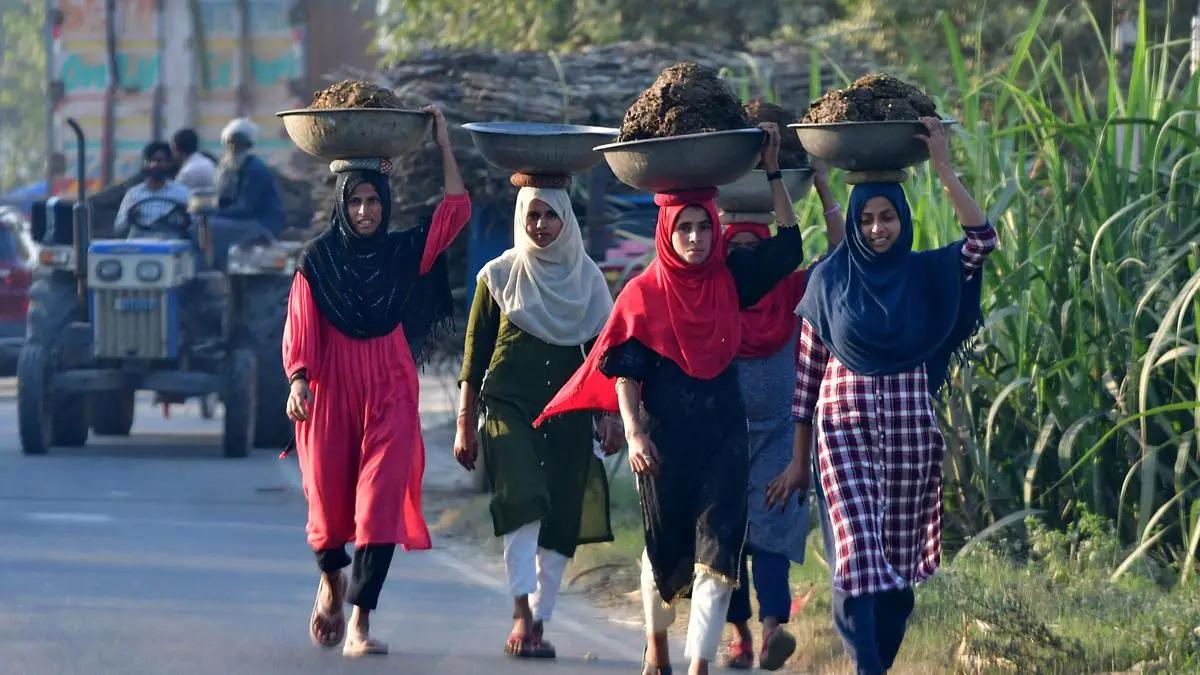

The government estimates that GOBARdhan could generate more than 1.5 lakh jobs across the value chain over the scheme’s ten-year horizon.
| Photo Credit:
SHIV KUMAR PUSHPAKAR
India’s rural economy has always produced resources that have been undervalued because there was no organised market around them. Cattle dung, crop residue, press mud and other organic materials have often been treated as waste or low-value by-products. GOBARdhan could change that equation, not simply by creating more compressed biogas (CBG) plants, but by creating markets around resources that were previously difficult to monetise.
The Union Cabinet’s approval of the ₹23,731-crore GOBARdhan National Circular Bioenergy Scheme in August marks an important step in that direction. To be implemented from 2026–27 to 2035–36, the scheme aims to drive nearly ten-fold growth in domestic CBG production through assured offtake, stable pricing, capital assistance, pipeline connectivity, credit support and technology development.
The foundation is already expanding. As of August 13, 2026, 1,929 CBG/Bio-CNG plants had been registered, with 217 commissioned and another 357 under construction. The next phase is therefore not only about adding capacity, but building the rural supply chains that can make this capacity commercially sustainable.
Job creator
Every CBG plant needs a dependable stream of feedstock. That creates an economic chain well before biomass reaches a processing facility.
Farmers and livestock owners can become suppliers. Aggregators can organise collection, while rural entrepreneurs can develop transportation, storage and preprocessing networks. Existing agricultural businesses can also become part of a more structured procurement ecosystem.
The government estimates that GOBARdhan could generate more than 1.5 lakh jobs across the value chain over the scheme’s ten-year horizon. These opportunities could extend beyond plant operations into feedstock collection, aggregation, transportation, processing and organic-manure value addition.
But the economic value of biomass depends not simply on how much exists, but on whether it can be collected, transported, stored and supplied consistently at a viable cost.
Opportunity to move towards integrated value chains
GOBARdhan recognises this challenge. Its CBG Ecosystem Challenge Fund includes feedstock resource assessment and mapping, aggregation infrastructure, district-level development planning, technology adoption and organic-manure value addition.
India does not have to build this ecosystem from scratch. Sugar mills, distilleries, dairy networks, agricultural markets, transport operators and other rural businesses already have relationships with farmers and access to organic resources.
Press mud from sugar mills, for instance, can become part of a broader circular model alongside other biomass streams. This creates an opportunity to move from isolated waste-management projects towards integrated rural value chains, where agriculture, energy, logistics and organic inputs reinforce one another.
Technology and market intelligence can further improve this ecosystem by helping businesses understand feedstock availability, seasonality, procurement requirements, logistics and market demand.
The real rest is commercial scalability
Policy support can create the conditions for growth, but long-term success will depend on project economics. GOBARdhan provides an important demand signal through assured CBG offtake and a government-backed administered price of ₹2,110 per MMBTU, equivalent to ₹105 per kg. Eligible greenfield projects can also receive capital assistance of up to ₹2 crore per tonne per day of installed capacity.
The real measure of GOBARdhan’s success should therefore not simply be the number of plants registered. It should be the number of sustainable rural supply chains created around them.
If farmers, aggregators, entrepreneurs, existing agricultural businesses and energy producers can participate in these new markets, India could achieve something larger than additional CBG capacity, a rural economy where waste becomes a resource, resources create new markets, and those markets generate income, employment and economic value.
The author is Chairman & Managing Director, JK India eAgriTech Ltd.
Published on September 27, 2026