
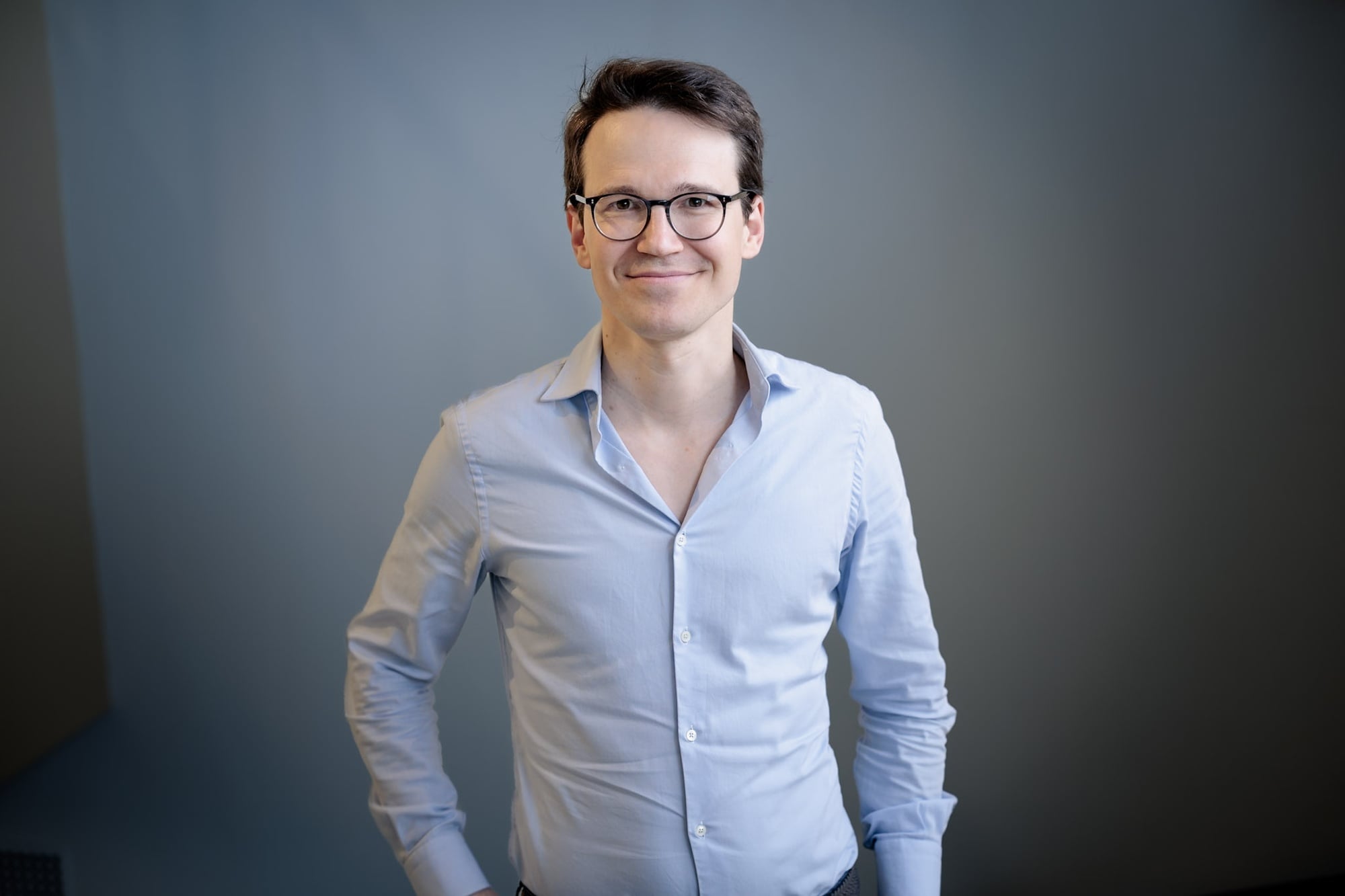
Harvard Economics professor Ludwig Straub thought he had missed a spam call.
Instead, it was the American Economic Association informing him that he had been awarded the 2026 John Bates Clark Medal — one of the most prestigious honors in economics.
“It felt very much unreal,” Straub said. “I was working from home, and then they tried calling me, but I didn’t hear the call.”
Straub, a macroeconomist who studies global economic dynamics, is the second consecutive Harvard professor to receive the award. He follows Stefanie Stantcheva, a professor of political economy at Harvard, who won last year. Past recipients include Harvard economists Raj Chetty ’00 and Melissa L. Dell ’05.
Awarded annually to economists under the age of 40, the Clark Medal recognizes significant contributions to economic thought. It is named after John Bates Clark, an American economist and former Columbia University professor.
Straub was honored for advancing a major shift in macroeconomic modeling: incorporating “agent heterogeneity,” or differences across households and firms, into frameworks that traditionally relied on a single, representative agent.
“For a long time, macroeconomic models were based on the assumption of a single sort of representative household that just behaves like the average of all households,” Straub said.
His work breaks that average apart, modeling householders with different incomes, occupations, skills, and ages — an approach that helped produce more realistic and predictive analyses of the economy.
Straub came to Harvard as a postdoctoral fellow in 2018, after earning a Ph.D. in economics from the Massachusetts Institute of Technology. He joined the faculty in 2019 and became a tenured professor in 2024.
“This is not an award for just one person,” Straub said. “I’m very, very thankful for all the support that I’ve received over the years.”
Colleagues said Straub’s research has reshaped how economists measure and understand key macroeconomic forces.
“He’s made groundbreaking contributions to economic measurement, including savings rates across income distribution, sectoral linkages, determinants of real interest rates,” Harvard Economics professor Gabriel I. Chodorow-Reich ’05 said.
He added that Straub’s work has also influenced research on capital taxation, fiscal deficits, and monetary policy during supply shocks such as the Covid-19 pandemic.
When Chodorow-Reich announced the award in an intermediate macroeconomics class they co-teach on Tuesdays, he said students responded with “a very large and warm round of applause.”
He also pointed to Straub’s growing influence among policymakers. Straub has co-authored three papers for the Jackson Hole Economic Policy Symposium, an annual conference convened by the Federal Reserve Bank of Kansas City that commissions research on pressing economic issues.
“They commission papers from top economists on things that policymakers are really trying to grapple with,” Chodorow-Reich said. “Having co-authored three in a period when I don’t think anybody else has co-authored more than one just shows how much demand there is for things that Ludwig thinks about.”
Beyond his research, colleagues emphasized Straub’s reputation as a mentor and teacher.
Harvard Economics professor Kenneth S. Rogoff described Straub’s work in macroeconomic methodology and its policy implications — including the relationship between inequality and interest rates — as “hugely influential”.
“He has inspired many of our best graduate students to pursue applications of his techniques and ideas,” Rogoff wrote in a statement.
Economics professor N. Gregory Mankiw called Straub “the complete package of what a professor should be,” praising both his scholarship and teaching.
Straub, in turn, credited his collaborators, colleagues, and students.
“I couldn’t, wouldn’t be here without my wonderful co-authors that have made my life so much more enjoyable and made my work so much more impactful,” Straub said. “And last, but certainly not least, the students I get to teach every day.”
“They just make all the difference to me,” he added. “It’s really phenomenal, how many fantastic students we have here at Harvard.”
—Staff writer Theresa F. Bartelme can be reached at [email protected] and on Signal at theresabartelme.15. Follow her on X @theresabartelme.
—Staff writer Uy B. Pham can be reached at [email protected] or on Signal at ubp.88. Follow him on X @uybpham.