
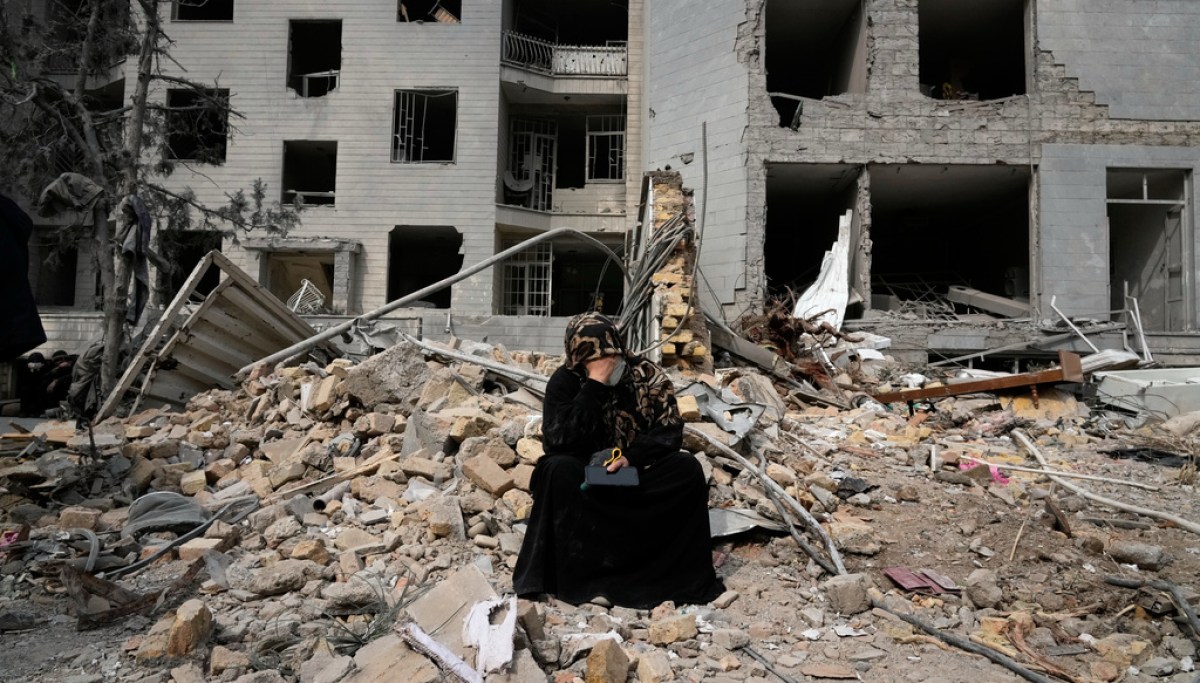
Iranian experts put the total economic losses from just Operation Epic Fury at $280 billion, not counting damage from follow-up operations and the naval blockade.
The figure was stated by Hossein Nouhi, a certified construction expert in Tehran’s municipality, during an event hosted by the University of Tehran’s Faculty of Urban Planning, Iran International reported. Nouhi said the figure was only from direct losses incurred during the opening 40-day phase of intensive combat operations, and even then didn’t count the cost of restoring industrial production and intangible factors such as psychological damages.
The event gave some of the first insights into the full extent of damage incurred during the war, primarily in Tehran. Municipal figures from Tehran Municipality’s Urban Planning and Architecture Department released at the event confirmed that Tehran was the heaviest hit location of the war, being targeted by a confirmed 650 strikes.
ESTIMATED IRANIAN ECONOMIC DAMAGE FROM WAR APPROACHES $150 BILLION
The city wasn’t uniformly hit, however, with strikes heavily concentrated in certain areas.
Of Tehran’s 22 districts, District 4 was the heaviest hit by a significant margin, weathering 90 strikes. District 4 contains Lavizan, a northeast neighborhood that also holds the headquarters and complex of the Aerospace Industries Organization, a central military-industrial subsidiary of Iran’s Ministry of Defense, and was suspected of holding a secretive nuclear research facility. It’s also home to a fortified military garrison.
Lavizan also appears to be home to key Iranian command-and-control complexes. During the 2025 Twelve-Day War, former Iranian supreme leader Ali Khamenei was reported to have hidden with his family in a fortified bunker in Lavizan, a location he presumably would’ve fled to again had he survived the current war’s opening assassination strike on Feb. 28.
The next most heavily hit district, District 21 with 62 strikes, is the site of Tehransar, a military housing neighborhood centered around an airport known for its use by the Islamic Revolutionary Guard Corps.
Another of the heaviest hit, District 22, is home to several key Guard facilities, including the Guard’s Aerospace Force headquarters in Chitgar.
District 17 got off the easiest, suffering just three reported strikes.
Overall, the strikes against Tehran destroyed or damaged 50,849 housing units, according to the municipal figures. Most of these were only lightly damaged, but 2,042 were completely destroyed and 9,315 were heavily damaged.
The figure of $280 billion in economic damages is significantly higher than most Western estimates. In May, the Foundation for the Defense of Democracies’s Center on Economic and Financial Power released one of the first Western estimates of the economic damage suffered by Iran, giving the wide estimate of $50 billion to $300 billion, with $144 billion being the most likely middle estimate. That analysis accounted for war damage to strategic assets and economic infrastructure, as well as disruptions to the economy.
One of the report’s analysts, FDD’s Center on Economic and Financial Power senior research analyst Daniel Swift, told the Washington Examiner in May that the total cost estimate didn’t take into account the cost of rebuilding its regional proxy network, human capital loss, astronomical wartime inflation, reconstruction financing, and many more factors that are likely valued in the hundreds of billions.
Iran was already suffering an effective economic collapse before the war, a situation that sparked the biggest protests the Islamic Republic had seen since its inception, culminating in the brutal January crackdown that killed tens of thousands and set off the chain of events leading to the war. The war has made all these problems, particularly inflation, much worse.
Last month, leading economists at a two-day conference in Tehran warned that the economic situation was growing increasingly critical. Former presidential adviser Masoud Nili said at the conference that Iran’s economy was transitioning from a manageable malaise into an acute crisis. Inflation has been the most persistent issue, exploding during the war as the economy effectively ground to a halt while the government kept printing money to pay its Guards.
Economist Mohammad-Mehdi Behkish, speaking at the conference, said the combined total needed to rebuild war damage, restore growth, and modernize industry stood at about $500 billion in investment. He added that much of this was needed from international sources, as Iran’s domestic resources had nowhere near enough to match this sum on a reasonable timeline.
In remarks carried by government-linked outlets, Central Bank Governor Abdolnaser Hemmati said per-capita income had fallen by 47%, reaching levels not seen since the 1990s, when Iran was still recovering from its nearly decade-long war with Iraq.
IRAN FACES FINANCIAL DEATH BLOW BECAUSE OF WAR
Unsurprisingly, Iran reached its highest-ever number on the Misery Index, an economic indicator combining the inflation and unemployment rates, at 91.1 points, up from 74.2 points in the winter and 51.7 points in 2022.
The economic situation is now far worse than it was in December and January, conditions that triggered a national uprising. But now the Guard has consolidated control over the government, with the technocratic factions of the Iranian government having been sidelined by hardliners who will choose to pursue rebuilding the military over civilian and consumer goods reconstruction, giving little hope that Iran’s economy will recover anytime soon.