

Joe Lennerz, Medical Director, Pathology Innovations at Natera, shared a post on LinkedIn:
“Medicine has spent the past decade asking whether artificial intelligence can diagnose disease. Increasingly, the answer appears to be yes. The more difficult question is what happens next. AI is not a laboratory test, a medical device, a drug, or a physician. It creates value in an entirely different way, yet healthcare reimbursement remains largely organized around these traditional categories. Unless payment models evolve alongside technology, the greatest obstacle to clinical AI may not be regulatory approval or technical validation—it may simply be that there is no sustainable way to pay for it.
On July 7th 2026, a CMS proposal suggest that this conversation has begun.
Before getting to the proposed rule there is a concept that might help understanding the proposed rule. Briefly, the broader significance of the proposed rule extends beyond reimbursement mechanics. Historically, Medicare has reimbursed the generation of clinical data (e.g., performing a laboratory test, acquiring an image, or preparing a tissue specimen). The proposed SaMS framework begins to recognize a different source of value: the computational interpretation of existing data.
This evolution creates the need for a term describing the product of algorithmic analysis. In this article, the termclinical intelligence denotes clinically actionable information generated through computational analysis that informs diagnosis, prognosis, risk stratification, and treatment decisions
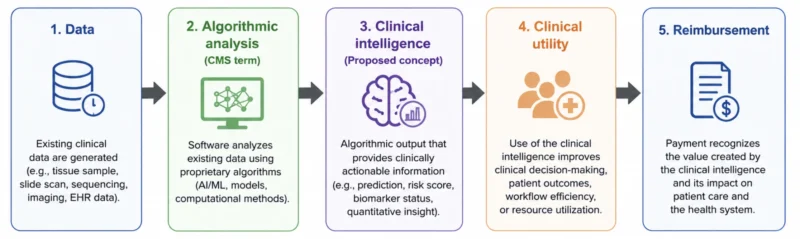
From Data to Value – the term clinical intelligence refers to the clinically meaningful output of an AI algorithm
Healthcare has always paid for activities. AI creates value through ‘intelligence’. The next generation of reimbursement must determine how to value intelligent contributions.
This question has moved beyond academic speculation. In its recently released 2027 Outpatient Prospective Payment System (OPPS) proposed rule, the Centers for Medicare & Medicaid Services (CMS) explicitly recognizes software as an emerging payment category by including dedicated policy considerations for Software as a Medical Service alongside more traditional topics such as devices, drugs, and outpatient procedures.
While the proposed rule does not yet establish a comprehensive reimbursement framework for AI, it sends an important signal: CMS acknowledges that software is becoming a distinct component of healthcare delivery that can no longer be viewed solely through the lens of conventional (i.e., existing) medical devices or professional services.
CMS explicitly states that the current payment system is inadequate
‘Current Medicare Part B payment systems for SaMS, including in the OPPS, are primarily designed to pay for services that rely on material resources, rather than technologies whose value is driven by proprietary algorithms and scalable, non-material costs.’
Although the specific payment proposals are relatively narrow, their implications are much broader. CMS is beginning to confront a question that extends across pathology, radiology, laboratory medicine, and clinical decision support: how should Medicare value software that generates clinical intelligence? Unlike traditional diagnostics, AI creates value through prediction, interpretation, and workflow optimization rather than through consumable reagents, imaging equipment, or physician time alone. As AI becomes embedded throughout clinical care, reimbursement policy will increasingly determine not only which technologies are adopted, but also which innovations are developed and supported in the first place.
In other words CMS quietly acknowledges in this proposed rule a new category of healthcare: software as a reimbursable clinical service.
If software is becoming a reimbursable healthcare service, how should we value the clinical intelligence it provides? The 2027 CMS OPPS proposed rule provides some of the first signals that this question is moving from theory to policy. While the rule does not yet define a comprehensive reimbursement framework for AI, it identifies software as a distinct policy area (‘Software as a Medical Service‘) and reiterates that Medicare payment systems must evolve to account for ‘changes in technology’ and the introduction of ‘new services.’
This immediately raises four practical questions.
- What is the reimbursable service? The proposed rule explicitly recognizes Software as a Medical Service as its own policy topic, suggesting that software is becoming more than an attribute of a medical device. Yet it remains unclear whether Medicare is purchasing software, an algorithm, a clinical interpretation, or the diagnostic insight generated by that software.
- How should software be valued? CMS emphasizes that OPPS payment groups are revised annually to reflect ‘changes in medical practice, changes in technology, and the addition of new services.’ AI challenges this framework because its principal output is information rather than a tangible procedure or consumable.
- How should AI evolve after deployment? The rule describes new technologies as requiring sufficient clinical information and cost data before permanent payment assignment and recognizes transitional pathways for emerging technologies. Unlike traditional technologies, however, AI continues to evolve after deployment through software updates, performance monitoring, and model refinement.
- How should evidence translate into payment? Throughout the OPPS methodology, payment is fundamentally linked to claims data, resource utilization, and demonstrated costs. AI introduces additional dimensions (e.g., diagnostic accuracy, workflow efficiency, and improved clinical decision-making). These are not easily captured by existing reimbursement methodologies.
CMS explicitly state that it does not yet know the correct payment methodology:
‘Questions remain regarding how best to structure payment for these services.’
The key message of this propose rule is thereby unfortunately not a direct answer. And more importantly, these are not simply “reimbursement questions”. These are policy questions about how healthcare defines value.
As software increasingly contributes clinical intelligence rather than performing a discrete procedure, payment policy must evolve from valuing activities to valuing information, prediction, and decision support.
Note. The 2027 CMS proposed rule does not yet answer how AI should be reimbursed. It does, however, acknowledge that software has become a distinct component of healthcare delivery and that payment systems must adapt to technological change. The next challenge is no longer whether AI belongs in clinical practice, but how healthcare should recognize, measure, and reimburse the value of the clinical intelligence it provides.
CMS proposes an interim solution
‘We propose an interim payment policy for SaMS for CY 2027 while we examine a range of approaches to payment for these kinds of technologies.’
CMS recognizes that software deserves its own payment pathway
Rather than continuing to force AI-enabled diagnostic software into reimbursement categories originally designed for laboratory tests, imaging procedures, or medical devices, CMS proposes an interim framework that explicitly recognizes Software as a Medical Service (SaMS) as a distinct class of reimbursable healthcare services. Specifically, the proposed rule would:
- Redefine the category, replacing the term Software as a Service (SaaS) with Software as a Medical Service (SaMS) to emphasize that these technologies provide clinical and diagnostic functionality rather than general cloud-based software.
- Identify 36 HCPCS codes as SaMS services, creating a defined portfolio of software-based clinical services eligible for dedicated payment consideration.
- Assign these services to New Technology APCs, recognizing that existing clinical APCs do not adequately reflect the unique characteristics and cost structure of AI-enabled software while CMS develops a more permanent reimbursement method.
- Create a new payment status indicator (‘O1’), defined as ‘Software as a Medical Service, paid under OPPS; separate APC payment,’ thereby establishing software as a separately reimbursable category within the OPPS payment architecture.
CMS makes clear that these measures areinterim. Rather than deriving payment rates from limited claims data, it proposes to maintain current payment levels while gathering additional evidence and developing a comprehensive methodology better suited to software whose value is driven by algorithmic performance rather than material resources.
Importantly, the 36 HCPCS codes are not 36 AI algorithms. They are 36 existing billable clinical services whose principal value is algorithmic analysis rather than specimen processing, imaging acquisition, or physician interpretation.
CMS essentially identifies a new class of services:
- AI-assisted image analysis
- Clinical decision support
- Computational risk prediction
- Algorithmic interpretation of previously generated laboratory or imaging data
- Digital pathology biomarker prediction
- Quantitative imaging analysis
- Predictive oncology algorithms
In fact, the proposal includes examples such as:
- AI-based prediction of microsatellite instability (MSI) from digital pathology images
- AI prediction of homologous recombination deficiency (HRD)
- AI-assisted prediction of actionable biomarkers in lung cancer from whole-slide images
- AI-derived breast cancer recurrence scores
- Algorithmic analysis of previously sequenced transcriptomic data
- Quantitative coronary CT analysis
- Clinical risk modeling and computer-aided detection (CAD)
The important conceptual point is that CMS is not paying for generating the underlying data. The tissue has already been processed, the slide already scanned, the sequencing already performed, or the CT already acquired.
CMS is recognizing reimbursement for the computational transformation of existing clinical data into new clinically actionable information. This is why the proposal even identifies 10 existing laboratory codes that describe algorithmic analyses performed on prior laboratory test results and proposes moving them from the Clinical Laboratory Fee Schedule (CLFS) into OPPS as SaMS because the billable activity is the algorithm, not the laboratory assay itself.
Importantly, the 36 HCPCS codes do not primarily represent new laboratory tests or imaging procedures; rather, they represent computational services that extract additional clinically actionable information from data that have already been generated. In other words, CMS is beginning to recognize reimbursement not for data acquisition, but for algorithmic interpretation.Summary
Every major technological advance in medicine has ultimately required a corresponding evolution in reimbursement. Artificial intelligence is no exception. The 2027 CMS proposed rule acknowledges that software has become a distinct clinical service and begins the process of developing an appropriate payment framework. The next challenge is no longer whether AI belongs in clinical practice, but how healthcare systems should recognize and reward the value created by clinical intelligence. The decisions made today will determine not only how AI is paid, but also which innovations reach patients tomorrow.
NOTE: Notably, the proposed rule never defines or even references clinical intelligence. Instead, it continues to frame reimbursement in terms of “services, procedures, technologies, and associated costs”. This reflects the historical design of Medicare payment systems. These were developed to reimburse activities rather than the generation of information. Artificial intelligence challenges this paradigm because its primary contribution is often neither a procedure nor a device, but the production of clinically actionable information.
Clinical intelligence can be defined as clinically actionable information generated from patient data that improves diagnostic, prognostic, or therapeutic decision-making.
This is more than a theoretical distinction
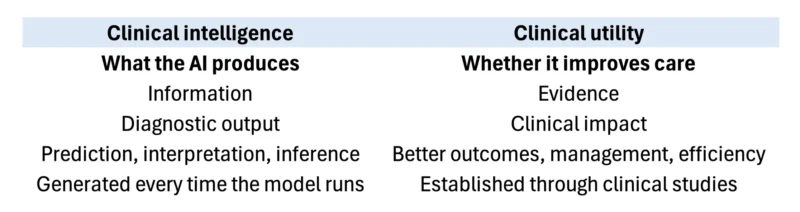
Clinical intelligence vs. Clinical utility – what is the difference?
AI transforms medicine by re-defining clinical intelligence as an output. Clinical utility is an outcome.
Example 1 – Microsatellite Instability (MSI)
An AI model analyzes a whole-slide image and predicts a 97% probability of microsatellite instability (MSI). This prediction, when reported, represents clinical intelligence: it transforms histologic image data into clinically actionable information. By itself, however, it does not establish value. Clinical utility is demonstrated only if acting on this prediction improves patient care, for example by reducing unnecessary molecular testing, accelerating confirmatory testing, identifying patients eligible for immune checkpoint inhibitors, or shortening time to treatment.
Example 2 – Minimal Residual Disease (MRD)
An AI model integrates histopathology, molecular residual disease (MRD) results, and clinicopathologic variables to estimate a specific risk of recurrence after curative-intent therapy. The individualized recurrence risk is clinical intelligence because it provides information beyond any single data source. Clinical utility is established only when this information changes management: for example by intensifying surveillance, guiding adjuvant therapy, avoiding unnecessary treatment in low-risk patients, or ultimately improving patient outcomes and resource utilization.”
Other articles about AI in oncology on OncoDaily.