
Skip to main content
Haiti
+ 4 more
Key Messages
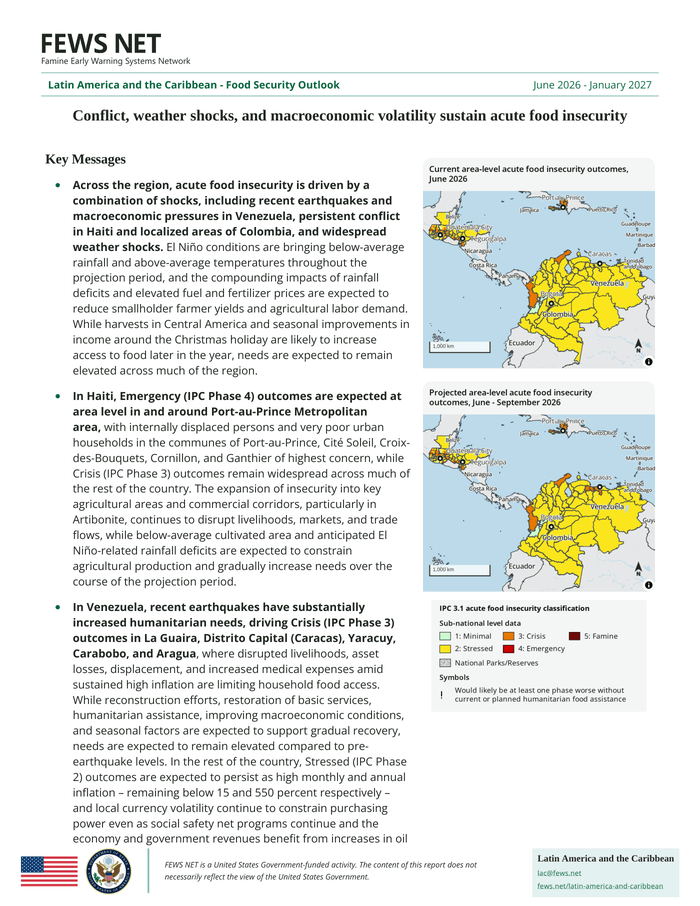
- Across the region, acute food insecurity is driven by a combination of shocks, including recent earthquakes and macroeconomic pressures in Venezuela, persistent conflict in Haiti and localized areas of Colombia, and widespread weather shocks. El Niño conditions are bringing below-average rainfall and above-average temperatures throughout the projection period, and the compounding impacts of rainfall deficits and elevated fuel and fertilizer prices are expected to reduce smallholder farmer yields and agricultural labor demand. While harvests in Central America and seasonal improvements in income around the Christmas holiday are likely to increase access to food later in the year, needs are expected to remain elevated across much of the region.
- In Haiti, Emergency (IPC Phase 4) outcomes are expected at area level in and around Port-au-Prince Metropolitan area, with internally displaced persons and very poor urban households in the communes of Port-au-Prince, Cité Soleil, Croix-des-Bouquets, Cornillon, and Ganthier of highest concern, while Crisis (IPC Phase 3) outcomes remain widespread across much of the rest of the country. The expansion of insecurity into key agricultural areas and commercial corridors, particularly in Artibonite, continues to disrupt livelihoods, markets, and trade flows, while below-average cultivated area and anticipated El Niño-related rainfall deficits are expected to constrain agricultural production and gradually increase needs over the course of the projection period.
- In Venezuela, recent earthquakes have substantially increased humanitarian needs, driving Crisis (IPC Phase 3) outcomes in La Guaira, Distrito Capital (Caracas), Yaracuy, Carabobo, and Aragua,where disrupted livelihoods, asset losses, displacement, and increased medical expenses amid sustained high inflation are limiting household food access. While reconstruction efforts, restoration of basic services, humanitarian assistance, improving macroeconomic conditions, and seasonal factors are expected to support gradual recovery, needs are expected to remain elevated compared to pre-earthquake levels. In the rest of the country, Stressed (IPC Phase 2) outcomes are expected to persist as high monthly and annual inflation – remaining below 15 and 550 percent respectively – and local currency volatility continue to constrain purchasing power even as social safety net programs continue and the economy and government revenues benefit from increases in oil production and other extractive industries.
- In Colombia, Crisis (IPC Phase 3) outcomes are expected to persist in La Guajira and Chocó, where weather-related shocks, localized insecurity, and elevated prices are reducing agricultural production, labor opportunities and associated income, and access to markets. El Niño-driven rainfall deficits are expected to worsen drought conditions and reduce livestock and crop production in La Guajira, while flood risk, river transportation disruptions, and intermittent confinement continue to constrain livelihoods in Chocó, particularly among poor Indigenous and Afro-Colombian households. Across much of the rest of the country, elevated prices for food, transportation, utilities, and agricultural inputs are expected to sustain Stressed (IPC Phase 2) outcomes.
- In Central America, Crisis (IPC Phase 3) outcomes are expected to persist in the most vulnerable areas of the Dry Corridor, as well as in parts of Alta Verapaz and the Western Highlands in Guatemala, while Stressed (IPC Phase 2) outcomes are likely elsewhere. Consecutive years of crop losses, atypically early depleted food stocks, below-average incomes, and prolonged market dependence are resulting in increased reliance on the use of coping strategies that further erode livelihoods. A strong El Niño event is expected to bring below-average rainfall, above-average temperatures, and prolonged dry spells that further reduce smallholder crop production and agricultural labor demand. Seasonal harvests and labor opportunities beginning in October are expected to improve food access. However, seasonal gains are not likely to fully replenish household stocks or savings and are not expected to fully offset elevated living costs, resulting in a continuation of Stressed (IPC Phase 2) and limited areas in Crisis (IPC Phase 3) post-harvest.