

Generative AI looks set to shape the economic history of the late 2020s. What remains uncertain is whether it delivers a productivity breakthrough or falls short of today’s high expectations.
AI could deliver a sustained period of stronger productivity growth, with labour-augmenting technology helping workers perform tasks more efficiently and creating new roles. It could be one of paradigm-shifting unemployment, in which labour-replacing technology boosts output at the expense of employment, rather than in concert with it. Or it could be a cautionary tale of animal spirits, in which firms leverage large bets on an unproven technology that turns out to have minimal productivity benefits.
So far, AI’s impact has been clearer in investment than productivity
AI is already affecting the global economy, but the clearest evidence so far is visible in capital expenditure rather than realised productivity gains. Demand for AI-related hardware has benefited supplier economies in Asia, while spending on AI, including information processing equipment and software, has sustained US business investment over the past two years.
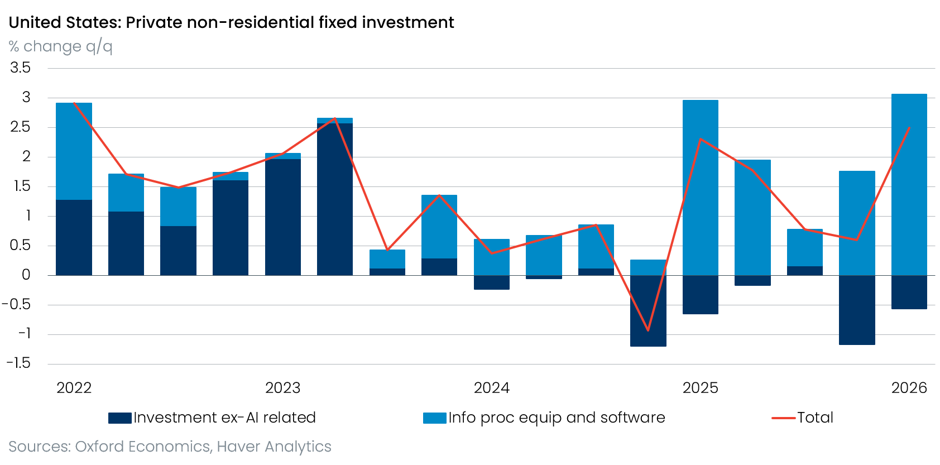
Evidence of a broad productivity uplift remains much less conclusive. AI adoption has increased rapidly, but its day-to-day use within firms remains uneven. In many cases, businesses still need to redesign workflows and develop complementary infrastructure before the efficiencies created by AI translate into higher firm-level output.
This contrast between rapid investment and limited realised productivity gains informs our measured baseline view. We expect generative AI to make the US economy around 3.5% more productive over the next decade, with the gain rising to 4.5% in the long run. This represents a meaningful improvement, although it sits towards the cautious end of published estimates, which range from a long-run uplift of around 1% to more than 12%.
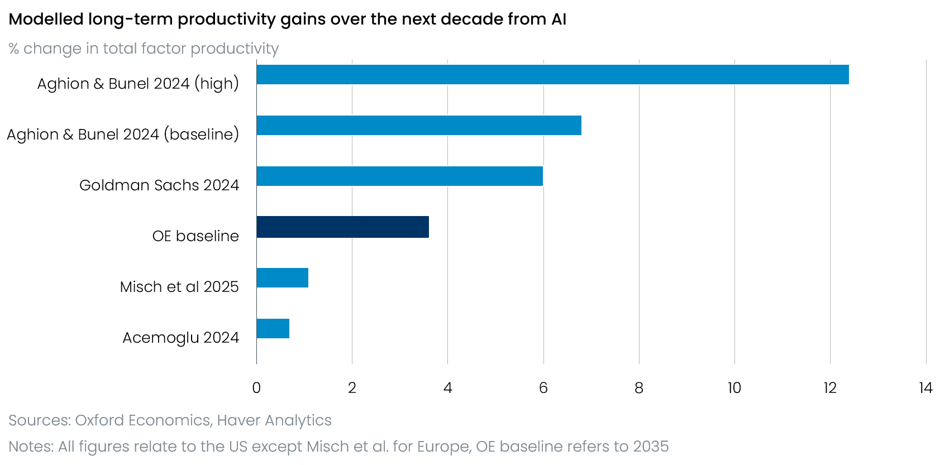
The range of plausible outcomes remains wide. To understand our central forecast, and what could cause the economy to follow a different path, we have built a series of “levers” into our Global Economic Model (GEM). These make the assumptions underlying our baseline explicit and allow us to assess the wider economic effects of alternative AI futures.
Three questions shape our AI outlook
Our model levers seek to answer three key questions about generative AI:
- How many tasks within the economy can generative AI automate?
- How many tasks within the economy will generative AI automate?
- Will generative AI be labour-augmenting or labour-replacing?
Let’s take each of those in turn.
How many tasks within the economy can generative AI automate?
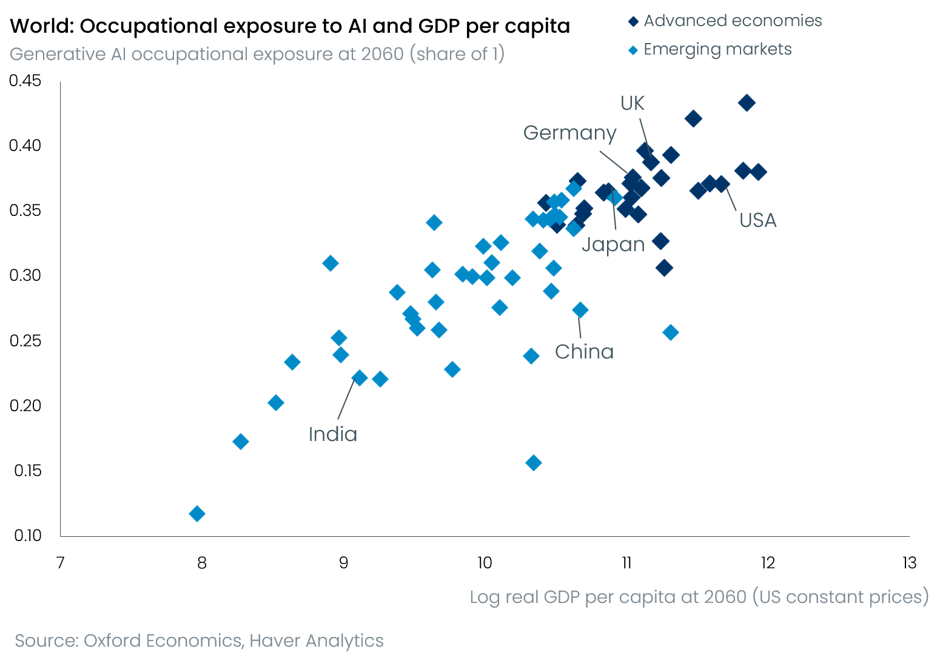
Our first “lever” determines the proportion of tasks in an economy that are automatable with generative AI: AI Exposure. We estimate exposure by assessing the share of tasks in each sector that generative AI could perform or support and then aggregate these estimates into an economy-wide measure, giving us proportions that vary across countries.
Clerical, administrative, and IT jobs are some of the most exposed to generative AI in our research, while physical activities like mining, construction, and fishing are least exposed. Emerging markets in which these activities account for a larger share of employment and output are therefore less exposed than advanced economies with larger knowledge-intensive service sectors.
How many tasks within the economy will generative AI automate?
The technology may be able to automate a large proportion of administration tasks, but the extent to which it does depends on firms’ adoption and integration of generative AI into their production and business processes.
Our second “lever” is AI Adoption: the proportion of those automatable tasks that are automated. We expect adoption to follow an S-curve, accelerating as the technology becomes more widely tested and integrated before slowing as it approaches saturation. Again, we see cross-country differences in our baseline forecast: the US is already leading in terms of AI adoption, while Japan lags behind due to a rigid and ageing labour force.
In our baseline, adoption accelerates towards the end of this decade, with the technology adopted in 80% of possible applications by 2040 across most advanced economies, but the lever allows us to explore how this might vary in certain scenarios.
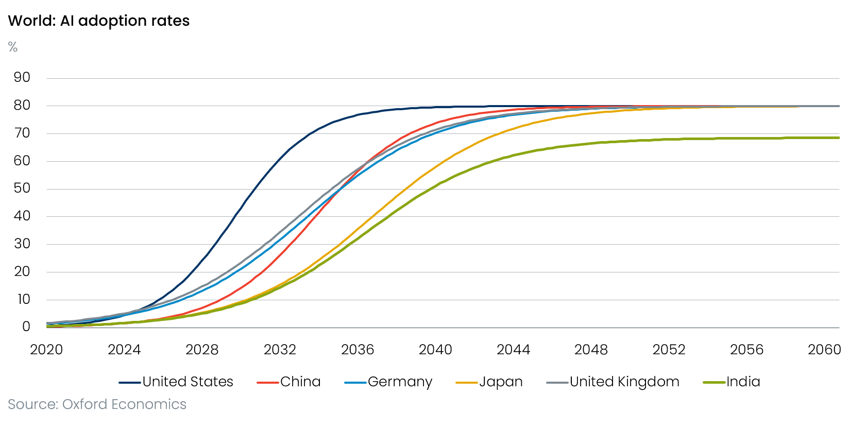
Could a political backlash cause governments to enforce restrictions on AI usage? Could adoption snowball as the benefits of the technology become clearer? We can easily speed up or slow down the adoption rate in our modelling to examine alternative adoption paths.
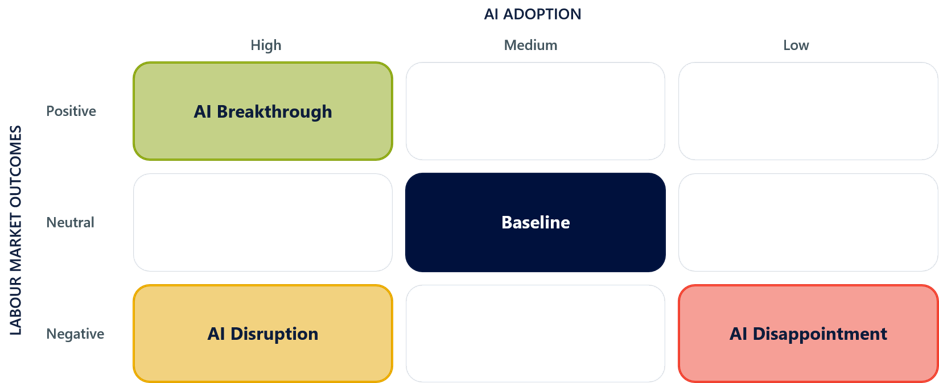
We vary these assumptions in AI Breakthrough and AI Disappointment, two of the three scenarios designed to complement our baseline forecast.
In AI Breakthrough, we explore a world in which AI adoption progresses more quickly than in our baseline forecast, front-loading the resulting productivity gains and pushing growth above baseline, especially in advanced economies with a higher prevalence of exposed sectors.
In AI Disappointment, AI adoption proceeds more slowly and ultimately reaches a lower level than we expect. The productivity benefits also fall short of expectations, leaving growth below our baseline.
Together, these first two levers help determine the timing and scale of AI’s impact on productivity and growth. Because they are fully integrated into our Global Economic Model, users can trace the wider macroeconomics effects of AI futures on the full suite of GEM variables.
Will generative AI be labour-augmenting or labour-replacing?
Suppose that a firm has identified a job’s worth of automatable tasks, integrated a generative AI agent that can perform them, and reaped the productivity benefit of doing so. How does that affect their hiring decisions?
At the most disruptive end of the range, every automated task reduces overall labour demand. Whether firms choose to let workers go or cancel hiring plans, full automation could result in a net loss from the workforce of all the tasks automated.
At the other end of the scale, automation does not directly replace workers. Instead, it allows them to concentrate on other tasks, oversee AI output or move into new roles made possible by the technology.
Our baseline view is that AI will primarily augment labour, helping workers perform tasks more efficiently and move into new roles rather than causing a lasting rise in unemployment.
In AI Disruption, fast adoption and significant TFP gains coincide with significant labour market disruption. GDP rises above baseline, but so does structural unemployment.
What do the scenarios mean for global growth?
The scenarios produce materially different paths for growth and employment, with significant implications for business planning.
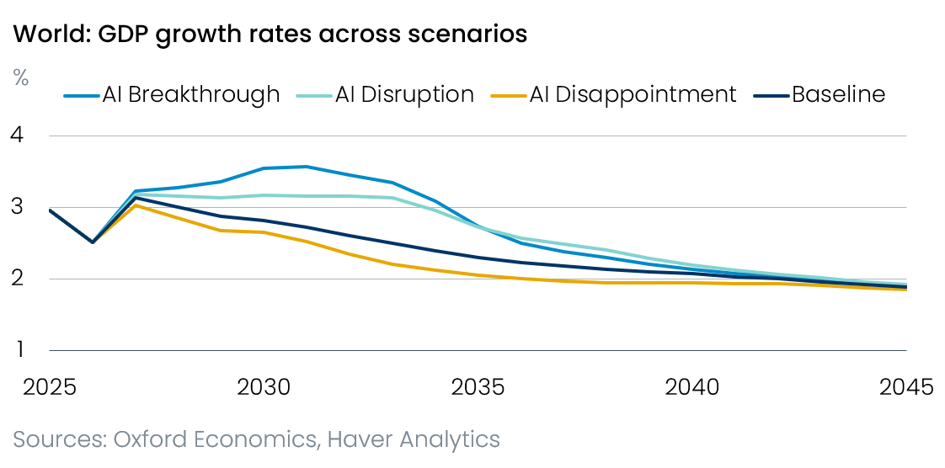
In AI Breakthrough, faster adoption brings forward the economic benefits of AI. The uplift to world GDP growth is largest during the initial adoption phase, before fading as adoption approaches saturation and growth returns towards its baseline rate. For the world, annual GDP growth averages close to 3% in the 2030s, compared with 2.4% in our baseline.
AI Disruption produces productivity gains similar to those in AI Breakthrough, but a very different labour market outcome. Structural unemployment rises as displaced workers struggle to move into new roles, weighing on household incomes and consumption. Weaker household demand therefore offsets part of the benefit from the increase in productive capacity. World GDP growth averages 2.8% a year in the 2030s, below the 3% in AI Breakthrough.
In AI Disappointment, slower adoption and weaker productivity gains push world GDP growth below baseline. In the 2030s, world GDP growth is around 2.2%. The effects extend beyond the smaller productivity gain: firms that have invested heavily in AI infrastructure face weaker returns, reducing their appetite for further capital expenditure. A reassessment of expected returns from AI would also weigh on equity markets, household wealth and consumer spending.
Explore the possibilities
The effects are not limited to GDP and productivity. Because these scenarios are integrated into the Global Economic Model, we can assess the implications for employment, wages, inflation, consumption, investment, trade, equity prices, bond yields and other macroeconomic and financial variables across countries.
This breadth matters for business planning because scenarios with similar GDP outcomes may have very different implications for labour markets, consumer demand and financial conditions.
GEM subscribers can access our baseline forecast and adjust the AI levers to test alternative outcomes. To explore the assumptions, results and country-level implications of our AI scenarios in more detail, visit our Megatrends service.
For a fuller discussion of our baseline, scenarios and wider view on AI, you can watch our webinar with Associate Director Dan Moseley and Lead Economist Adam Slater, or read the report underpinning our AI modelling.